

Henry Moore keeping focussed with an open mind
For two weeks in December 2006 the Bengal Gallery of Fine Arts in Dhaka hosted a fine exhibition of Henry Moore’s Graphics. The exhibition, which was beautifully installed in the gallery, was organised in a close collaboration between the Bengal Foundation and the British Council. The show attracted much interest, and I was fortunate to participate in the accompanying educational programme, by lecturing on Henry Moore and related topics
The lithographs and etchings that made up the exhibition were loaned to the gallery from the British Council’s collection, which had benefited from several hundred prime examples of Moore’s graphic work that he presented to the Council on the occasion of its 50th anniversary in l984. These works, like others in the Council’s collection, travel the world in touring exhibitions.
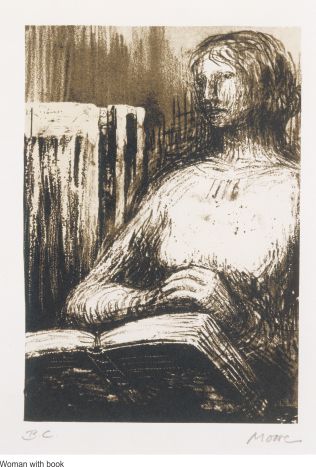
Requests for exhibitions of Henry Moore continue to flow in to the British Council, and are also addressed to The Henry Moore Foundation, a registered charity, setup and generously endowed by Moore in 1977 ‘to advance the education of the public by the promotion of their appreciation of the fine arts and in particular the works of Henry Moore’. There is usually an exhibition of Henry Moore’s work showing somewhere in the world at any given time.
In Dhaka I found a real and probing interest in the art of Henry Moore, and in the work of younger British artists. My audiences were full of artists of all ages, as well as students and their teachers. Our discussions were lively and informative to a stranger, and I learnt a lot about Bengal and its culture in just a few days. The very great thing about the arts is that they always generate discussion, with people discovering similarities of opinion and practice, as well as their differences. For me this was a wonderfully positive experience, as the work of Henry Moore allowed conversation to spread out into many topics.
Thinking about Henry Moore’s internationality, and the way in which his work speaks across vast cultural differences, one can begin to understand why his sculpture, drawings and prints are always in demand, and are welcomed so warmly in vastly differing places and spaces around the world. The reason, I believe, comes from his undoubted humanity, which speaks with enormous strength through the constant themes in his work.
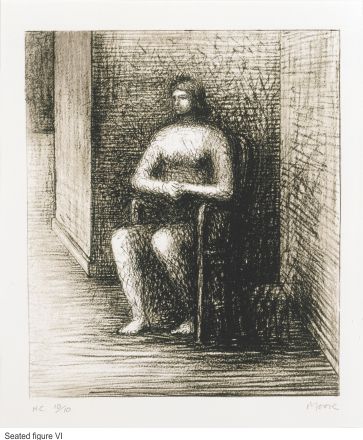
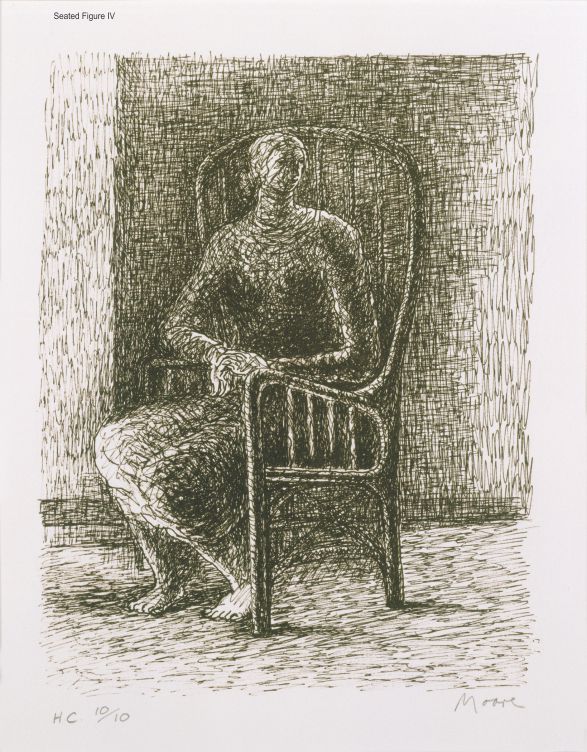
‘All my sculpture is based on the human figure,’ said Moore. ‘Most artists have obsessions in their subject matter —some may be mainly landscape painters, some mainly figurative, others may do portraits or concentrate on animal painting.
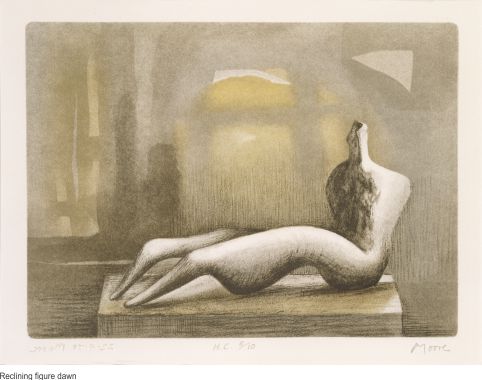
‘There are three recurring themes in my work: the ‘Mother and Child’ idea, the ‘Reclining figure’, and the ‘interior/exterior forms.’ Some sculptures may combine two or even three of these themes.’
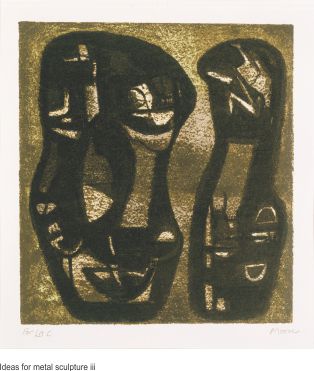
Although Moore professed these allegiances to the human form, from which he never strayed far, he also worked in an abstract way, blending abstraction and figuration through his observation of natural forms—stones, bones, shells, driftwood, and the larger landscape, in which he liked to see his monumental sculptures placed.
In notes at the time unpublished, but now cited in Alan Wilkinson’s book Henry Moore: Writings and Conversations (Lund:Humphries 2002), Moore had written in 1937, ‘I do not see why an artist should have to be a complete surrealist or a complete abstractionist.’ He also wrote at the same time, ‘I find myself lined up with the Surrealists because Surrealism means freedom for the creative side of man, for surprise & discovery & and life, for an opening out & widening of man’s consciousness, for changing life & against conserving worn out traditions, for variety not uniformity, for opening, not closing— ‘
Moore’s is a story that has been told time and again by many eloquent writers. His is a straightforward biography, one of a man of modest origins; a man with such strength of purpose that transcended the fame and fortune that was to come quite late in his career.
Henry Moore was born in Castleford, Yorkshire in 1898. Queen Victoria was on the throne—albeit towards the end of her reign— and Britain was still an imperial power. Moore, however, was born into a working class family. His father was a miner, working daily in the coalmines of Yorkshire. One of eight children, the family lived in a small, terraced house, with two—at the most three—bedrooms. They lived in close proximity to one another.
Moore’s father was keen that his children should not go into the mines, and set great store by their education. Moore entered Castleford elementary school, and gained a scholarship to Castleford Grammar School. School holidays and weekends were spent cycling in the countryside around Castleford—wild moorland with rocky outcrops, which were in due course to imprint their influence on his work. His earliest encounters with sculpture were at Methley Church, near his home in Castleford. The church contained several carvings of medieval stone heads, as well as some alabaster sarcophagi with knights and ladies lying in repose, small dogs at their feet.
When Moore was at Grammar School a young and enthusiastic art mistress, Alice Gostick, was a formative influence. He began to consider career as a sculptor, although at his father’s insistence he worked initially as a teacher. His determination to become a sculptor was not undermined, and dissatisfied with teaching, he applied for, and received, an ex-serviceman’s grant to study at Leeds Art School, and by the end of his second year in Leeds, he won a scholarship to the Royal College of Art, London, in 1921.
At this time in Britain, art school training was academic, based on carefully observed drawing of the human figure. This was rigorous, and considered to be an essential discipline before one could move into the realms of personal expression. With these skills absorbed, Moore was ready to branch out on his own, eschewing the tight formality of nineteenth-century figurative sculpture, finding his own voice in robust carvings in wood and stone.
Throughout the Second World War Moore saw no active service, but worked as a war artist, during which he produced drawings of people sheltering in the London Underground during the Blitz, and miners working for the war effort. His Shelter Drawings were both sculptural and humane. Rows of sleeping figures under draped blankets, closeups of children with their parents; these were moving works, and form a telling record of the time.
In 1940, however, he and his wife, Irina, moved to Perry Green, a small hamlet in Hertfordshire, some thirty miles north of London. He set up his studio, and was to live there for the rest of his life. As his fame and fortunes grew, he added further land, studios and buildings to form a large estate, which is now home to The Henry Moore Foundation.
It was not until 1946 that Moore’s long awaited only child, Mary, was born. His career was burgeoning, and he also had his first visit to New York, for a travelling retrospective exhibition of his work at the Museum of Modern Art. This exhibition contributed significantly to introducing Moore to the American public, some of whom became his greatest collectors. Unlike the British press, American critics held Moore in great regard, and Interestingly, his American public never wavered in their support, and collected his work for the rest of his career; many still do so.
Moore’s working methods have been well documented, more so than almost any other artist. He collected all kinds of natural materials from the landscapes that inspired him, the forms of which found their way into his sculptures. He drew parallels in his work between, for example, a bone and a head, a flint or stone and an abstract form, a rippled shell and drapery. Some of these objects he incorporated in his clay or plaster models, or maquettes, before casting them in bronze.
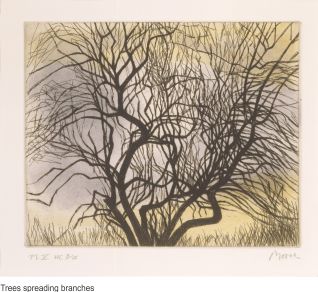
‘Besides the human form, I am tremendously excited by all natural forms, such as cloud formations, birds, trees and their roots, and mountains, which are to me the wrinkling of the earth’s surface, like drapery. It is extraordinary how closely ripples in the sand on the seashore resemble the gouge marks in wood carving.’
In 1948 Henry Moore represented Britain at the XXIV Venice Biennale, for which he was awarded the International Prize for Sculpture, marking his first major success in his work with the British Council. This also built on his reception in the United States, and heralded a long and fruitful association with the Council, who toured his work to many parts of the globe, and continues to do so.
From then his fame grew, he worked increasingly in bronze, and in the stone quarries of Carrara, where Michelangelo had worked centuries before. He made more prints, and through editions of his graphics and bronzes, his work became available to more collections and collectors internationally. Today hardly a public building in most major cities stands without a Henry Moore at its entrance. Moore was also awarded countless honours and degrees throughout the world, but continued to work as he had always done, in his studios, working clay and plaster into ideas for sculpture, filling countless notebooks and sketchbooks, making prints and drawings, until his death in 1986, at the age of eighty-eight.
One of the most frequent questions put to me in Dhaka was about Henry Moore’s followers, who did he influence? Looking at the sculptors who followed him sequentially: Kenneth Armitage, Lynn Chadwick, then Anthony Caro and Phillip King, for example—the latter two were his studio assistants for a short time—one can see that their works bear no relationship to those of Henry Moore. In fact there was no ‘School of Henry Moore.’ Moore worked individually in areas that interested him, initially from ‘truth to materials’, and certainly from first principles. He looked to the art of the distant past to find his own way forward. He thought for himself, and this is what he encouraged young artists to do. He championed personal discovery. ‘I believe nothing is taboo—no theory or prejudice should close one’s mind to discovery.’ This openness has continued to enrich the progress of British sculpture, which generation on generation changes and surprises.
Ann Elliott is an art critic based in London
For two weeks in December 2006 the Bengal Gallery of Fine Arts in Dhaka hosted a fine exhibition of Henry Moore’s Graphics. The exhibition, which was beautifully installed in the gallery, was organised in a close collaboration between the Bengal Foundation and the British Council. The show attracted much interest, and I was fortunate to…