

a conversation with alak roy back to nature
Alak Roy (born 1950) belongs to a generation of artists whose sensibilities have been shaped by momentous political events and social upheavals, both leading up to, and deriving from, Bangladesh’s war of independence. The war itself was a cataclysmic event — a nine-month-long bloodbath that, on the one hand, showed the flint and the steel of the Bengali character, its capacity to endure pain and suffering, and on the other, the cruelty and rapacity of those who helped the enemy carry out its atrocities. After the country became free, its political leadership failed to live up to people’s expectations. There was widespread deprivation and want, resulting in a famine in 1974. Given the devastation caused by the war to the economy, particularly the infrastructure, economic depression was perhaps inevitable. But people could not believe that their dream of a Golden Bengal would evaporate that quickly. The subsequent political and social history is thus underlined by that initial disappointment and desperation
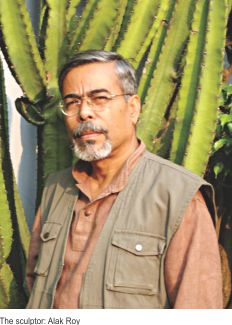
Alak Roy, who passed out from the Institute of Fine Art of Dhaka University in 1973, like many others of his generation, had fond hopes for his country. Attracted to leftist ideologies early in his life, he dreamt of a progressive and truly secular society where people would live a life free from hunger an want. Political developments, however, charted a different course, and the killing of the country’s founding father, Sheikh Mujibur Rahman, with many members of his family in 1975, reversed much of the gains of the 1971 war. Secularism was discarded as a state principle; so was socialism. Pakistani collaborators were rehabilitated while freedom fighters were consigned to neglect and oblivion. In the aftermath of the revival of a Pakistani style political philosophy and the involvement of the army in the day-to-day governance of the country, cultural freedom was restricted. It suddenly looked as if, except for a new geographical identity, nothing substantial had been gained. If artists despaired, it was for good reason.
The above picture of the political and social situation of the 1970s is important for an understanding of Alak Roy’s art, for it provides a background of his work. Some of his works are tall pieces, resting like columns on their bases, while others stretch horizontally, their full length hugging the ground. Shapes too, are as varied as there are ideas going into the sculptures, but overall, round and smooth shapes, rather than angular or sharply edged ones predominate.
Alak teaches sculpture at the Department of Fine Art of Chittagong University. Until recently, he used to live in the city while his studio was located at Choudhury Hat, a village about 10 km away from the city. He has since moved into his studio complex which has spacious indoor and outdoor working places, a gas-fired kiln, and storage facilities. The move has been very helpful, since Alak can now save the time commuting between his city apartment and the studio. Besides, he now lives right in the middle of a sprawling countryside with paddy fields, large ponds, jungles and thick bamboo groves which host a large colony of birds and animals. Alak’s recent work attempts to reach out to nature. ‘I want my sculpture to bring back the feel of nature that once we took for granted,’ he says.
His words, taken out of context, would sound a bit like clichés, if not pretentious, and politically correct. But as I caught up with him in his Choudhury Hat home cum studio one autumn afternoon for a chat, and sat on his 2nd floor terrace roof, sipping coffee, I could feel how genuine was the ring of his words. Alak, indeed, is going back to nature. ‘I’d like my works to remain in their outdoor settings for as long as they last, and eventually become part of nature,’ he says. To accomplish that, he has planted saplings around, even inside, a few of his sculptures, hoping that these would grow and eventually claim the sculptures.
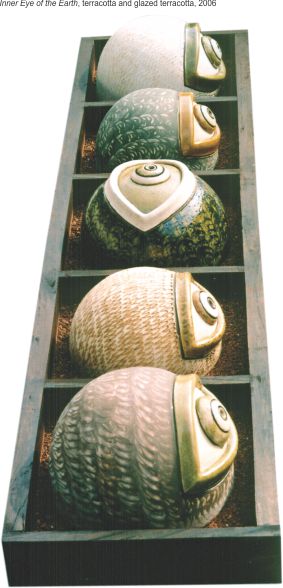
I asked Alak to explain what role nature plays in his work. For an answer, he referred to some of his recent works where the world is seen to possess eyes and ears—an anthropomorphic projection of sorts, but one that also accommodates a muted spirituality as well. The world, which for Alak translates as nature, also has an inner eye with which it can clearly see the shape of things to come. If the spread of technology-driven, engineering-based urban civilization confines nature only to reserved forests and national parks, laying waste all its other vestiges, then humanity will have to pay a huge price. Alak however, believes in the power of nature to protect itself. It is after all, a living entity, and has been there longer than the homo sapiens. In the Inner Eye of the Earth series, Alak celebrates this latent power of nature. Large earthen bowls lie half-sunk in the ground, and from the hollow of the bowls, large eyes stare at the sky. He also made a similar composite sculpture for the last Asian Art Biennale in Dhaka. Five eyes in the sculpture represent the five main continents of the world. The world is watching us, the humans, and we too should watch out, the sculpture seems to suggests. Alak made another series of sculptures for an installation on an island beach in Vietnam, which are shaped like giant ears. He titled the work Listen to the duet of wind and sea. In a variant work, he substituted the word ‘forest’ for ‘the sea.’
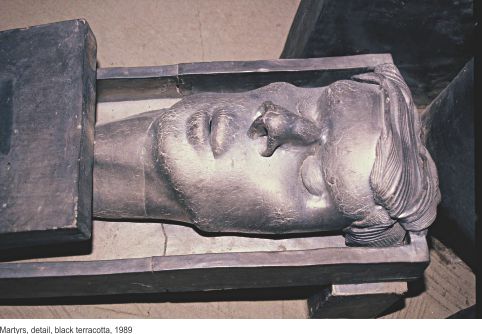
When reminded that his recent works are assuming a tactile quality —both through their smooth and rounded feel and their celebration of the sense of touch—Alak said, ‘any satisfactory sculptural work should possess both visual as well and tactile qualities. It should invite the viewer to touch it, to feel it, and start a dialogue with it. If a sculptural work persists in its cold detachment and measured isolation, it ceases to generate that sense of intimacy which allows the viewers to have an ownership of it.’ None of Alak’s work is heavily or weightily at rest; they indeed have a material weight and dimension, but the material appears to have been softly drummed together, as indeed does a potter when he makes a clay subject. Another recent series, The Potter’s Fingers brings into focus how, through the feeling of touch, a potter shapes his object. Alak has always marvelled at the way potters make pinched dolls. These dolls carry the against which his artistic philosophy took shape and helps us identify the constraints within which he had to begin his career. Sculpture, particularly iconic sculpture was frowned upon by the conservative Pakistani society—a fact that explains the rather narrow range of activities in this area before 1971. The war of independence changed that landscape and, instead, encouraged large, outdoor sculptures of freedom fighters. But, in the late 1970s, conservatism was back again. This time round, however, artists were not willing to give in, and they persisted. Thanks to their efforts, sculpture today has become an integral part of the artistic landscape. Indeed, it has more practitioners and patrons now than ever before.
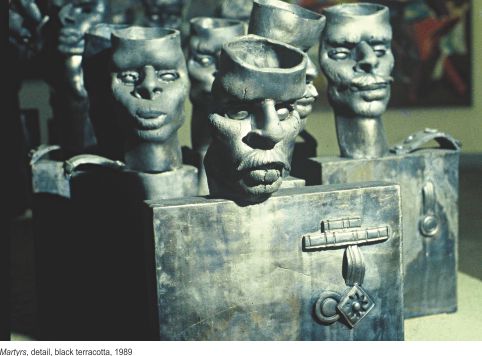
Alak was never politically active, but his pro-people beliefs and views naturally inclined him towards social protest. For his sculptures, this protest translated into a questioning and often rejection of ‘academic styles’ pursued in classrooms, and an incorporation of social, and later, environmental themes in his work. From his early days as a sculptor, Alak began to redefine mass and volume: he experimented with materials but took care that the finished work did not succumb to their defining power. He rediscovered the magical properties of terracotta and found new ways to accommodate his constant need for change and his love of experimentation. In place of the illusion of permanence and substantiality—to which most sculptural works tend to aspire—Alak has celebrated the temporary and the insubstantial. In a recent series, Alak has laboured to make sand and clay sculptures on a stretch of sea beach for hours only to watch rising waves flatten them and wash away all their traces.
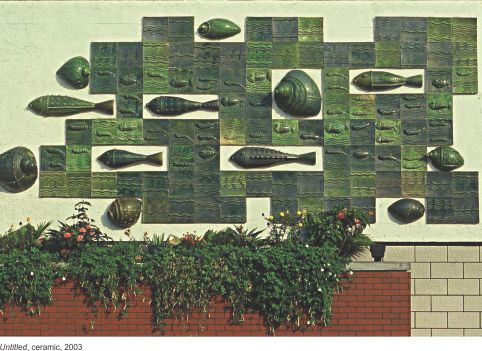
If we look for the distinguishing marks of Alak Roy’s sculpture, the list won’t be too long, but each will certainly stand out for its uniqueness. Alak’s early terracotta work shows both his predilection for installation-like arrangements (his work, indeed, is a precursor to that recent art form in this country) and his sharp eye for detail; his site-specific sculptures reveal an intimate understanding of what the Chinese call feng-shui, or the spirit of the place; and instead of working solely on the outside of a sculpted object, he often starts with its interior spaces, slowly reaching outwards, so that the work progresses much like a bird taking flight. This necessarily invites the viewer’s gaze both to the exterior and interior of an art object, thus eliminating the restrictions of mass, volume and dimensionality.
Alak’s work varies in size and dimension. He is equally challenged by the verticality and horizontality imprint of their makers’ fingers which appears to animate them. Alak is an admirer of Helen Keller, the celebrated American essayist and memoirist who, despite her blindness, could ‘see’ with her fingers. Alak believes that fingers can indeed see, and that each of us have eyes inside our heads. Unfortunately, we never know that they exist.
Elaborating on the tactile aspect of sculpture, Alak mentioned a 2001 project he did at the Fukuoka Art Museum in Japan. Loosely titled The Art of Touch, the project invited schoolchildren into a room in the museum, and gave them each a box of soft clay. The children were asked not to look inside; all they were supposed to do was to use their hands to make some shapes with the clay. After the children had finished making their sculptures, they were asked to leave the room. The sculptures were brought out of the boxes and put on a table on display. Amazingly, when the children returned, almost all could identify their own works.
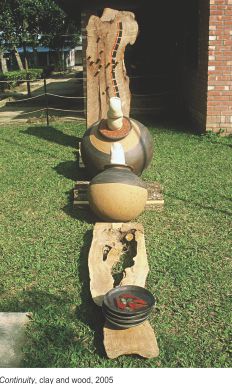
Alak’s recent works are also becoming engagingly experimental. He now makes sculptures which will naturally interact with the elements and grow or wither as natural objects do. In some of his works, water is an implied presence. In another series, bowl-shaped compositions are placed outdoors. As rainwater collects in their hollows, inlaid forms and objects are submerged, and, after a while, moss begins to gather. The beauty of the works lies in their changing colour and texture as the elements keep working on them. Alak feels that in many countries, such as Japan, public gardens have existed for centuries and any garden sculpture is also guaranteed a long span of life. In Bangladesh however, gardens are the most endangered places, and most die in infancy. Yet he hopes that once a tradition is started, sculptures genuinely rooted in the environment will gain in popularity.
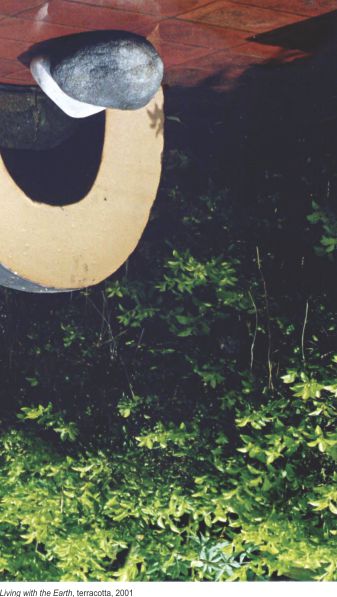
I asked him about his ‘back to nature’ philosophy. He referred to the Gadani Beach workshop in Balochistan in Pakistan in 2006, where he made sculptures of eyes out of sand and clay. Many of these had the hidden eye motif. Alak also painted them—indeed followed all the procedures of ceramic sculpting except kiln firing. However, after these works had remained on display for some time in all their brilliance, they were claimed by the rising tide. Back to nature!
This one-off variety of art work which is non-ownable and transient is akin to installation art. But the difference is, here art pronounces its own demise. Dust to dust!
In a composite sculpture for a forthcoming show at the Alliance Française at Chittagong, Alak’s politics of protest take a tangible form. The work is huge and quite intricate. There is a sprawling chessboard whose 64 squares are filled up by 64 clay birds. On two sides of the chessboard are a black house and a white house —the white one, with two ominous looking snakes curling around has obvious references to the house that George Washington built but chose not to live in. The other house is ironically called the house of peace. The house breeds fanaticism and religious extremism. The symbolism is elaborate, and a bit laboured too, but the message is loud and clear: the world cannot allow duplicity and hypocrisy to reign for too long.
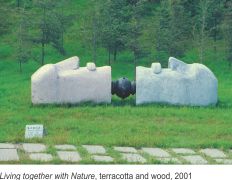
I asked Alak about his exhibitions abroad. He mentioned the work he had done in Korea and China. In a composite piece he did in Kunming in 2005, five huge human heads in stone in five colours were joined by a bronze casting suggesting a tree, with a seed placed at the end. Five is an important number for Alak—it symbolizes the five continents where human beings live, five senses that make us up, and so on. His entry in the sculpture exhibition organized in connection with the 2008 Olympics in China, Love, Friendship and Peace, which received a citation, elaborates on his inner eye theme. Then the Museum of Modern Ceramic Art in Gifu, Japan, included a piece by Alak Roy for its show on 100 years of ceramic art. Titled Waiting for the Light, the sculpture tells the story of man’s long relationship with nature. Alak used the technique of ring wells in rural Bangladesh for the work, and it received wide acclamation.
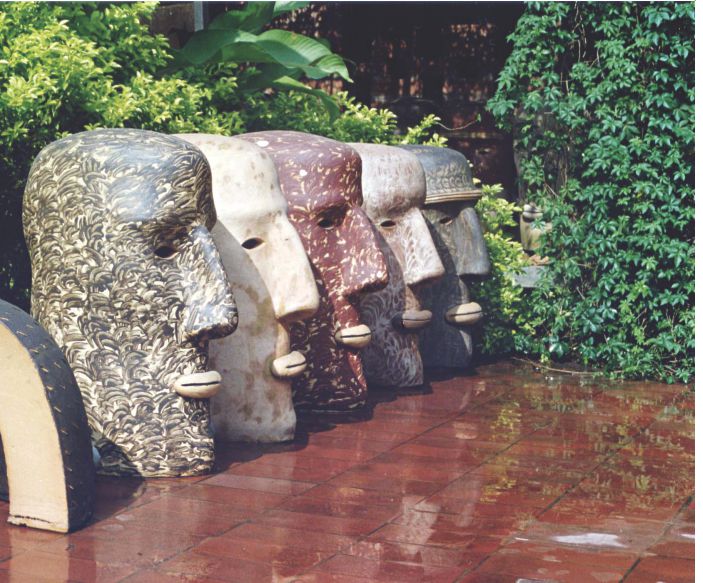
Alak’s sculptures, within the movement of their composition, are always related to the adjacent space of nature. Material is important for him, but experience outside the material concerns is equally significant, which may range from a sense of alienation that the modern world generates in an artist to a sense of fulfillment when one discovers the eternal rhythms of life in nature. For Alak believes with Henry Moore that sculpture is ‘not a decoration of life but an experience of the significance of life.’ And that significance can best be derived from one’s interaction with nature.
Syed Manzoorul Islam is a member of the Jamini editorial board
Alak Roy (born 1950) belongs to a generation of artists whose sensibilities have been shaped by momentous political events and social upheavals, both leading up to, and deriving from, Bangladesh’s war of independence. The war itself was a cataclysmic event — a nine-month-long bloodbath that, on the one hand, showed the flint and the steel…