

in conversation with tareque masud
Tareque Masud locates his films on the confluence of high and popular art and urges for the rise of pre-modern Islamic culture as a response to Islamomania. James Leahy caught up with Tareque Masud for an intriguing interview.
James Leahy: Obviously Matir Moina (The Clay Bird) is deeply rooted in the culture of Bengal and the history of Bangladesh, which are arguably as important thematically and filmically as the story of Tareque’s childhood with which they are intertwined.
However, these roots, though less explicit, seem equally important in Ontorjatra (Home-land). Thus, for me, the double bill of these two features provided a fitting climax for the film screenings segment of the British Museum’s ‘Voices of Bengal’ programme. Can you talk about the importance of Bengali culture in your work, and to you personally?
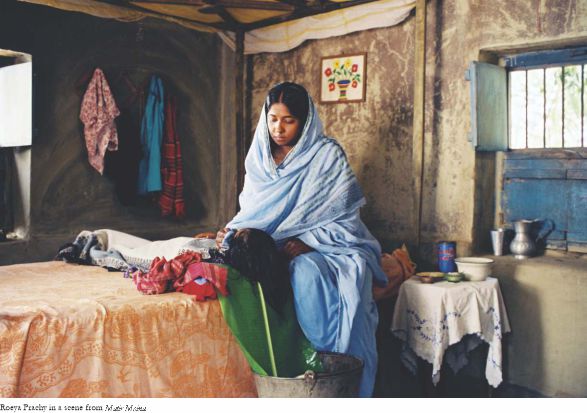
Tareque Masud: I agree with your observation that despite the fact that both films are in a way very different in terms of subject, canvas and backdrop, there are certain commonalities between the films. It is not limited to these two films, but a common theme in all of our films. The search for identity is common theme in most of our films. In essence, anything that is related to questions of identity is embedded with questions of culture. So, Bengali culture is omnipotent and omnipresent in our work. Although this is not the focus of our films, this is a very inherent and ingrained aspect of our films. When I say Bengali culture, I mean it in the widest sense of the word, not in a narrow nationalist sense. I’m proud of the rural, folk, and pre-modern parts of our Bengali culture.
That culture is egalitarian, inclusive, and syncretic. This is the culture of Bengal that I am very interested in. In all of our films the egalitarian and pluralistic culture of Bengal is portrayed. Like in Matir Moina the Sufi mysticism, the popular folk culture, is very much evident. This mystic folk culture, which is called, ‘Baul’, is a combination of Buddhist mysticism, Hindu mysticism, and Iranian Sufism. Baul philosophy is a culmination of these three strong influences, and through this we have incredibly popular and powerful syncretic culture, which is in opposition to the present political and religious polarization of Bangladeshi society. For example, there is an extreme rise of Islamism in Bangladesh; there is also an equally problematic rise of Bengali ultra-secularism. This is an upper middle-class phenomena which is very much limited within the urban populace. In the greater population in the rural areas, things are much more egalitarian and much less polarized. In rural areas the presence of ultra-secularism or political Islam is still very limited. I see an antidote in the syncretistic folk mystic tradition to the extreme polarity of urban ultra secularism and political Islam. I think that the encouragement of this so-called premodern culture could be a solution to these new modern syndromes.
JL: Songs and music are extremely important in your films; is this on account of their having a similar importance in Bengali culture?
TM: Very much so. If we want to evolve a regional or indigenous language of cinema I think we have to find inspiration in our traditional folk culture and folk forms. This understanding of traditional folk forms can help us shape a proper cinematic language, instead of a blind importation of Western film syntax or idioms. The technology of cinema was invented and evolved initially in Europe and the United States. Of course, this doesn’t mean that the science that evolved in Europe belongs to Europe only. The whole world is the inheritor of this technology. I would like to compare it with religion. When we are adopting Islam, we can definitely adopt the creed of Islam from the Middle East. But when we try to adopt the culture that came along with this creed, which is specific to the Middle East, this becomes a forced implantation.
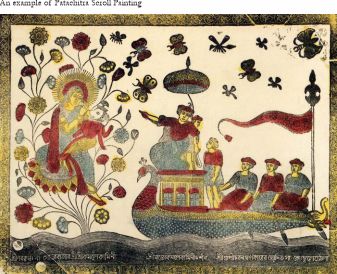
So when the Islamic creed was adapted to the South Asian culture, which is exactly what happened during the expansion of Islam, it became integrated with South Asian culture. That’s why I would say that the technology, the essential grammar, and other structural elements of cinema are definitely okay to borrow from the West. But unfortunately we don’t only import the technology; sometimes we import the content and context with the technology. To evolve our own mode of expressions, language, syntax, and the idioms of cinema, we don’t have to be completely original. Our folk plays are musical, our folk songs are narrative, and even our visual art, like scroll paintings are also musical and narrative. So if you consider film as a predominantly visual art it can easily take its inspiration from scroll paintings, like Gajir Geet or Patachitra. Traditionally, when these scroll paintings were displayed, it was like a type of prehistoric cinema. A scroll is rolled with the right hand, and there are different frames of paintings that rotate in front of the viewer’s eye. As one picture changes to another the person who is rotating the scroll narrates a story through song. The story is told visually through song. So I think it is very natural that our cinema should have strong music elements to it. I’m not the first one to explore this possibility. To quote Satyajit Ray, when Ritwik Ghatak died, he was recorded as saying, “Ritwik Ghatak was a much more Bengali film maker than I am.” And I think it is just tried to evolve a language that is very much rooted in Bengali theatrical, musical, and narrative traditions, which are all very melodramatic.
The very famous Bengali musical folk drama, ‘Jatra,’ which is punctuated with many songs, is melodramatic in structure. He used that melodrama very consciously in his otherwise very internationally contemporary films. I don’t see myself as pioneering any iconoclastic new film approach, it is a road which has already been paved by Ritwik Ghatak, and in some ways also by Satyajit Ray, despite the fact that Ray’s mindset was much more Western. Even so, there is a strong use of music and song in Ray’s films. He himself was a musician and had very strong roots in western and eastern music. I am also very fond of folk music. So these are the reasons that many of our films contain songs and music.
JL: The song about Matir Moina : is the title of the film taken from the song, or was the song written specially for the film?
TM: First of all the title is partly taken from the song. If you remember the young Anu who brings the clay bird from the village fair and gives it to his sister, Asma, which is very close to my own real life experience. It is not only a very special moment in the film;
it is also a strong moment in my own life. Particularly after my own sister died, that little gift, the clay bird, remained very close to my heart. But in addition, it meant more than that personal gift to my sister, or Anu’s gift to his sister in the film. The clay bird is a representation of one of the core themes in the film, abstractionism versus paganism, which is the ongoing debate throughout the film. As you know, Anu is sent to the madrasa because his father wanted to refrain him from local pagan influences.
When I was a child, I was drawn to and intrigued by pagan elements. I think most children are. I think that goes not only for children, because there is a child in every adult. We are all drawn to pagan phenomena, festivities, and pagan icons. The adult abstractionist intellectuals, including many of the Judeo-ChristianIslamic prophets, tried to reform these ‘children’, in the wider sense of the word. But it is instinctive human nature to go back to paganism. So, in, Matir Moina, the whole conflict between paganism and abstractionism is an undercurrent theme. The song has a very complex history of origin, like other songs in the film too. They were not written for the film, but they were not purely pre-existing songs either. I used the traditional folk songs and rephrased them; or rather I should say I compressed them. Generally these songs are longer than six minutes. For example, the song in which the man and woman debate goes on for an entire night. It’s not six minutes; it’s more like six hours. So I had to confine this whole debate into six minutes for the film’s sake. Same with the ‘clay bird’ song in this film, I literally copied the diction that is generally used in folk songs. The moina, which is the name of a bird, is often referred in mystic Bengali folk songs. The moina always means something close to the soul – a metaphor for the soul.
According to Sufi tradition and the Koran, the human body is made of clay and the soul is like a bird that always wants to be free and flying but is trapped in the human body. So this whole paradox is reflected in the song and also in the greater body of the film. The song is thus a very pertinent element in the film, and the theme of Matir Moina is not limited to the song.
JL: What about other cultural influences? I know you have written about Satyajit Ray’s adaptations of Tagore’s stories, and that Persian poetry is important to him. Can you both expand on this?
TM: Besides films and filmmakers, there are also some other cultural and literary influences. I was exposed to Persian classic literature during my madrasa times. Farsi literature was part of my studies. I was introduced to Hafis, Khayam, and other important Iranian writers. Many of these writings contained Sufi mystical elements. Later on I was drawn to Persian Mogul paintings. I find a parallel to the narrative character of these paintings in Patachitra scroll paintings. I grew up in an area of Bangladesh called Faridpur; a stronghold of Baul culture. Faridpur contains many lower cast Hindu artisans. I grew up seeing, ‘Jatra’ and the Vishwa Karma Puja boat festival. Besides the boat festival there were a lot of village fairs, which we call ‘mela.’ While I was in the madrasa I was in a place of absolute austerity. It was extremely uneventful and monochromatic. We had to wear mostly white clothing. It was devoid of any festivity. Upon returning home from the madrasa, the entire village’s colors and sounds used to burst upon me. Unlike my peers, I was more interested in pagan festivities because I was deprived from seeing these things during most of my childhood.
JL: Many of these are influences from high or elite culture. How do you respond to the charge that is often leveled at filmmakers in your position, including many of the great African filmmakers, that you are making films for an elite minority rather than a popular audience?
TM: I totally admit that many of my influences come from so-called ‘high art,’ like Tagore and Ray.
But most of my influences do not; they come from populist, folk, and pre-modern sources. I see myself as a result of the combination of high and popular art. If you watch our films carefully you will see that these are not typical art films. Our films are mostly seen and appreciated by ordinary people in Bangladesh, and I am sure abroad as well. We are known as populist filmmakers. At the same time I am absolutely aware of my influences from certain high art sources. Even as a viewer I greatly admire populist cinema in my own country and also many of the films that are coming from Africa, Latin America, South America and Palestine.
JL: I have been struck by the strength of family ties in your work. Thus, in Matir Moina, the father, who is, in the words of the boatman, a “new Muslim… full of fervour,” remains close to his brother, despite not approving of his opinions and beliefs. Ontorjatra is effectively about the reintegration of the family, and this is possible because the members’ ties are stronger than their resentments or weaknesses. As far as I can remember, this attitude is rare in European or American cinema, and I’ve been wondering if it reflects your personal beliefs, or whether it is also an important aspect of Bengali social relations?
TM: I think it is an interesting observation on your part. It is a part of my personal experience more so than my personal beliefs. I grew up in an extended family atmosphere. My uncles, cousins, aunts, grandparents, etc. were all together. In Bangladesh there is still very much of an extended family culture. ‘Family values,’ not in a Western-specific political sense, but in more of a traditional sense, still matter. All of my films are about familial relationships. It isn’t just the affinity, but the dynamics and differences. In some ways this reflects my own family relationships.

Through my own work I try to come to terms with my own relationship with my parents. I agree with you that it is very much unlike the sensibilities that are reflected in Western cinema. Although the familial ties are breaking down here, there is a widening gap between old and young generations. That is why it is very important to me to address these family bonds. I find Ozu and Ritwik Ghatak to be very great inspirations. Their sensibilities are very close to my own. I think this is not just limited to Ontorjatra and Matir Moina, it will continue to be important in future films.
JL: Why did you reject telling the story of Matir Moina chronologically, and instead decide to flash back to the village after opening in the madrasa?
TM: In some ways we tried to make the film according to a traditional structure because we wanted it to have a folkloric simplicity, which is my biggest inspiration in filmmaking. But not only during the flashback, but also in the rest of the film, we tried to get away from this linear and cathartic approach to storytelling. As soon as a story becomes very absorbing to the audience, we make a sudden departure from that linear structure and go into a folk song or a political debate, which is a recurring pattern in the film. The story and the debate are interchanged throughout the film so that once the audience becomes absorbed in the narrative aspect of the film we take them away from that narrative and cathartic involvement that has been used so far in the film.
Especially in the case that you are mentioning, I didn’t want to start chronologically with Anu’s pre-madrasa time building up to his madrasa time. I wanted to start with an ambient aspect, like the early morning fog on the steps. So I introduced this whole ambience to the audience and then gradually led them to the village where Anu came from and then of course showed what circumstances led his parents to send him to the madrasa. This is a complex structure and I think we tried to do it without any conventional flashback treatment. I felt that starting the film in the madrasa was a more natural approach because it was going to be the core location for the audience to remember.
Also, as I mentioned, it was a part of the non-linear structure of the film that demanded this type of beginning. JL: Can you say something about the relations you and your films have with the expatriate Bengali community in the U.K.?
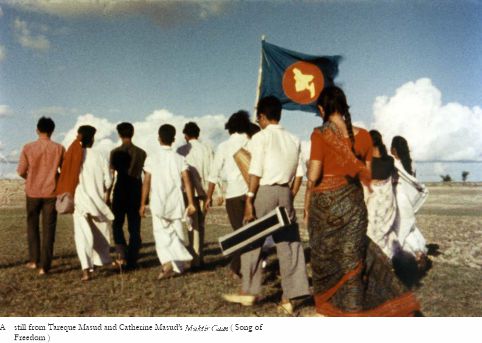
TM: We have a very good relationship with the Bengali community in East London. We visit London quite often and we have visited with members of the community many times. We have many friends and family living there. Every film we have made has had a very successful screening there. We interacted a lot with the audiences every time we went with one of our films, especially Muktir Gaan, Muktir Kotha, and of course, Matir Moina. So this relationship is definitely a long lasting and important one. Living in New York for five years during the 1990s, we developed an interest in and understanding of the Bangladeshi community living abroad. So, indirectly, we do have some type of a shared experience with this diasporic community. In both London and New York we used to receive many requests from community leaders asking us to make a film about their lives. But we always shied away from this because we felt we were not ready to make a film about a life that we were not a part of. After returning to Bangladesh, Catherine and I starting thinking about people like us, who lived abroad at one point and decided to return. Planning to come back is one thing but actually returning is a strange experience. When you come back to visit, as a ‘probhashi’ (expatriate), it is one thing, but when you come back to live in Bangladesh it’s very strange. You find that the country has changed and you have also changed. It’s not just that you have difficultly adjusting to the country you’ve returned to, you are not accepted as a fellow countryman. You are seen as half ‘bideshi’ (foreigner). When Catherine goes back to the United States she feels kind of culture-shocked. Her friends and family also find her to be quite changed. It is a common feeling we share, of not totally belonging in either place yet at the same time trying to belong to both. For example, Catherine would be in the USA and a shopkeeper would ask her where she is from.
When she would say, “I’m from here,” they wouldn’t believe her, and they would ask her again, “But where are you originally from?” because she has developed such a strong South Asian accent. Most of our experiences living as ‘probhashis’ come from living in NYC. But since our return we have kept closer ties to the community in East London, and the story of Ontorjatra is partly based on the true stories of some families there. James Leahy is a film historian and screenwriter based in London. His writings on cinema have appeared in The Guardian, Sight & Sound, Cahiers du cinéma in English, Vertigo and PIX.
Tareque Masud locates his films on the confluence of high and popular art and urges for the rise of pre-modern Islamic culture as a response to Islamomania. James Leahy caught up with Tareque Masud for an intriguing interview. James Leahy: Obviously Matir Moina (The Clay Bird) is deeply rooted in the culture of Bengal and…