

south asian cinema and bharat muni towards a new film aesthetics
The Natyasastra, or “Principles of Drama” as set forth in the ancient Indian tradition, may guide us towards a better understanding of the unique aesthetics of South Asian cinema. “Popular” cinema, while looked down upon by elitist critics, has many elements drawn from the Natyasastra, such as an emphasis on “emotional arousal” over narrative. Father Roberge calls for a more serious and in-depth study of popular cinema to formulate a comprehensive understanding of South Asian film aesthetics.
Two thousand words to discuss a two thousand year old tradition? Can I?
Perhaps one word suffices: popular. But then, it may take 2000 words to define and describe a popular movie.
Why this emphasis on ‘popular’? Because two thousand years ago, in his Natyasastra, Bharat Muni wrote: “Playwrights and producers should take the people as their (ultimate) authority (as regards the rule of the art).” 1
It is the public that proclaims a movie popular. How?
Not just by making it a box office hit. A popular movie is, of course, a movie that many people see — and this makes it a box office hit. But all blockbusters are not popular movies. The popular movie is a movie that not only many people see, but many people see more than once, thus showing that they consider the movie a special one. Moreover, people discuss popular movies amongst themselves.
part one: popular movies
However, and this is the major problem of movie scholarship, popular movies are dismissed by most scholars, and consequently, by many students.
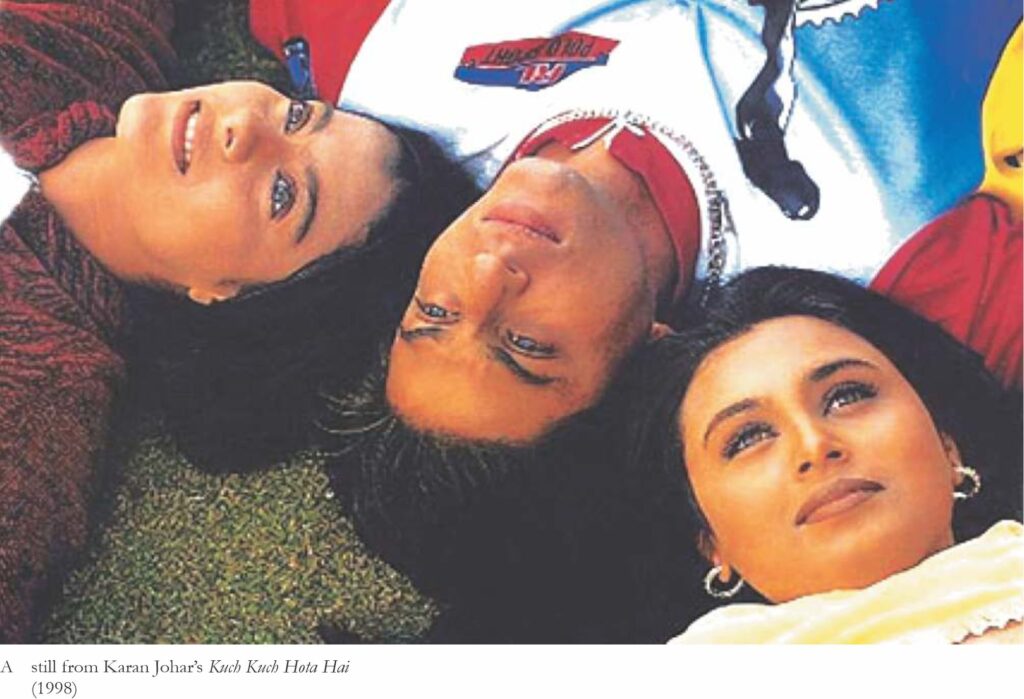
Example One: I once conducted a seminar on the communication media with a group of students at the National Institute of Design in Ahmedabad. I asked them if there was any interesting movie being shown in town. They all answered, “Yes, Kuch Kuch Hota Hai.” (1998). I had not seen the movie, so I asked if I could see it. They said, “No, it’s not your type of film. It is one of those popular movies.” The same evening, I eventually went to see the movie, and the next day we discussed it in class. One of the students who had seen the movie thrice and could not say what had prompted her to see it that many times, now discovered that for her the movie was an affirmation of her Indian identity. In the context of coercive globalization, such affirmation is comforting. Had we not discussed the movie, it might have remained for the student a repressed, though enjoyable, un-integrated experience. Moreover, movies are not in the syllabus. Therefore, they remain outside the scope of institutional education.
Example Two: I once addressed a group of thirty-five high school teachers. That was the time of Roja (1992). I found out that thirty of the thirty-five teachers had seen the movie. They affirmed that their pupils too had seen the movie. Then I asked them what they did or said in class about the movie. They were surprised. They had done nothing, not even so much as mentioning the movie. Yet, upon discussing the movie, they realized that the movie had made them relish in negative feelings towards some Indian people, while it entertained them with a love story. On their own they would not have entertained such negative feelings. They would have disowned them. Thus the educational system ignored a very important experience of these students.
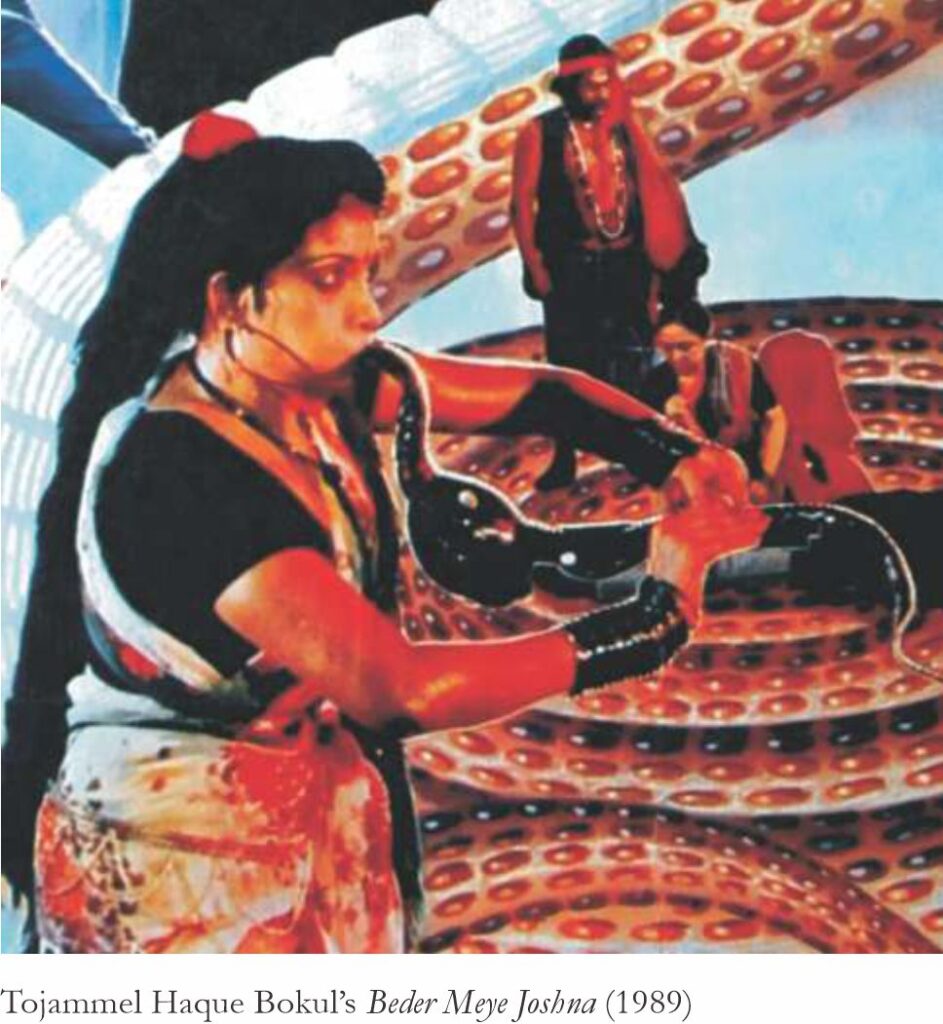
Example Three: I was in Dhaka when the movie Beder Meye Josna (1991) had just finished running in cinema halls. It was one of the most popular movies ever in the history of Bangladeshi cinema. Naturally, I wanted to see it. But again I was told that the movie was not “for me”, as it was a popular movie. I insisted and out of kindness my hosts arranged a screening for me. The director and the producer came to the show, curious to see who had wanted so badly to see their movie. They told me they did not understand why the movie had received such an enthusiastic response. After all, they argued, it was based on a hundred-year old story that everybody knew. They hadn’t realized that just a few months before Mr. Ershad was thrown out of power, a movie that told the traditional story of a ‘bad’ leader who is forced to be reconciled with the poorest of his people can only be welcome by the masses with positive expectations. Moreover, the movie was well made technically. So why should a significant movie be looked down on by intellectuals and students alike? Especially when most of them saw and liked the movie. This example shows that a ‘good’ popular movie is not simply an exercise in escapism. And it is possible to think that, although it was not intended to be a political call to mobilization, the movie may nonetheless have had the effect of hastening the mobilization of the people.
When the adapted version was shown in West Bengal, I attended a show in a packed cinema hall, and there was spontaneous loud applause when Josna told the ‘bad’ king: “You may be the king, but you are not above the law.”
The three examples mentioned here show that in South Asia popular movies are looked down upon by the self-proclaimed elite. If it is true, as Bharat Muni had said, that the ultimate authority here is the public, then to start with we have a difficult problem if we rely on academics to formulate an Indian movie aesthetic that, while it is open to global trends, can retain its local identity — or identities in the case of India. Fortunately, we have a number of Indian movie makers who respect their audience and are most appreciative of their reaction. Satyajit Ray was one of them, and he himself once quoted Jean Renoir as a movie maker who was thankful to his public. For, Renoir said, without that appreciative public French cinema would not have progressed as it did.
part two: the emotional arousal
am not in a position to quote either from ancient texts or from recent scholarly works, but if I accept the lead of the public, my first observation is that the public responds to ‘meaningful’ movies, that is, movies that relate to their existential situations. However, responding to such movies is not the primary factor that mobilizes the public even though it is a necessary element. What matters above all is what Bharat (not Muni, this time) Gupt has described as the “emotional arousal.” And Gupt sees emotional arousal as the primary factor in both the South Asian (Bharat Muni) and Greek (Aristotle) traditions. On that point Gupt is emphatic.
[…] the ancient audience went to theatre with a desire to be moved by emotion and to revel in it. They were not content to sit back, analyze, speculate or intellectually assess acting, dramatic themes and social problems. They wished to go through an experience which they wanted to be total and moving, so that when they returned from the playhouse they felt different. They did not want to have a different perspective on the problems of the year, but to have an experience they could recall for a year until the next Dionysia or the next vasantotsava. Emotionally arousing the audience was, therefore, a primary objective of ancient theatre which unlike the modern European theatre depended most for effectiveness on emotional communication.2
Emotional arousal through narrative would reach a limit beyond which the playwright could not hope to go.
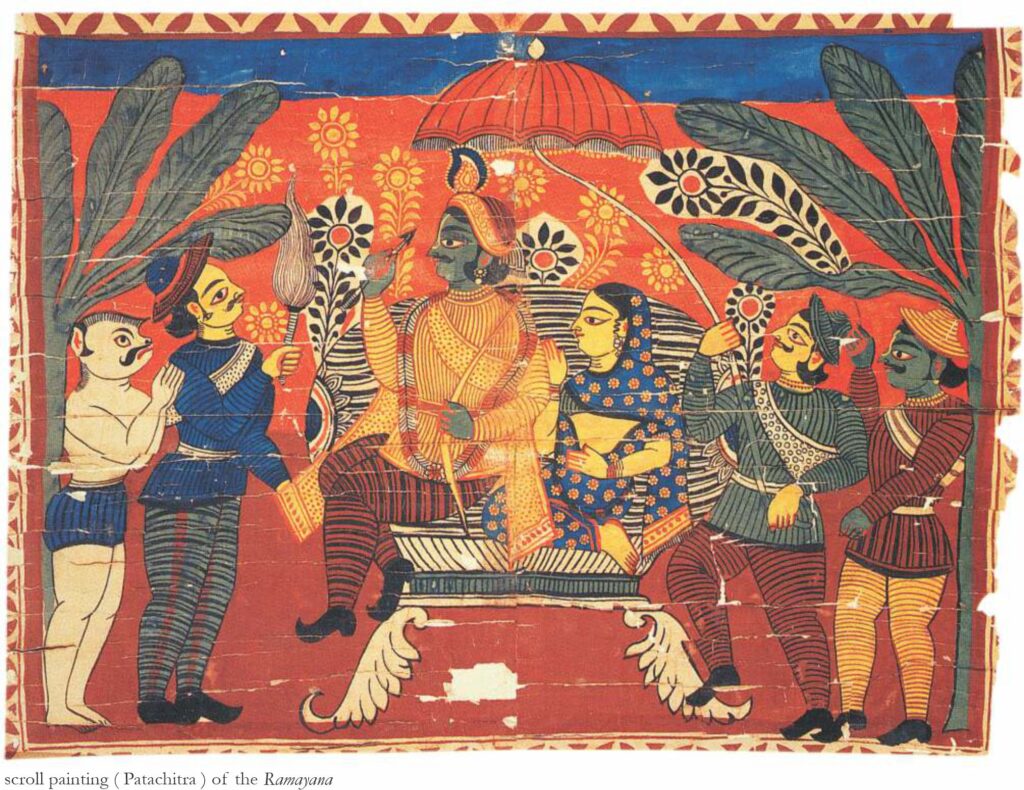
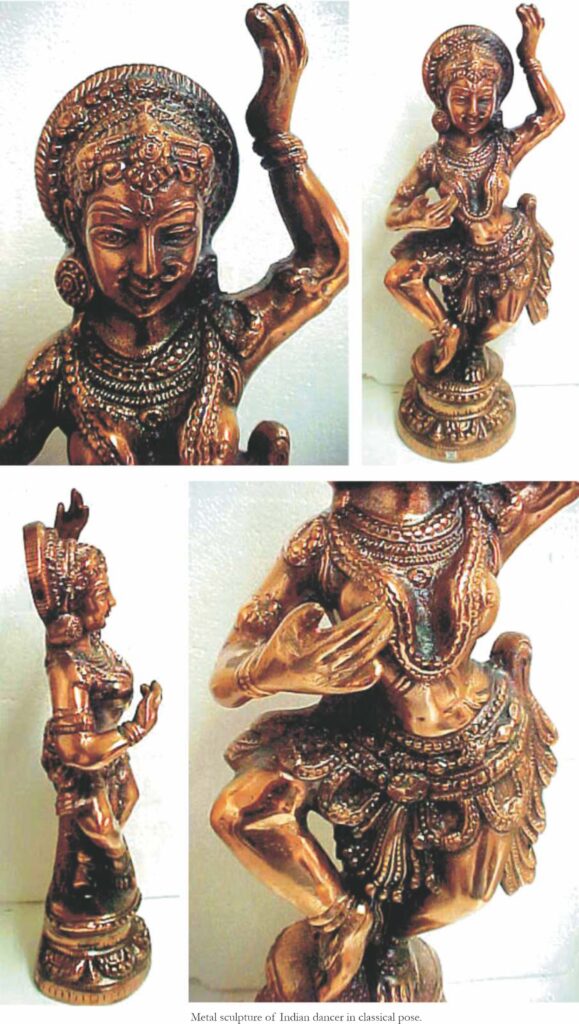
Body language, especially dance and music, had to be resorted to. While the story appealed to the mind of the audience, dance and music appealed more directly to the emotion, bypassing to an extent the rational mind of the audience. Already in his time, Bharat Muni, wrote that the spectator became so used to this passage from one level to a higher one, that he/she instinctively understood when the moment had come during a performance to resort to a dance or a song or music. And that is immediately relevant to Indian movies. It is possible that the response of the audience to dance or music or song in film is rooted in that age-old desire for emotional arousal. But since scholars, and the elite in general, looked down upon popular arts, they soon reduced the use of bodily language to a formula, like so many dances and so many songs are required for a movie. The result of this approach has been to trivialize if not vulgarize songs, music and dance in popular movies.
One is tempted here to mention Satyajit Ray’s Jalsaghar (The Music Room) as an example of a high standard use of music and dance. But in that movie these two are part of the narrative. On the other hand, in the tradition of the Natyasastra, where the narrative is not supreme, dance, songs, and music often suspend the development of the narrative to achieve their purpose, and lift the emotional arousal to a higher level. Critics often complain that the song and dance formula of many an Indian movie interferes with the development of the narrative. These critics seem to ignore the priority that music and songs are given over the narrative in South Asian popular cinema. That is, critics evaluate a movie in terms of the principles enunciated by Aristotle, rather than those enunciated by Bharat Muni. Perhaps makers of so-called “commercial” movies might be encouraged to pay more attention to the quality of the dances and songs they insert in their movies if the critics helped them to better understand the role of song and dance scenes in their movies. Who knows, their movies might shift from being blockbusters to being popular.
part three: the pace of a movie
Another aspect about which critics often mislead the public is that of pacing in movies. In Satyajit Ray’s Pather Panchali, for example, there is a sequence where, unknown to their mother, the young boy Apu and his sister Durga prepare a little banquet of pickles for themselves. There is then a series of alternating closeups: the face of Durga, the face of Apu. From the point of view of the narrative two or three of such close-ups would be quite sufficient. But Ray has given a few more.
That is, he keeps the close-ups on the screen longer than the time it takes to “read” their meaning. In doing so, he invites the viewer to enjoy the sight of children experiencing great delight in their little mischief. There years later he would surely have reduced the number and duration of close-ups on the faces of the children. But I am not so sure of that. For, while in his successive movies Ray has shown his ability to mount shorter series of close-ups, each kept for a minimum time, in Pather Panchali, at least in the sequence I am discussing, he seems to be guided not by the Aristotelian principles of narrative, but by Natyasastra principles regarding emotional arousal. Here again, with their preference for the Poetics over the Natyasastra, critics mislead the public and filmmakers alike. This is something Ray himself has deplored. In his 1948 essay, “What is wrong with Indian film?” Manikda had written that inadequate resources had done harm to movies, but, he added, “I have no doubt that equal harm has been done by critics who keep peddling muddled notions about the art form.” 3
sing — “bharat abar jagata sabhai sresta asan pabe”, India will again occupy a special place in the assembly of nations. Thus our cinema will find its rightful place in the pantheon of world cinema.
conclusion: the task ahead
Both the critics and the scholars have now a difficult job to do. I would detail it in the following aspects:
1. Study a number of ‘popular’ movies and do field research to analyze the public reaction; for example, after Beder Meye Josna was shown in West Bengal, some 36 video interviews were made with people having seen the movie. For instance, a middle-aged housewife was asked which character she preferred in the movie. Her answer:
Tara. Asked why, she replied, “Because although she was a woman, she did something important in the story.” This is a very revealing comment from a cultural point of view. No less revealing was the fact that the interviewed woman seemed not to make much of the fact that to accomplish her mission, Tara had to disguise herself as a man, complete with a moustache.
2. Identify ‘traces’ of the Natyasastra tradition in today’s popular cinema, and suggest ways in which these films can be improved from the movie making point of view. For example, Kuch Kuch Hota Hai.
While it is true that inadequate technical resources, erratic financing, slackness in writing and direction and acting, have all contributed to the general poor quality of movies that surround us, I have no doubt that equal harm has been done by critics – which in movies, means anybody with access to print – who keep peddling muddled notions about the art form.
Document how particular popular movies, while absorbing elements of the growing global culture, still preserve and enrich their local identities. For instance, Manasarovar (2004), a film that is typically Indian, even typically Malayalam, but has been shot in English and has a musical track made by an Irish band.
Should we do that, then as Tagore would say — or Bharat Muni: Natyasastra, (A treatise on Ancient Indian Dramaturgy and Histrionics) ascribed to Bharata-Muni. Completely translated for the first time from the original Sanskrit with an Introduction, Various Notes and Index by Manomohan Ghosh M.A., Ph.D. (Cal). Revised Second Edition. Calcutta, Manisha Granthalaya Private Limited, 1967. p. xxiv: 126. See also 120-121, and xxvii: 39.
Natyasastra, Ghosh’s edition, xxiv: 126. See also 120-121, and xxvii: 39.
Ray, Satyajit: Our Movies, There Movies. Orient Longman Limited, 1976.
Pp. 12-13, Pp. 19-24 Father Gaston Roberge has written extensively on Indian cinema and media-related themes. His is based in Calcutta and teaches at St. Xavier College.
The Natyasastra, or “Principles of Drama” as set forth in the ancient Indian tradition, may guide us towards a better understanding of the unique aesthetics of South Asian cinema. “Popular” cinema, while looked down upon by elitist critics, has many elements drawn from the Natyasastra, such as an emphasis on “emotional arousal” over narrative. Father…