

dispersing dhaka developing a nexus of towns
2008 was an important year for planet earth as for the first time its urban population reached fifty percent of its total population. It is now estimated that by 2050, seventy percent the figure will go up to indicating that the world is becoming increasingly urban.
2008 was an important year for planet earth as for the first time its urban population reached fifty percent of its total population. It is now estimated that by 2050, the figure will go up to seventy percent indicating that the world is becoming increasingly urban. Currently, Tokyo, Jakarta, Seoul, Delhi, Guangzhou, Mexico City, Mumbai, New York, Sao Paulo, Manila and Shanghai are the most populous cities of the world. But rapidly growing cities like Karachi, Shenzhen, Lagos, Beijing, Dhaka, Guangzhou-Foshan, and Istanbul are climbing up the ladder. The forecast is that by 2020, the top ten populous cities of the world will be Tokyo, Mumbai, Delhi, Dhaka, Sao Paulo, Mexico City, New York, Kolkata, Shanghai and Karachi.
Dhaka, the capital of Bangladesh, and a megacity featuring fifth in the list of rapidly growing cities of the world, has been experiencing phenomenal growth during the last few decades which is not showing any sign of slowing down. Bangladesh is one of the most densely populated countries in the world, with an estimated population of around 160 million, inhabiting an area of 143,999 square kilometers. Since its independence in 1971, the country has been experiencing a rapid urbanization process, much of it concentrated in Dhaka, followed by its second largest city, Chittagong.
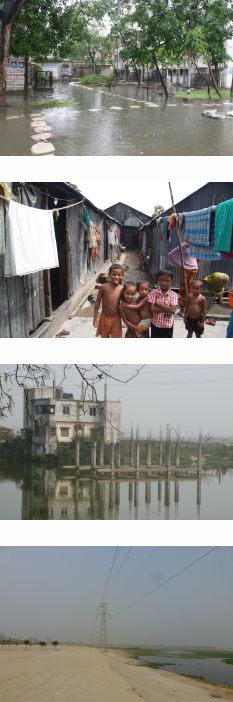
Cities all over the world have many things in common but there are also many differences, an important one being the living condition. The rapid pace of urbanization in Dhaka has exerted tremendous pressure on its urban infrastructure, causing a near breakdown in its services. In particular, the road networks system experiences a regular congestion, causing substantial economic loss and unbearable discomfort to users. Haphazard urban development has choked the natural storm water drainage system, which is responsible for periodic water logging. No wonder the Economist Intelligence Unit study has found Dhaka to be the worst livable city for a number of years.
Poor governance, absence of effective planning, and lack of substantial investment in urban infrastructure have contributed to the current situation. Nevertheless, despite the difficulties of functioning as a livable city, Dhaka the home of more than a million people, continues to thrive, attracting a large number of migrants every year. The dual role that Dhaka plays, being both an administrative as well as a legislative center and the economic hub of the country, is its chief attraction for its citizens.
The fact that the city’s harsh living conditions have not deterred people from not making Dhaka their home may give some solace to some people. but one cannot also escape the question, for how long can this state of things go on? The day may not be far when a total breakdown of the urban system may occur in spite of all the piecemeal measures currently being adopted for its mitigation.

GROWTH INFINITUM
Dhaka has been growing both demographically and physically. The physical growth, visible both horizontally and vertically, has taken place mostly in a poorly planned manner, creating numerous problems in the quality of life in the city. Initially extending into flood-free areas, the physical expansion of the city is now taking place in the vast flood plains that surround the city. This process of urbanization of the ecologically sensitive flood plains has been accelerated by indiscriminate dredging of sand from the rivers around the city which is then transported in barges and pumped into the flood plains.
The intention of this mammoth operation is addition of flood-free land for building. This process of land filling and extending the urban boundary has also not been a peaceful one; rather, there are numerous instances of force being applied to occupy land for filling.
Dhaka’s edge conditions defined by nature are continuously being altered. Rivers, canals, ponds, wetlands, and villages are constantly being erased to create land to satisfy the demand for growth.
Alteration of natural conditions without proper planning will no doubt create enormous environmental problems that can have serious implications for the future sustenance of Dhaka. Some such problems are already visible in terms of the quality of the environment, social conditions and urban amenities. In terms of environmental changes, the city has lost essential buffer open spaces, natural drainage, and flora and fauna. Socially, there has been an erosion of law and order as clashes and conflicts continue over the issue of land grabbing and forceful eviction of original owners. This process of urban accretion and needs to be looked into with urgency in order to find effective remedial measures.
DEVELOPING TOWNS AROUND
DHAKA IS AN OPTION
Judging from the current situation and development trends, it can be said that Dhaka will continue to be the centre of the country’s administration and economy in the coming days and the pressure on it is not going to ease soon. The increasingly complicated ‘Dhaka problem’ needs to be addressed on an urgent basis – one has to look into all the available solutions before formulating a strategy. Work is required with both the existing city as well as the expanding city.

The focus of this article is the expanding city. Whether the city will continue to expand without a boundary definition and ecological sensitivity or alternatives are matters that require urgent attention. An alternative that needs to be seriously considered is decentralization and dispersion of Dhaka, that is to say, to look beyond Dhaka. Decentralization offers the possibility of improving both existing cities and towns, and also developing new towns and urban areas with easy communication connection with Dhaka and other major cities of the country while offering attractive living, working and leisure urban environments. New developments can lead to absorption of a sizable number of the future urban populations and also initiate a counter migration from Dhaka to these places. This process will undoubtedly reduce pressure on Dhaka.
Towns that can be looked into to share Dhaka’s growth include Narsingdi, Munshiganj, Manikganj, Tangail, Kishoreganj, Brahmanbaria, Comilla, Chandpur, Gopalganj, Madaripur, Shariatpur, Faridpur, Rajbari, Mymensing, Sirajganj and Pabna.
At their current rate of growth these towns and their surrounding areas have ample scope of absorbing more population, thus easing the pressure on Dhaka. Most of these towns are well connected by the national highway network, rail and waterways, and through these networks, access to the two major seaports as well as the land and airports. Success of this option will, however, largely depend on appropriate development economic strategies.

Creation of investment and employment opportunities, quality housing, education, health and leisure facilities for all walks of life is a must for offering attractive alternatives to people opting to inhabit these new areas. What is required is a careful study to identify which activities – manufacturing, service or agriculture – will support the economy of these new developments and provide a dependable and sustainable infrastructure for them.
As a deltaic country, Bangladesh is crisscrossed by numerous rivers and canals that continue to play a major role as an important communication network. Development of existing and new cities and towns can take place by utilizing this economic mode of communication that nature has provided. Water transportation at this stage offers zero traffic congestion and with suitable landing stations and easy connection to other transportation modes it can be an efficient basis for new development. Along with water communication, expanding other existing modes of transportation will also make these new developments viable. The building of express roads and rail connections also needs to be considered.
While communication is an important requirement, the quality of the environment will also be a critical consideration for people deciding to move into these new developments. Needless to say, the environment of the new developments needs to be an attractive one. Places that are less crowded, having facilities for ease of movement, healthy and safe housing and work places, quality educational and health facilities, ample open spaces, parks, playgrounds, theatres, museums, art galleries and places of leisure, with dependable and clean supply of utility services which one prerequisites for an attractive environment can promote sustainable urbanization.
PUTTING TOGETHER A STRATEGY, MASTER AND IMPLEMENTATION PLAN
Implementing a plan for dispersing Dhaka and developing towns around Dhaka to absorb a sizable population in the coming years rests largely on arriving at a consensus involving the givernment, political parties, business communities, most of all citizens. And, for arriving at such a consensus, it is important that a dialogue involving all these stakeholders and actors be initiated without delay.
Once a consensus is reached and potential areas of development identified, the next step will be the preparation of a plan. This plan will essentially have a two-stage exercise. The first stage will involve preparing a strategy plan, and the second stage a master plan. The work can be done in two stages. The strategy plan will describe and illustrate planning and design policies and principles based on a thorough assessment and analysis of existing and future developments. The strategy plan should include the rationale for identifying locations for developing a new township, including its economic potential, communication links with the national road networks, rail networks, year round navigable water system, seaports, land ports and airports, extent of future physical growth keeping in view the physical condition of the location, existing demography and future growth projection, and various institutional requirements such as education, health, and leisure. A timescale and various components of the plan and design also need to be clearly identified in the strategy plan.

The next stage is the preparation of a master plan for each of the identified locations. The master plan has to be a detailed, three-dimensional plan which sets out an intended layout of the development. It will present proposals for buildings, spaces, movement, land uses in three dimensions matching the implementation strategy. The master plan also needs to include ways of sustainable urban environment keeping in view natural and other important features, population size, physical extent of development, communication networks, distribution of housing, workplace and leisure ares, source and distribution of utilities, urban design and planning guidelines and visualization of parts of the proposed township.
The strategy plan and the master plan will together form the essential guideline for implementation.
As the task of preparing the strategy and master plan requires a vision of the future urban environment, it needs to be entrusted to architects who will be aided by urban and regional planners, economists, sociologists, engineers and other experts. Emphasizing the need for an architect to lead the team is based on the fact that they are trained to produce three dimensional visualizations. The entire exercise can be coordinated by the Ministry of Planning in conjunction with other relevant ministries, the important ones being the Ministries of Finance, Land, Commerce, Local Government, Energy, Water Resource, Communication and the Prime Minister’s Office. The initial investment for carrying out the task of preparing the Strategy and the Master Plan can be carried out with local resources.
The proposal outlined above should not be a difficult one to pursue as the government is already carrying out plans for establishing Export Processing Zones (EPZ) and Special Economic Zones (SEZ), Readymade Garments Village and Tannery sites. Our proposal here is an extension of such plans but includes housing and various institutions with a quality urban environment in mind. With Bangladesh’s urban population on the rise, a major shift in its distribution within the country is likely to happen in the next decade; and the bulk of the population will surely head for Dhaka unless attractive alternatives are in place. Dispersing Dhaka is therefore an urgent issue. The sooner this strategy is pursued, the better are the chances of averting an urban disaster of greater scale then what is already happening. The future can be decided today.
Saif Ul Haque is a Dhaka based architect involved in practice, research and education. Salma Parvin Khan is an architect and an urban and regional planner in Dhaka. Diagrams and renderings are by Sadia Sharmin and photographs by Saif Ul Haque.
2008 was an important year for planet earth as for the first time its urban population reached fifty percent of its total population. It is now estimated that by 2050, seventy percent the figure will go up to indicating that the world is becoming increasingly urban. 2008 was an important year for planet earth as…