
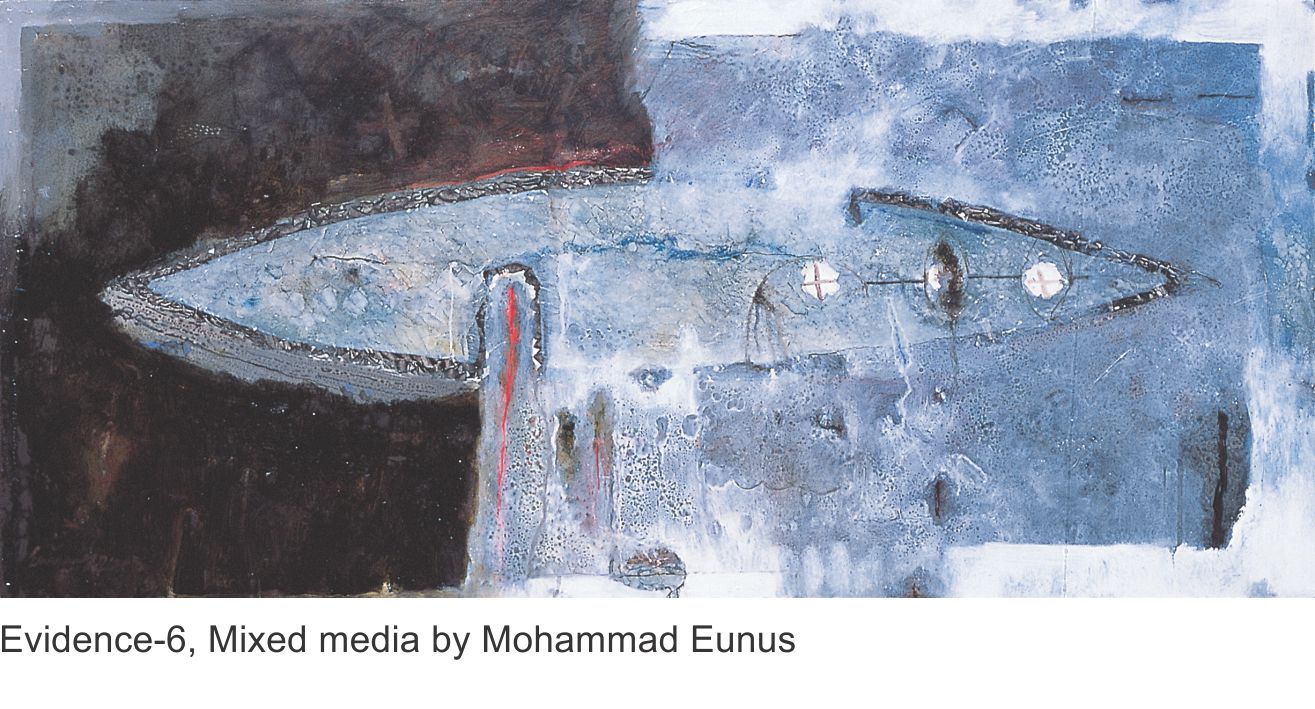
Evidence: our time reflected in Eunus’ artwork
Bengal Gallery of Fine Arts, Dhaka January, 2004
Mohammed Eunus’ works are semi-abstract in appearance but do not fail to reflect the bleakness of the time we are passing through. He does a lot of minimisation in his works but if one looks deeply forms can still be found. ‘I feel that realistic work is bound within limitations and you cannot stretch your imagination very much in them’, says Eunus.
The new works in the Evidence series dwell on the Liberation War of Bangladesh. One painting displays splashes of green that surely represents the countryside. One aspect that captures the viewers’ attention is Eunus’ s use of burnt colours, often the colour of burnt and dried blood. A few works use charred corrugated plastic sheets that represent the suppression of truth. A painting depicts an image of a horse, which is the symbol of power and passion to the common people. But here too Eunus presents it in burnt colour.
Suggestions of the sea and oblong gelatinous shapes in gray, white and black placed on blue are often commonplace in Eunus’ paintings. Old walls with lichens are shown in shades of brown, black and gray that represent the decay of human vision. ‘The wall is a witness to the truth although it cannot say anything. There is a hope in the old wall that one day it will be something beautiful and bright. The wall is a symbol of the oppressed, people no one bothers about but who continue to exist,’ Eunus explains.
The painting with a peacock in blue, grey, red and black seen from behind and the front presents the dancing bird as a mystery. The grey sky at the back is splashed with blue and red. The golden haze of the evening from another picture merges with the afternoon when a yellow streak falls over houses, trees, rice fields and water expanses in the village. Eunus has brought simplified forms also in his Journey with a single oblong shape supported with a rectangle that stands for a boat. The artist plays with texture in all his paintings and this seems to give him a great deal of satisfaction.
A painting projecting a horn and a bison seems to take us to the beginning of civilisation. In other works simplified forms of human beings are portrayed with child-like simplicity against a background of brown, beige and white. The piece Watcher presents an orchestra but with the keys of the piano at the bottom of the canvas. The abstract splashes on top with burnt sienna, beige and blue evoke the aura of a grand musical evening.
Although Eunus lived in Japan for a long time, the tender beauty of Japanese art has not directly influenced him. His colours clearly voice the existential dilemma of our times. However, Eunus’ paintings do not only show the bleaker aspects of our existence, they incorporate hope and the search for beauty as well. In his abstract paintings, he documents the discontent and fear of our time. Flashes of fire singe the smoothness of his canvas. The images that Eunus has created by burning acrylic sheets are evidence of a decaying world. The abstract expressions of this artist are different from other contemporary artists. Instead of using pleasing appealing colours, he bears witness to the madness of the current times through his use of eruptions of violent colours in different layers. Such eruptions are accentuated by the textured surface, which together give his abstractions an expressionistic character.
Bengal Gallery of Fine Arts, Dhaka January, 2004 Mohammed Eunus’ works are semi-abstract in appearance but do not fail to reflect the bleakness of the time we are passing through. He does a lot of minimisation in his works but if one looks deeply forms can still be found. ‘I feel that realistic work is…