

in the land of the thunder dragon
‘I live in this area,’ says Antanas Jonynas, a poet and translator from German, who was also the moderator for the evening. ‘This will be our quarter, the quarter of the artists, as Schwabing once was in Munich. The apartments and houses are still inexpensive here, but that will soon change, as much has to be renovated.’
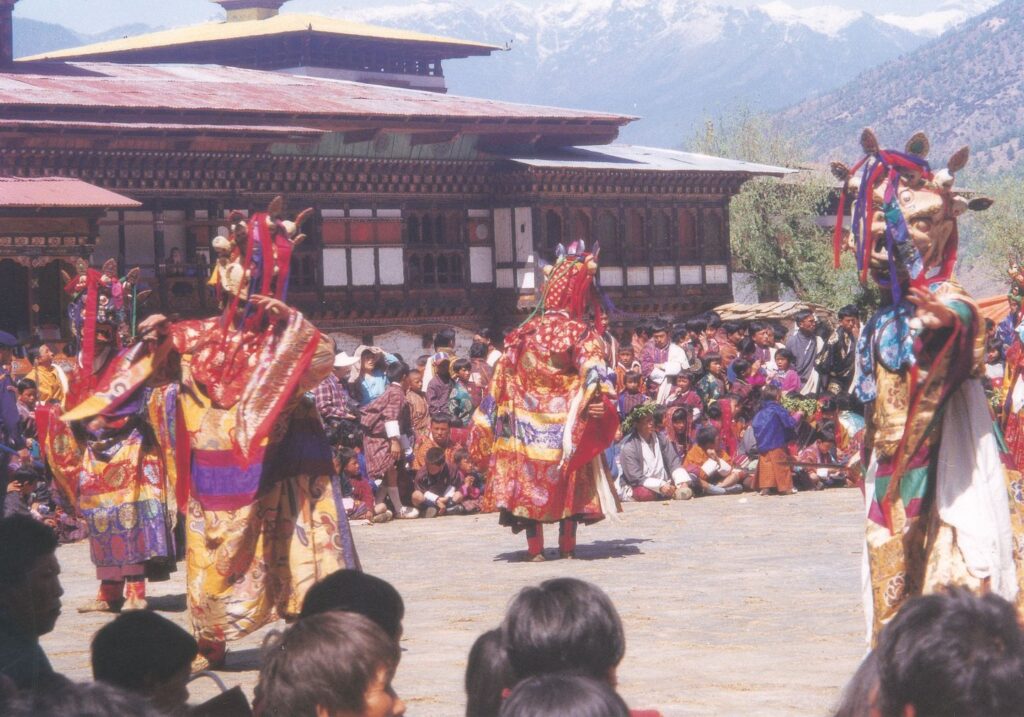
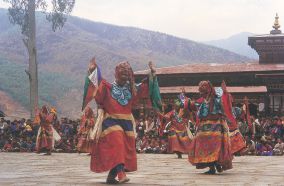
On the steep slopes of the eastern Himalayas is a tiny kingdom known to its inhabitants as ‘Druk Yul’ or ‘the Land of the Thunder Dragon’. The inhabitants, who are mostly Bhotias, call themselves Drukpas (Dragon People) and proudly claim their land to be the last Buddhist kingdom of the world. This land is also known as Bhutan. Druk Yul or Bhutan hardly ever makes world headlines. No news is often good news. In any case, if you wish to run away from the sound and fury and madness of the world, you may actually ‘discover’ here the last Shangri La in a unique religious festival called the Tsechu.
Tsechu means the Tenth Day and the festival has this name since it is usually held on the tenth day of the Bhutanese lunar calendar and because it celebrates the birth of the Mahayana Buddhist saint, Guru ‘Rinpoche’ Padmasambhabha, and his great deeds, all of which are believed to have taken place on the tenth of one or another month. Celebrating his birth and deeds is important since he introduced Buddhism to the kingdom in the 8th century. For the Buddhist Bhutanese, attending a Tsechu is an act of piety as the festival actually seeks to celebrate the victory of the Buddhist doctrine of Dharma over evil powers and bolster the Buddhist faith in the laity. But the festival is also a time for family reunions. So, a Tsechu turns out to be a colourful annual social gathering, where people dressed in their best get together to rejoice.
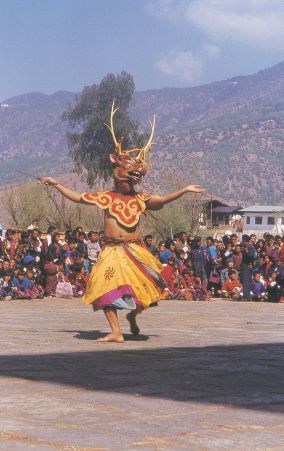
There are numerous Tsechus. There is a Tsechu in Bhutan almost every month (except a few months in the winter and the rainy seasons) in some district or the other. Some of the most popular Tsechus are celebrated in Thimpu, Paro, Wangduephodrang, Trongsa, Bumthang, Mongar and Trashigang. The festival usually lasts from one to five days. In most cases it is organised by the local community of monks and the laity. However, the state provides logistic support for the major Tsechus such as that of Thimpu (celebrated in autumn) and Paro (celebrated in spring).
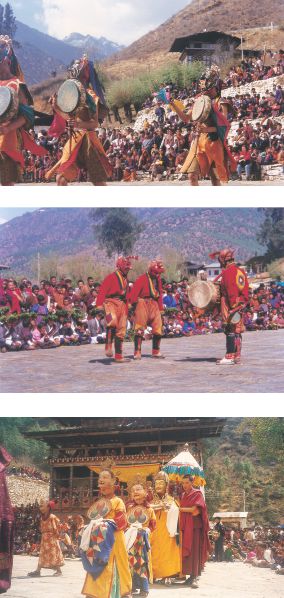
Of all the Tsechus, the one held at Paro is possibly the most spectacular because this festival offers an open-air performance and is spread over five days. It is also the most accessible to foreign tourists because Paro hosts the lone airport in Bhutan and in springtime the hillside comes alive with blossoming of rhododendrons. The performance at Paro Tsechu comprises fifteen traditional ritual and celebratory dances, three didactic plays, and numerous folk dances and folk songs, all strung together by grotesque Atsaras (a corruption of the Sanskrit term âcârya or ‘spiritual teacher’, here denoting clowns) playing the fool. The performers, monks and members of the lay community, participate voluntarily and consider the act of participation a matter of great honour.
The performances of the Paro Tsechu are held in two venues. On the first day, the venue is the Rinchen Pong Dzong, a fortress-monastery halfway up a hill on the outskirts of Paro town. The dzong, consecrated in 1646, is the administrative seat of the district of Paro and houses a monastic community of about 200 monks. Inside the oblong monastery is a large paved courtyard with a tower at the centre. The performance is held in the western half of the courtyard, flanked by the monastery building on three of its sides and the tower on the fourth. The orchestra box (occupied by two jaling or clarinet players, two trumpet or dung players, six hand-drum or nga players and three cymbal players) is on the ground floor of the monastery on the southern side of the courtyard. The head lama and other dignitaries sit on the 1st floor, above the orchestra box. Some other musicians, who play long trumpets, drums and gong, occupy the top floor. The performers enter and exit from two openings on the northern flank of the monastery building. The spectators sit on three sides on the top floor, the western flank of the ground floor and all around the courtyard, leaving clear the two openings for the performers and another to the orchestra box.
For the remaining four days, the Tsechu performance shifts outside the fortress-monastery, to the Deyankha courtyard. Located in the southeast of the monastery and within its compound, the Deyankha is a four-storied building used as the dressing room for the dancers. The head lama views the performance from a window on the third floor. The courtyard of the Deyankha lies immediately in front of the building. It is paved and measures about 90 feet by 80 feet. Beyond the paved area stands a building with two boxes on its upper floor, one for the royalty and the other for dignitaries. On one of the remaining two sides stands a three-storied building which is used as the orchestra box. The other side of the courtyard is slightly undulating and gradually merges with the slope of the adjacent hill. The spectators sit on three sides, leaving the Deyankha side free most of the time. Beyond the Deyankha area is the fair ground which has stalls selling food, clothes, mats, toys, masks and gift articles. On a fine festival day, one can gamble, see Hindi movies, drink beer and play darts.
The performance begins and ends with a procession from and to the Dzong, respectively. These are important because they remind the laity that the source of the festival is the monastery which is also the seat of local administration. Furthermore, all five days begin with the Beri, in which the village heads, accompanied by the monastery orchestra (comprising two jalings, two dungs, six ngas and three cymbals), ceremoniously circumambulate the performance space in an act of public avowal of the people’s allegiance to the state. This act of public avowal is also incorporated in some of the performance events. Thus, the festival serves to hold together the monks and the laity, the erudite and the earthly, the state and the people.
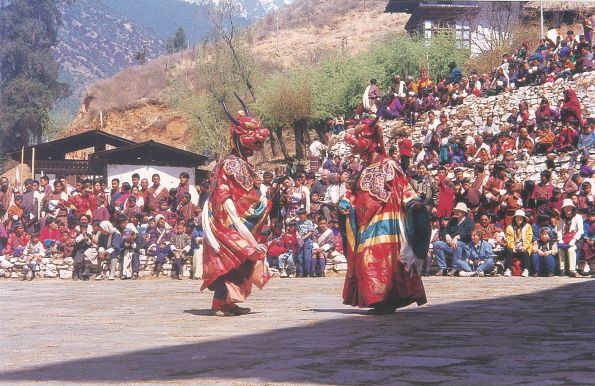
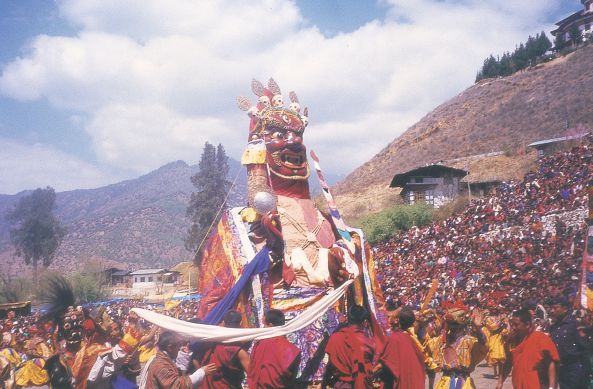
Undoubtedly, the most spectacular events of the performance feast at Paro Tsechu are the traditional and ritual dances. What is their social function? ‘They teach the people not to be scared after death when they confront these beings’, a monk will reply. While this may seem scary, once you begin to see the masks as surrealistic images of life or if you consider the performance as a dream-time, you realise that you don’t need to ‘understand’, and can directly experience the performance only with a bit of contextualising.
A ritual dance performed at the very beginning is the Shinje Yab Yum (the Dance of the Lord of Death and His Consort). Two monks perform the dance in the roles of the Lord of Death and his consort and seek to purify the performance space before the later rituals can commence. Another purifying ritual dance, the Shanag Cham (or the Black Hat Dance), is performed by twenty-one monks playing the roles of Tantric siddhas. The dance aims at the forceful conquest of evil spirits (Shitro) which cannot be overcome peacefully.
A ritual dance performed to subjugate the evil spirits is the Durdag (or the Dance of the Lords of the Cremation Ground). In it, four monks in white skull-masks assume the roles of Dharmapalas (the Protectors of Dharma) and capture the evil spirits inside a triangular ritual box so that Dharma can spread unhindered. Another is the Degye Cham (the Dance of the Eight Kinds of Spirits), in which twenty-one dancers representing the gods subjugate all the eight categories of evil spirits who continuously torment the mortal beings. In the Ju-ging Cham, the dancers represent the Gings (Guru Rinpoche’s liberated retinue) and subjugate the Nyulema demons.
The Dramitse Nga Cham (the Dance of the Drums from Dramitse) is more benign. Twelve lay performers in the dance represent the attendants of Guru Rinpoche whose heavenly abode is the performance space. The dance is performed so that the evil spirits may be subdued, the gods can be triumphant and all living creatures can be happy. Where peaceful means of subjugation fail, force may be applied. This is the action of the two ritual dances known as the Tungam and the Dri-ging Cham. In the Tungam, performed as a sequel to the Durdag, the evil spirits captured in the box are ‘won’ over by a sacrificial murder. In the Dri-ging Cham (the Dance of the Gings with Swords), performed as a sequel to the Ju-ging Cham, the Gings dance with swords and kill the evil spirits they have captured. The act of killing, it is believed, is compassionate, because it liberates them by sending them to paradise.
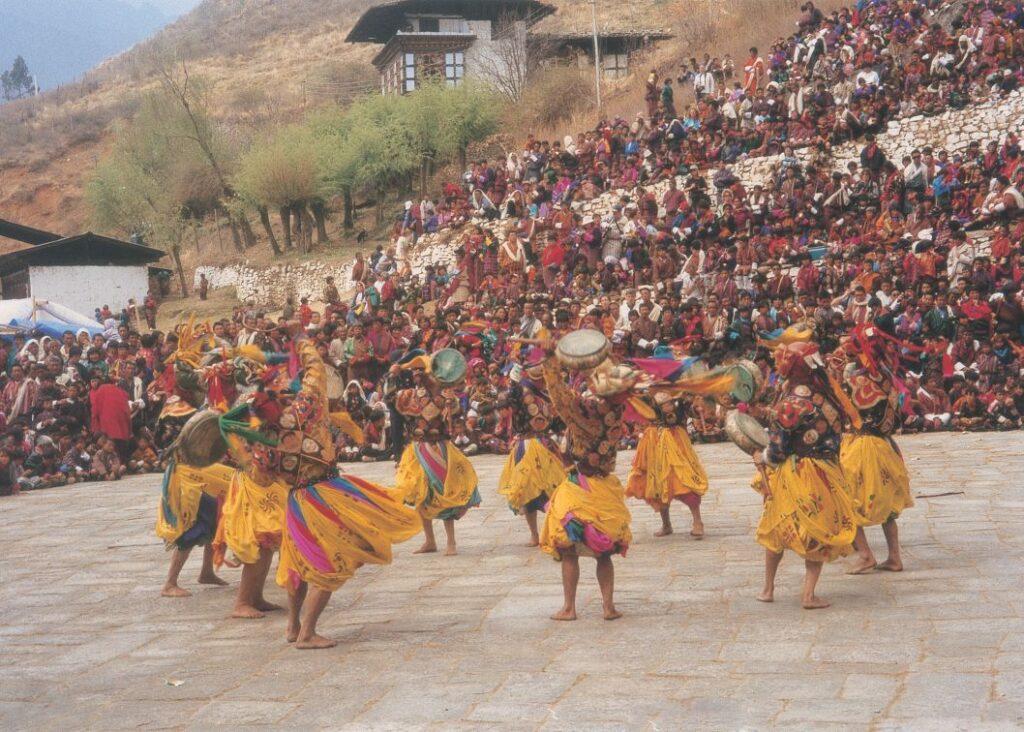
Some of the rituals of subjugation of evil spirits discussed above have a dance sequel that is actually a celebration of victory. One of these is the Shanag Nga Cham (the Dance of the Black Hats with Drums), in which the Black Hat dancers of Shanag Cham dance with drums (ngas) to celebrate the victory of Dharma over its enemies. In the Nga-ging Cham, the Gings dance with drums to celebrate their victory over the evil spirits. The Ging Dang Tsholing (the Dance of the Ging and the Tsholing) combines coercive cleansing and celebration of victory. In it, the dancers represent the Tsholings (the non-liberated protectors of Dharma) and the Gings (Guru Rinpoche’s liberated retinue). The action of the dance takes place in and around the Zangdog Pelri (the celestial palace of Guru Rinpoche), and is divided into two parts. In the first part, the Tsholings destroy evil spirits (symbolised by an effigy or linga) imprisoned in the ritual box. Then the Gings celebrate victory over the evil spirits through a joyous dance with the drums (ngas).
Beside the eleven ritual dances discussed above, the Pao Tsechu also features four traditional (non-ritual) dances that celebrate the victory of Dharma over evil forces and pay homage to Guru Rinpoche. One of the four dances is Guan Drug Pawo, performed by twenty-one dancers, each carrying a small drum in the right hand and a bell in the left. They represent the Pawos (heroes) and Pamos (heroines) of the Guru’s heavenly palace in Zangdog Pelri. In the concluding segment, when the dancers pass through rows of spectators in a single file, some monks join the dancers at the end of the file and distribute Guru Rinpoche’s grace in the form of Thulchu (holy water) and Thinde (mixture of flour, butter and sugar). Another dance, known as the Sha-cham and performed by four dancers representing stags, commemorates Guru Rinpoche’s subjugation of the King of Wind by riding a stag (the mount of the King). The Pa-cham (the Dance of the Heroes) is another celebratory dance in honour of Guru Rinpoche, meant to lead Guru Rinpoche’s devotees to his presence. The fourth dance, known as Guru Tshen Gye, is the most elaborate. It pays homage to Guru Rinpoche who appears in the dance with all his eight manifestations and attendants. The first part of the middle section consists of a dance of all the eight manifestations (except Padmasambhava) in the court of Guru Rinpoche. It takes place concurrently with a ceremony of public blessing in which people receive a thread from the Guru. In the second part of the middle section, sixteen fairies (emanations of the Goddess of Offering) pay homage to Guru Rinpoche. During this time, the spectators pay obeisance to Guru Rinpoche and offer money to the attending monks.
None of the dances mentioned above contain any narrative. Those that do are the Shawa Shachi, the Phole Mole, and the Raksha Man Cham. These are more like didactic plays performed with improvised dialogues, songs and dances. In the Shawa Shachi (the Dance of the Stag and the Hounds), saint Milarepa converts a fierce hunter named Gonpo Dorji into Buddhism. The Phole Mole (the Dance of the Noblemen and the Ladies) is a play about two princes and their two wives (two princesses). It teaches matrimonial fidelity. The Raksha Man Cham (the Dance of the Judgement of the Dead), is set in Bardo, the intermediate state where Shinje Chhogyel, the Lord of Death, judges the dead. It shows the trial of two dead persons: a sinner called Nyelwabum who is led to hell and a virtuous person named Chimdapelkye, who is led to paradise.
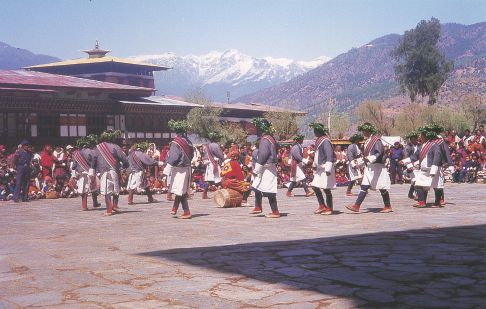
Beside the traditional and ritual dances described above, the Paro Tsechu features numerous folk songs and dances. These are all in praise of the Buddhas, Guru Rinpoche and various saints or elucidate important aspects of social life and exhort the spectators to follow the Dharma.
The role of the Atsaras is of particular interest. They physically connect the planes of the performance with that of the spectators. They do so at any time except during some ritual dances. The phallic symbol that they carry amply shows that they emphasise the profane. Unlike the aura of the monks in their ritual dances, the Atsaras evoke laughter and ridicule. They are a fine example of ‘grotesque realism’ (Bakhtin, 1984: 9) and emphasise the images of bodily life: fertility, growth and abundance. Degradation is their essential principle degradation which means ‘coming down to earth … that swallows and gives birth at the same time’. They bury, sow and kill simultaneously, ‘in order to bring forth something more and better’ (Bakhtin, 1984: 21). They are in the state of unfinished metamorphosis, ‘epitome of incompleteness’ (Hauser, 1958: 25-26) situated in between and containing opposites.
The Paro Tsechu thus ranges from the profane to the sublime. But perhaps there is one brief span in the festival when the devotional fervour thickens. This occurs when the Thongrol (a huge appliqué Thanka, claimed to be the world’s largest) is unveiled early in the morning of the fifth day. It shows Guru Rinpoche at the centre, flanked by his two female consorts (Mandarava, the lady of wisdom, and Yeshey Tshogyel, a representation of the goddess of knowledge) with the Guru’s numerous manifestations encircling the three central images.
The structure of the Paro Tsechu is complex not only because of the numerous dances, songs and plays but also because many items are repeated. Day one, set in the monastery, is heavily laden with rituals. These gradually diminish as the festival moves in to Deyankha, the space of the laity. The movement is from the sombre monastic air to open celebration. Day two to four contain didactic plays, but there are none on the first and the last. The final day focuses more on celebration: veneration of Guru Rinpoche and victory of Dharma. Furthermore, the ritual dances, non-ritual traditional dances, and didactic plays are carefully punctuated with folk songs and dances.
Day one begins with purification of the ground (Shinje Yab Yum), then moves on to subjugation of evils (Durdag). Further purification is followed by establishment of authoritative control (Shanag Cham), then repeated acts of subjugation (Dramatse Nga Cham and Degye Cham) and finally ends with a song and dance of praise. Thus, day one is actually a ritual act of exorcism of evil from the land, performed by monks for the benefit of the laity. There is hardly any note of compassion. Instead, the air is thick with the eerie note of death; the scene is dominated by skeletons from the cremation ground and powerful humans (siddhas) who can control malevolent spirits by their spiritual power.
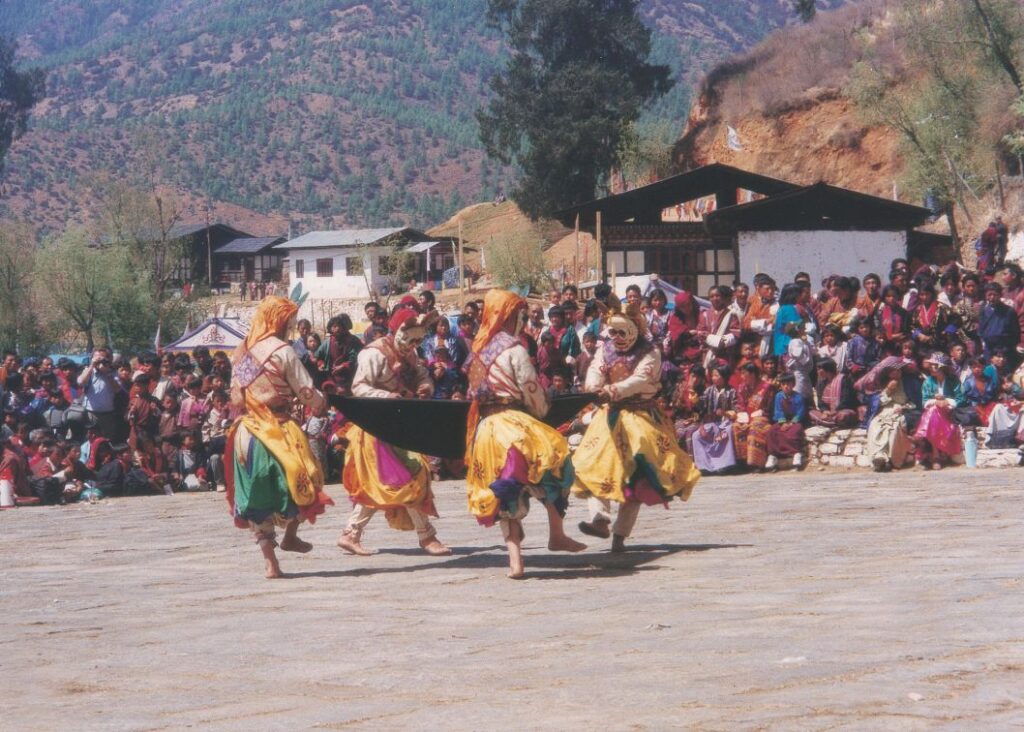
On day two, the performance physically moves from the Dzong to the Deyankha. In effect, the movement represents the efficacious working of Dharma spreading from its locus in the monastery to the habitation of the laity. At the same time, with the procession at the beginning and end of each day’s performance, the monastic body subtly reminds the laity that the source of Dharma is the monastery. Day two begins again with a ritual of purification, for the festival has now moved to a new space. The Black Hat Dancers who had purified and established control the previous day celebrate the victory of Dharma and thus re-establish their control in the new space. Then follow the dances of the Gings which move from the hunting and capture of evil forces to their subjugation and extermination and then to the celebration of the victory of Buddhism. Finally, the day ends with the comedy of the first part of Shawo Shachi, which, on the following day, will teach compassion through the example of none other than the famous saint Milarepa.
Day three is composed of three parts: (i) subjugation (in the Durdag) and purgation of evils by means of sacrificial murder (in the Tungam), followed by (ii) the celebration of the victory of Dharma and its physicalized dissemination to the laity (in Guan Drug Pawo), and ending with (iii) two moral instructions to the laity (a) to maintain conjugal fidelity (in the Phole Mole), promising protection to those who do so (in the Key Cham) and (b) to show compassion (in the Shawa Shachi). The order of events in the day’s performance shows a clear shift away from monastic preoccupations with magic and brooding over evil to preoccupation with the mundane life of the laity.
On day four, the performance of the Sha-cham may be viewed as a prayer to Guru Rinpoche to subjugate all evil spirits on earth. However, the focus is the reminder of the judgement of the dead, which is issued between offering of homage to the Guru and celebration of victory. The message of the Raksha Man Cham is clear: one who remains loyal to the principles of Dharma has nothing to fear after his or her death. Though the theme is death, there is a striking contrast with day one. Instead of uncanny brooding over evil, the Raksha Man Cham is a joyous celebration of the end of a journey of life that is led by the principles of Dharma. One who strays away can only be a fool.
The final day is devoted entirely to paying homage to the Guru. It begins with the ritual of the Shugdel where the Guru is represented as a non-moving image of the huge appliqué Thanka. Then the devotees are physically led to his celestial palace Zangdog Pelri (in the Pa-cham) and are reminded that his retinue of the Gings and Tsholings are fully capable of rooting out all evils (in the Ging Dang Tsholing). Finally, the devotees are presented with a vision of the Guru where they get a chance to actually ‘see’ him in all his eight manifestations and with his attendants in Zangdog Pelri. The final day, thus, promises that if the laity follow Dharma, the Land of the Thunder Dragon will surely be Zangdog Pelri.
Thus, in the structuring of the Paro Tsechu performance, one can clearly trace the working of a particular design that operates at two levels. At the outer level, the processions, the Beri ceremony and all participations of the laity in the dances, seek to achieve symbolic as well as physical solidarity of the monks and the laity. At the inner level, the performance events seek to cleanse and establish Zangdog Pelri. At this level, the action begins with cleansing the performance space (by extension, the Land of the Thunder Dragon) and then moves on to subjugation, purgation and cleansing. When this is achieved, moral lessons are imparted to the mortals. Finally, the devotees of the Land of the Thunder Dragon are promised the establishment of Zangdog Pelri if they follow the Dharma.
I had a glimpse of Zangdog Pelri in the Tsechu of the Earth-Hare Year that I attended. It was held from 27th March to 31st March 1999. Unexpectedly, snow had fallen on the night before the festival. Fortunately, there was enough sunshine on festival days and I must have been one of the very few who faithfully sat through the entire stretch of the five days. On the morning of the fifth day, the procession carrying the Thongrol came from the Dzong to the Deyankha a little after 3:00 AM. By that time, thousands had already gathered. As soon as the Thongrol was unfurled, there was a ripple of murmuring awe. Such moments are enigmatic and contagious. I had to accept that there is some truth in the belief that viewing the appliqué Thanka is supposed to deliver people from their sins and lead a true believer to enlightenment. There was a gentle breeze and a soft glow of human warmth. Even a non-believer like me felt touched.
Then commenced the Shugdel (Blessing and Offering Ceremony) performed by the monks of the Dzonka, in front of the Thongrol, on the courtyard of the Deyankha. At the end of the courtyard, in its centre and opposite the Thongrol the Head Lama sat on a raised platform. His assistant sat to his right, on a lower level. In front of them, in parallel rows perpendicular to the Head Lama, monks took their seat in descending order. They recited verses in praise of the Guru. Where the rows ended, there stood a large table with food offerings. Beyond it was another long table at a higher level, where butter lamps burnt. There was still another long table, higher than the others, where stood a number of Tormas. To its right burnt a heap of incense sticks. People sat and stood on three sides of the courtyard. A large queue had lined up on the fourth side, where people were offering money to the monks. Then they went inside the Deyankha to worship a mask of the Guru. As the candlelight melted into the first glow of dawn, I gasped. It must have been the incense sticks, the droning chant of the monks, and the sharp chill in the air because, for a moment, it seemed that the image of the Guru was smiling, glowing and then floating off in space. But the vision lasted only a moment. Either it was too strong for my exhausted body or the merit I had accrued from attending the festival must have run out.
As I trudged downhill from the Dyenkha back to my hotel at the end of the festival, I looked around one last time. As in all performances, when the last of the spectators are leaving and the structures are being dismantled, when the festival is over and yet not over at that threshold of space, if the time is also the threshold of evening, you will surely hear the sounds of ghosts. It struck me suddenly that over a hundred thousand Bhutanese of Nepali descent are languishing as refugees in various camps in eastern Nepal, victims of ethnic cleansing. Suddenly, the ritual cleansing of the dances of Paro Tsechu made sense. If the festival seeks to establish Zangdog Pelri in the Land of the Thunder Dragon, the last Buddhist kingdom of the world, the Bhutanese of Nepalese descent (who are Hindus and not Buddhists), have no place in it though they comprise 35 per cent of the entire population.
Having witnessed the Paro Tsechu, I think I know what it means to purify and cleanse.
Syed Jamil ahmed teachers theatre at the University of Dhaka. He has most recently published in Praise of Niranjan : Islam, Theatre and Bangladesh (Dhaka, Pathak Samabesh, 2001)
‘I live in this area,’ says Antanas Jonynas, a poet and translator from German, who was also the moderator for the evening. ‘This will be our quarter, the quarter of the artists, as Schwabing once was in Munich. The apartments and houses are still inexpensive here, but that will soon change, as much has to…