
raas mela
It was my second visit to the Sundarbans and first attempt to document and experience the famous fair, Dubla Mela, which coincides with the Hindu festival called Raas Leela, and takes place on Dubla Char, the biggest offshore fishing island
It was my second visit to the Sundarbans and first attempt to document and experience the famous fair, Dubla Mela, which coincides with the Hindu festival called Raas Leela, and takes place on Dubla Char, the biggest offshore fishing island.
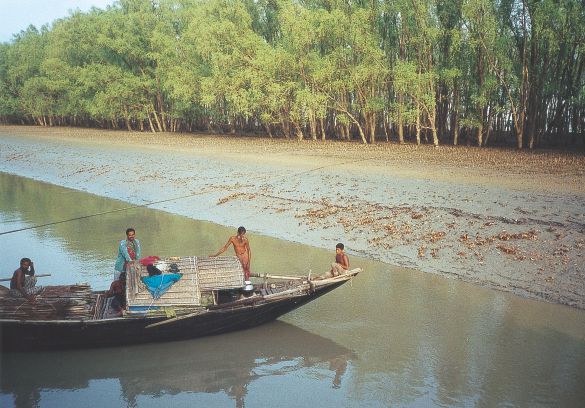
We cruised all the way from Dhaka to Sundarban and reached Katka at midday on 21st November. It was an incredibly beautiful day and the journey was breathtaking as the ship moved through a maze of waterways. The next day we were due to take the trawler Chhuti to Dubla Char. This island in the southeast of the Sundarban forest becomes a major scene of fishing activities in winter when fishermen in their thousands establish temporary camps to fish in coastal and estuarine waters. The crew of the trawler assured me they would find a boat the following morning that was heading for the Dublar mela before daybreak.
We had planned a preliminary survey and documentation of the festival as part of our film Sundarbaner Lokalaye Deen Raatri based on the people who make a living in and around the Sudarbans. The chance forgone this season would mean waiting for one more year. By now I had gathered enough information regarding the Mela, read articles as they appeared, spoke to those who had first-hand experience of it, and discussed it with the fishermen, the local mawals and bawalis. The more I learnt about the mela the more intrigued I became; all this helped me prepare a preliminary outline for my film script.
The day went by and nothing had yet been arranged. Perturbed, I wondered how anything could be fixed between now and early morning in a place where the nearest source of tele-communications was eight hours away. The forest offices were equipped with ancient telecommunication gadgets dating from the 1940s, which often did not work. Disheartened, we all retired for the night.
Morning of 22nd November. The alarm clock went off at 4:15 am and I jumped out of bed and hurried through the lighted aisle to find it was still dark and not a soul stirring while the anchored ship was swaying gently to the ripples of the ebbing tide. An occasional deer call could be heard at a distance, and the splashing of water as the fishes rose and fell. These were the only sounds that broke the silence. Tension about how to reach Dubla blurred my senses, and yet I could not help imbibing the beauty around me of the setting moon and its dancing reflection on the incoming tide, as I sat on the deck looking out into the dark.
The sky started to clear and one could see the hazy silhouettes of egrets and Brahmini kites against the foggy morning light. Suddenly gurgling and chatting men could be heard far back at the stern of the ship. I rushed to inquire if the crew was lucky to find a trawler that was heading for Dubla.
The ship crew was already negotiating with the sareng of two trawlers belonging to the Khulna forest department, on a routine patrol to Dubla after a night halt at the Katka forest office. They agreed to be of assistance, intrigued when they found our team was led by a woman willing to travel the choppy waters of the mighty sea to document the festival. Perhaps my prayer was answered. Chhuti was also scheduled to take the tourists to visit the Mela but so much later in the day that it did not coincide with our filming schedule to document the event in its full glory. Hence we decided to travel ahead.
The tiny trawler cabin with a forest range officer and three of its crewmembers could only accommodate two more when our requirement was for four (since camera equipment occupies the space for one). Professional women in South Asia are looked with reverence and are simultaneously subject to pity, especially when a lone female is found amidst a few male members. The men clamoured to make space for ‘the poor lady’ (which happened to be myself), and showed some consideration for the cameraman and suggested that the camera equipment and the young sound recordist could manage space in the ramshackle little bow area. But since in a film unit camera equipment gets the highest priority even if the producer/director and others have to stand all night on one leg or fall and die, I volunteered to swap places with the camera, feigning claustrophobia in the little cabin rather then taking the trouble to explain to our host the bizarre priority of camera equipment over Man. The cameraman took position next to the camera. Our journey to Dubla had finally begun.
The sun was slowly peeping over the horizon as we sped over the waves of the Bay. Our trawler looked like a toy boat in this vast expanse of water. We took our first shot of the day. The forest staff shared their ration of tea and puffed rice with us while we offered them the cookies and banana that the Chhuti crew had packed for us.
The first 45 minutes was smooth sailing; then the boat moved further from the coast towards the sea. I clutched the sides of the boat and for once wished I had accepted the chivalrous offer of the cabin crew and sat in the security of the tiny cabin next to the camera.
As he was tossed around in that little space, the wide-eyed sound recordist muttered curses between gritting teeth. The cameraman had already dozed off in the tiny cabin. Later, I learnt it was the effect of antihistamine taken as a precaution against seasickness to which he was prone.
All the while I was agonising over what lay in store. What if the boat gave way and we all ended up on the sea floor? What if the cameraman was taken ill and could not work for the day? If we fell ill should we consult a local quack and take medicine made out of tiger parts? All sorts of things crossed my mind while I clutched on to my still camera bag like a frightened bird with broken wings.
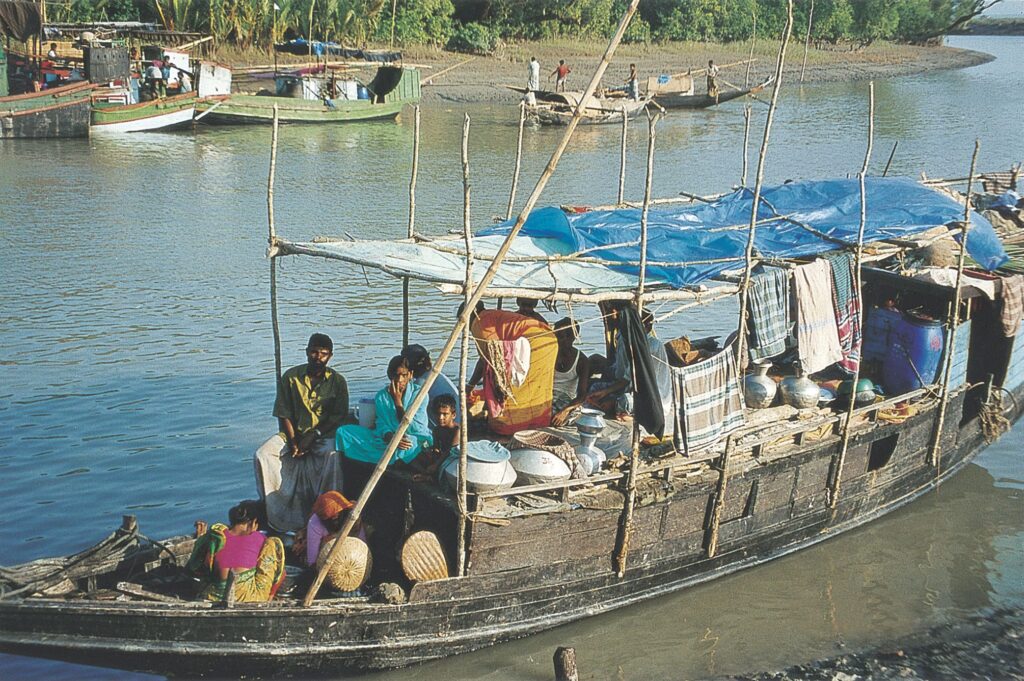
Around ten in the morning we entered a canal that was to take us across to the other side of the char, which fronted the sea. As we chugged along more boats of different sizes and shapes sailed past, all headed for Dubla to participate in the festival. Though very experienced, our boatman lost his way, ending up in the wrong canal.
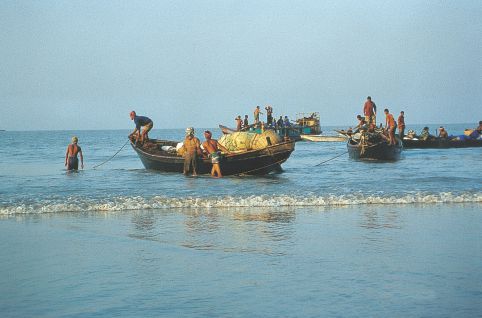
At this time of the year a large number of people head for the offshore islands in the southeast of the forest, while thousands of fishermen start camping on this island from September to fish in the coastal and estuarine waters. At times the Sundarbans looks ideal, pristine and uncomplicated; on other occasions it appears to be dark and mysterious. But irrespective of its dual nature, the mangrove forest and its waterways provides succor and support to the inhabitants of southeast Bangladesh. The journey across the seawaters is long and at times seemed perilous. It finally ended around 11:15 a.m. as we disembarked on the island, around which numerous other boats had assembled for the carnival.
Hundreds of families had already started to camp on the island while others stayed in anchored boats. Preparing for the fair seemed an elaborate affair. Making sweetmeats, crispies, and other delicacies is part of the festivity itself, and activity which for many involved the whole family. The film crew, once on the ground, bounced back to normalcy and hurried across to little tents set up as shops, looking for food. Perhaps all was well with the crew; I heaved a sigh of relief.
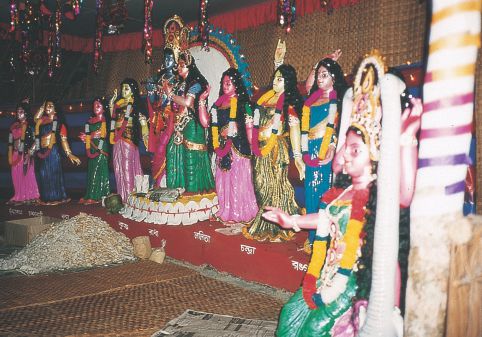
The Dubla Mela is essentially a celebration of the Hindu deity Lord Krishna’s divine and erotic love for his beloved Radha known as ‘Raas Leela.’ This unique manifestation is spiritual and yet very joyous. Raas is the essence of all the rasas (emotions) and leela is the depiction of episodes from the life of Lord Krishna.The story goes that raas was performed some 5,000 years ago by Lord Krishna and his brother Balaram. Radha is Krishna’s main partner. One day, when Krishna deserted Radha, the weeping maiden with her friends enacted episodes from Krishna’s life in order to keep his memory alive. And so, as legend has it, the first Raas Leela was performed.
Luck was on our side. We continued to explore the island documenting as much of it as was possible in the daytime. We were treated to special lunch along with other guests by Major Zia, who hasbeen a legendary figure here ever since he took refuge on this fishing island during the liberation war in 1971. He has patronized the mela since.
As evening fell I scoured the horizon through my binoculars–amongst other boats I found Chhuti already docked in the outer bay, ferrying its tourists to the Dubla shore in a speedboat. The news of our arrival had spread and the crew smiled with delight, eyes sparkling in anticipation of a good night’s rest.
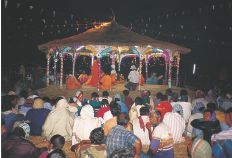
By nightfall everyone was poised to participate in the rituals that distinguish this fair. The locals performed jatra, enacting scenes from Radha-Krishna episodes, and sang bhajans and kirtans. The revelry continued all night long. Raas Leela takes place on the day of the full moon during the Purnima Tithi in the month of November, which traditionally has been known as Maaha Raas.
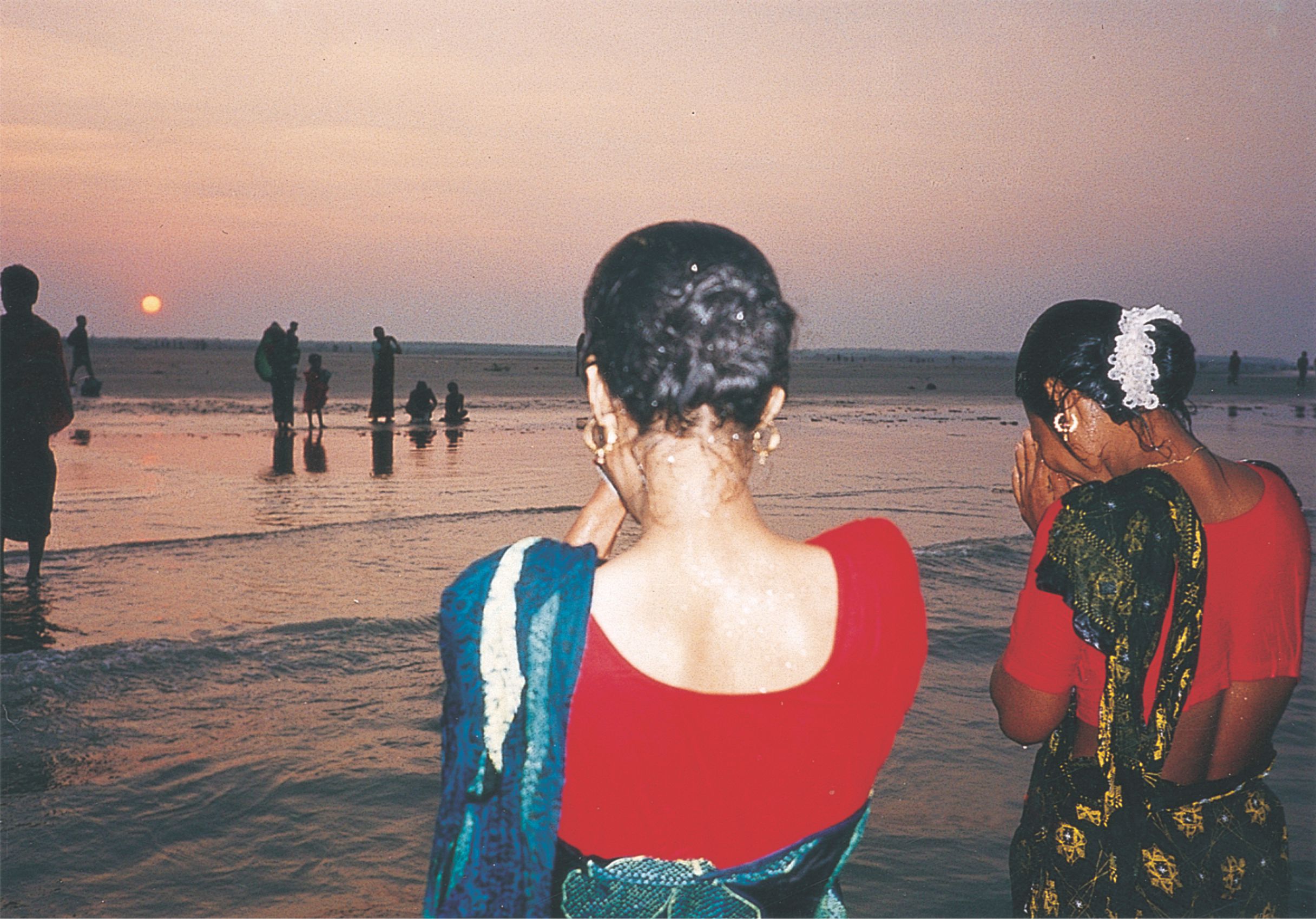
The next morning, 23 November, the rituals began in full swing with daybreak. Devotees in their thousands sat along the shores in groups facing the sea. Led by Purohits, they said their prayers, floated offerings to the gods, darted into the sea, and took a dip in the onrushing waters. There was hope and excitement in the air. It is believed that a dip in the waters of the first tide purifies the spirit and washes away one’s sins. The onlookers, probably outnumbering the devotees, shared in the general merriment.
To film amidst this teeming population was a tough job, especially when we also had to cope with the fear of saline water affecting the camera lens. In pure documentaries, unlike docu-dramas and feature films, there is no scope for rehearsal or repetition of shots–you have it or you don’t, especially where thousands are milling around you and so we had to shoot as quickly as we could.
Soon the sun was way above the horizon spreading light and warmth, a balm for the shivering devotees in the cold November waters. Boats loaded with the early morning catch continued to arrive. The religious fervour was coming to an end. Families filled their pitchers with sea water from the incoming tide and a handful of soil collected from the sea floor as holy anointment and headed for their boats. Another Raas Leela festival on Dubla Char had come to a close!
By now we were so famished that nothing seemed to register. Chhuti’s siren was blowing, summoning its passengers to hurry back. We were the last of the lot to jump into the waiting speedboat that ploughed against the tide to the waiting ship. Our twenty-four hour sojourn on Dublar Char had left us all exhausted. As for myself I hadn’t sleep much the last two nights. As I was changing into fresh clothes a wet piece of paper fell from my shirt pocket–without much thought I tore off the paper and scattered the pieces on the waves – the sketchy outline of my film script needed to be rewritten after my first-hand experience of the Raas Mela!
Razia Qadir is a freelance film-maker and head of the NGO. Dharitri
It was my second visit to the Sundarbans and first attempt to document and experience the famous fair, Dubla Mela, which coincides with the Hindu festival called Raas Leela, and takes place on Dubla Char, the biggest offshore fishing island It was my second visit to the Sundarbans and first attempt to document and experience…