

a strange bird of passage
Whether belted out by a diva like Farida Parveen or croaked by an off-key bathroom singer, Lalon Shah’s (or Shai’s, to be more precise) earthy-mystic lyrics are a living presence in this land. He is the greatest icon of indigenous Bengali culture, and the most celebrated of the Bauls, heterodox advocates of a home-grown libertarian humanism.
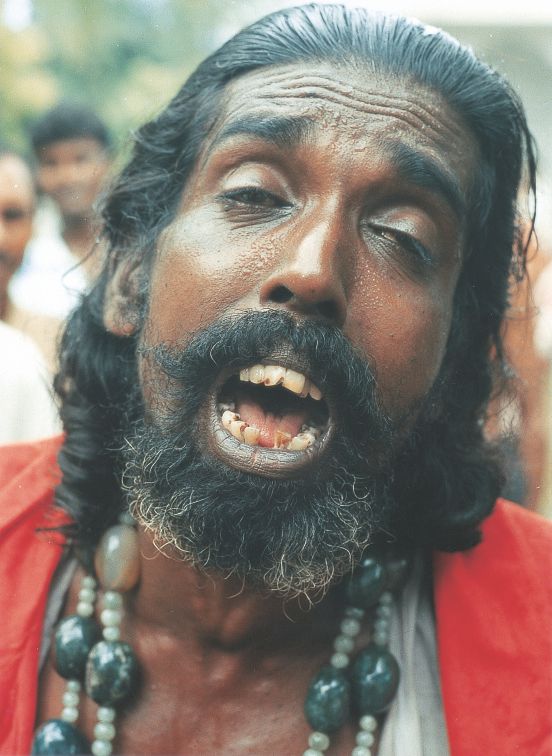
The earliest known uses of the word ‘Baul’ date from the fifteenth and sixteenth centuries, and it can be roughly translated as ‘ecstatic,’ i.e. ‘a person who has periods of intense trancelike joy.’ From circa 1700 it refers to our familiar ‘folk religion’ and its votaries. Since then there have been at least 40 Baul masters and many more anonymous composers of Baul songs. Middle Bengal, comprising the districts of Nadia, Kushtia and Jessore, has been particularly congenial to the Bauls, but they can in fact be found wherever Bengali is spoken. Half a century ago Upendranath Bhattacharya, who wrote a magisterial study of the Bauls to accompany his lovingly compiled anthology of Baul lyrics, expressed the fear that in twenty-five years there might not be any Bauls left. Happily, the fear has turned out to be unfounded.
Drawn from the lower orders of both the Hindu and Muslim communities of Bengal, the Bauls have opted out of society; and many lead a wandering minstrel’s existence, subsisting on alms. In one of their songs, which are the sole expression of their philosophy, Rabindranath Tagore found ‘a religion expression that was neither grossly concrete . . . nor metaphysical in its rarefied transcendentalism. At the same time it was alive with an emotional sincerity. It spoke of an intense yearning of the heart for the divine which is in man and not in the temple, or scriptures, images and symbols(The Religion of Man). Driven by what may be described as a Gnostic urge, Tagore felt drawn to the ‘folk religion’ of the Bauls, and even identified with them. Edward Dimock has celebrated Tagore as the ‘Greatest of the Bauls of Bengal,’ an appellation that is not 100 percent accurate. In fact, Tagore was instrumental in promoting what detractors might call the cult of the Baul. The intelligentsia, looking for the living roots of an emerging national consciousness, had found them in the Bauls. Tagore then portrayed the Baul in the highly idealized form of the lonely seeker after enlightenment, divorced from any socio-historical context, a romantic figure in his patched flowing robe, between blue sky and green earth, twanging his one-stringed ektara fashioned of gourd and bamboo splints, as he sings his passionate melodies.

Contemporary scholars like Jeanne Openshaw, who combine textual research with anthropological field-work, have tried to emend Tagore’s perspective. The Bauls are not a homogeneous group, but combine Hindu and Buddhist Tantricism, Vaishnavite devotionalism, and Sufism in varying proportions. Nor are they all mendicants. Tagore describes them as questors for what he translates as ‘the Man of the Heart,’ and interprets as the divine spark in the individual. A more accurate translation would be ‘Innermost one.’ The phrase is often used to mean a lover, and in the case of the Bauls the partner with whom the Tantric erotic rites are performed.
Unsurprisingly, Tagore, who admitted to having been shaped intellectually and morally by the Victorian age, cannot bring himself to talk about these practices. ‘These Bauls have a philosophy, which they call the philosophy of the body,’ he acknowledges; ‘but they keep it secret; it is only for the initiated.’ Actually, it has, at least in its essentials, long been an open secret.
According to the logic followed by the Bauls, the status of the transcendental world of divine beings is conjectural; this world and the human body, by contrast, are certainties. Therefore it is wisest to seek the ultimate spirit in the body, where it must reside. This is achieved through the union of man and woman, who are complementary and whose bodies are microcosms containing all that there is. ‘Whatever is there in the cosmos can be found in the human body,’ goes a Baul song. ‘Know yourself and you will know the universe,’ goes another. An elaborate system of correspondences illustrates the connection. The human body has an outer form, which is male or female (depending on the proportions of the male and female principles, rather like the Jungian anima and animus, in a person); within the body is the human essence, which may be represented by any deity, depending on the particular Baul’s orientation.

The form of Tantric Buddhism that has influenced the Bauls is the little-known sahaja yana (or simple vehicle), which is peculiar to Bengal. According to this school the ultimate truth is the experience of the simple yet supreme joy which is the essence of the universe, and which male and female attain through union resulting in a calm mood in which the ego vanishes, the self is transcended, and one’s senses are eclipsed. Such simple joy is nirvana.
According to Tantric physiology, there are three subtle channels named after three rivers running down the spine and uniting in the lowest chakra. The supreme soul resides in the highest chakra and its physical manifestation is the sperm or seed. The female principle is manifested in the menstrual flow. The former is calm, its essence is love; the latter is fiery and creative, its essence is sexual energy. During the menstrual period, when, according to one song, the tide rises in the river of life, it is time to catch fish, a homely metaphor for the sought-after joy. Bauls describe the time of the menstrual flow as the darkest moonless night, whose essence is lust. But this is also when the full moon of love’s essence appears. The conjunction of darkness and brilliance is the indispensable condition for the devotional rites. The male and female essences mingle; then they are separated in a process described as churning, and the male essence is propelled upward to regain its position in the highest chakra. Occasionally the rites include what is curiously described as ‘piercing the four moons,’ i.e. tasting the four elementary substances in the body–urine, excreta, sperm, and menstrual blood–of which the last two are the most important. This seemingly bizarre ritual signifies at one level the ingestion of the basic elements of the physical universe, and at another the breaking of a taboo, an essential aspect of the Baul’s askesis, through which the initiate strives to become a humane, liberated individual, such as Lalon was.
Most scholars believe that Lalon Shah (or Shai) was born in 1774 or thereabouts in a village in present-day Kushtia. His family was Hindu, of the kayastha caste. An only child, Lalon lost his father early and, having already married, had to look after his mother and wife. The three of them could not get along with others of their extended family and so moved to another part of their village, where their neighbours included a number of Bauls. In their company Lalon went on a trip of religious significance. Some say they went to have a ritual bath in the Ganges; others, that they went on a pilgrimage. Wherever it was, on the way back Lalon was stricken with smallpox. The attack was so virulent that Lalon fell unconscious. His companions gave him up for dead and, fearful of contagion, abandoned him by a river. He was found by a Muslim woman who took him home and with the help of her husband nursed him till he recovered. The disease blinded him in one eye and pocked his face.

Lalon returned to his village, only to face ostracism. The village elders as well as his relatives refused to allow him back into their fold for two reasons: because his obsequies had taken place, and because he had taken food and water in the house of a Muslim. This provoked the crucial existential decision of Lalon’s life. He turned his back on the society he was born into, with its inhumane caste rules and rigid ideas of purity and propriety. Henceforth he would belong to no faith or family or caste or clan. Infused with a spirit of renunciation, the only identity he could confidently affirm was that of a human being.
Lalon’s wife would have liked to accompany her husband, but was unable to defy her society. The unhappy woman died within a few years, as did Lalon’s mother. By then Lalon had been initiated by a Baul guru called Siraj Shai and was well ensconced himself in the role of Baul-guru in an akhra (or unorthodox ashram) in the village of Sheuriya in Kushtia district.
Lalon travelled widely and made numerous disciples among Muslims as well as Hindus. He married again, a Muslim woman this time, and lived like a householder. Contrary to popular belief there is no contradiction in this; it is quite possible for one to be a Baul and a householder, as long as one does not become a slave to social mores and prejudices.
By the time of his death in 1890, Lalon’s influence had spread to the Calcutta intelligentsia. Gaganendranath Tagore did the sole portrait of the Baul, in pen and ink. It shows an introspective man with somewhat epicene features. But he could be roused to violent action when occasion demanded. Once a journalist friend of his published a report exposing the iniquities of the zemindars. The zemindar of Shelidah (of Tagore’s family) sent stick-wielding thugs to teach the impertinent fellow a lesson. Lalon, the story goes, mobilised his Bauls and routed the zemindar’s hirelings. Small wonder that Lalon is a hero not only to those with otherworldly inclinations but to pro-subaltern activists as well.
Lalon’s tomb in Sheuriya, just outside Kushtia town, is a place of pilgrimage to his devotees and admirers. A visitor can always expect to find a clutch of Bauls there, singing with full-throated abandon, or smoking marijuana, discussing Baul philosophy, or going through some esoteric ritual. But the most vibrant, carnivalesque time is during the three-day Lalon Mela, or Lalon Fair, which starts every year on 16 October, the Baul-guru’s death anniversary.

Sadly, Mammon has made an incursion into the citadel of Baul culture. In the name of ‘developing’ the place, some local honchos have built a featureless two-storied commercial structure around Lalon’s tomb. Protests by Lalon aficionados (writers, intellectuals, artists and artistes) had no effect.
The idea of a commercial building overlooking Lalon’s tomb is so repugnant to Bauls that a number of them couldn’t bring themselves to participate in the last Lalon Mela. Does it mean that Lalon will eventually be appropriated by shady businessmen? I think not. The way of the Baul has always been marginal to the mainstream of socio-economic life. Bauls will always carve out a secret space for themselves. And they will keep the true spirit of Lalon alive. If one may adapt an image from one of his best-known songs, Lalon will always be a strange bird of passage who can mysteriously fly into our ribcage and touch our hearts with his songs about the trammels of samsara, the bliss of nirvana.
Kaiser Haq is a member of the Jamini editorial board
Whether belted out by a diva like Farida Parveen or croaked by an off-key bathroom singer, Lalon Shah’s (or Shai’s, to be more precise) earthy-mystic lyrics are a living presence in this land. He is the greatest icon of indigenous Bengali culture, and the most celebrated of the Bauls, heterodox advocates of a home-grown libertarian…