
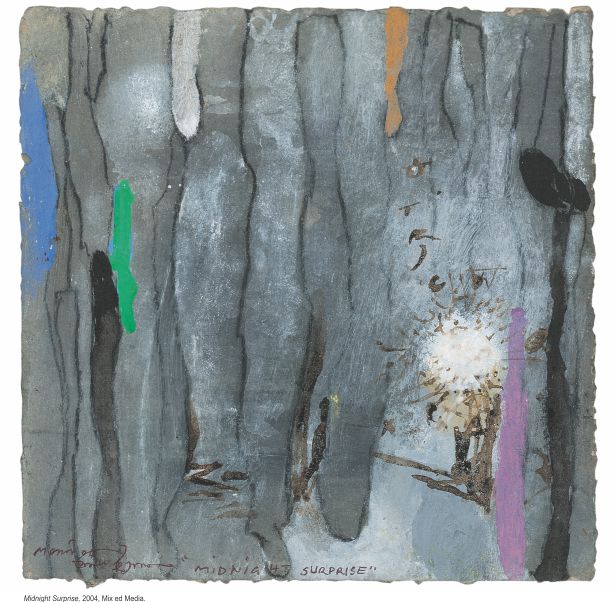
spanning two worlds
Jamini editorial board member Syed Manzoorul Islam recently talked to Monirul Islam in his studio in Dhaka on a range of subjects related to his work.
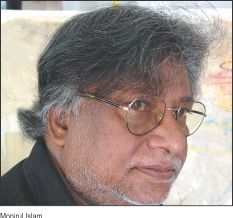
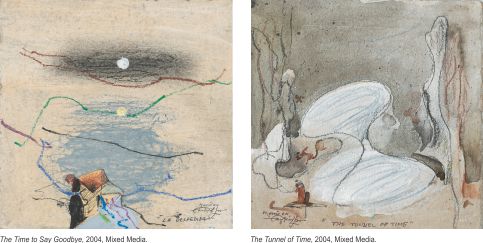
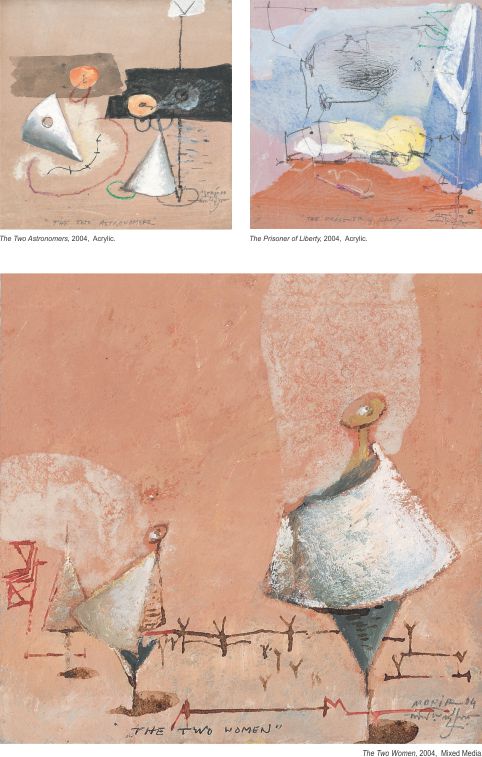
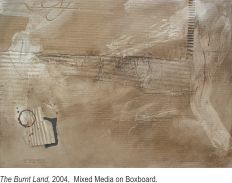
In 1969, when he was 26 and a Lecturer at the College of Art in Dhaka, Monirul Islam went to Spain on a scholarship to study painting. He eventually settled in Madrid. He set up a studio and his work began to appear in exhibitions and galleries in Spain, USA and other countries. In 1977 Monir won a Spanish national grand prize which gave him wider recognition. Over the years, Monir has kept up his association with Bangladesh, visiting it whenever he can, conducting workshops, and exhibiting in galleries here. He is now considered a major artist whose work is distinguished by a sensuous and poetic use of colour, the application of a robust yet resonant line, a lyrical and contemplative use of space, and a rich visual imagination that ranges freely from the abstract to the semi-abstract to the figurative. His oils, watercolours and graphic art employ a pictorial style that bears his distinct signature.
How do you plan—organize—your work?
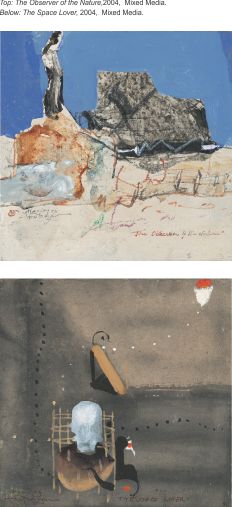
The premise from where I begin is: what I’ve done once is done; it is dead; what I haven’t done yet is what should challenge me. Since my concern is to capture the images that come to me in short, intense flashes—like epiphanies—I can’t start with a ground plan. I do have an idea—a plan, if you will—as to how to put those images onto canvas or paper or copper plate—but I can’t be too focused on details. They work out as the composition progresses. I consider a painting basically as a design, but one that comes together only when I begin to pursue its elements.
The images come from all kinds of sources. Nature. Everyday life. An unusual experience etched in my mind. When I begin to draw them out, however, I feel the urgency to capture them before they swim away. I believe in a daily encounter with art, since each day reveals a new combination and new surprises.
Surprises?
Yes. I want to create art that will surprise me. Without surprises, a work, however technically correct, becomes boring.
You have piles of sketchbooks. Are they
important to know your art?
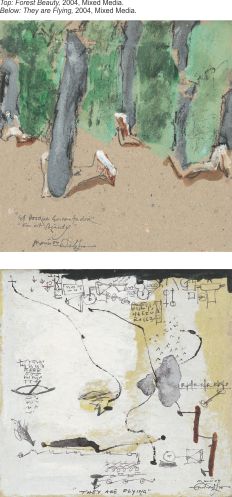
Well, the sketchbook is my way of keeping up the tempo—like the daily practice of a vocalist: when he goes to perform in a full house, he will have to improvise. The sketchbook records the glimpses of images that come to me. The first images, the virgin images. But I don’t transfer them entirely, or even partially, to the canvas. They give me ideas, contours of forms, and they’re of great help when I have a mental block. A fragment, a particular line, a particular thought or an impromptu arrangement sometimes helps me get out of the block. The first image gives me a visualization of an object, an idea; and visualization, as it happens with most artists, leads to line, to form and to colour. But I never self-plagiarize. Each work is a new creation.
Don’t you feel daunted by the prospect of creating new work everyday?
It’s not that I work everyday. I often take time off, do sketches, doodles, see films, and go to the theatre. But when I work, I want different subjects and different treatments. But whatever I do, it ultimately has to look like my work. If I want to make a portrait of my son in the morning, I’ll do it; and then if I want to do a landscape, I’ll do it too. But I don’t want a logotype factory production; at the same time I don’t want to give the impression that I am out there creating a style. Style should evolve from the work. Organically, so to speak.
I also feel the fatigue that comes from using a particular medium for too long. I switch mediums, I play with them. That way I don’t feel the pressure of creating ‘new work.’ What I want instead is a satisfying work, one which will surprise me, challenge me, and will speak to me.
You were known for your watercolurs and oil/acrylic paintings. What made you interested in intaglios?
Before I went to Spain, I had only done one small etching as class work, a dry point. In Spain I learnt how to do fresco, which is quite an expensive and time consuming medium. Besides, not many people patronize it. I then moved towards etching, encouraged and guided by Virgilo Avido, a Philippino artist, with whom I shared a room. He used to do small, colourful etchings on copper plates, which looked exceptional. When I showed my interest in the medium, he asked me to buy a folio-sized zinc plate and do a self-portrait. Avido used to teach at the Applied School of Art in Madrid, where he took me to use its press. There was a professor in the school who was technically very competent. He also helped me pick up the technicalities of printmaking. There I took out my first prints. They came out well. I used to be quite tense before I took a print—I still am—since you don’t know how the lines will turn out and what tricks they might play. It’s like expecting a baby. I wanted to go straight to colour, but Avido told me to go slow. I am glad that I showed patience, since it helped me consolidate my base, and go for innovations. Etching is a controlled, often rude language. It is difficult to bring musical qualities to an etching, but I have tried. When I came up with my own technique of etching several years later, in which I apply wash-like effects that come naturally to a watercolourist, many galleries contacted me to give them my work. It was considered quite a new contribution to graphic art.
Tell us about your first ventures in printmaking.
In 1971, when the Bangladesh war of liberation began, I had to stay back in Spain. I decided to use the time doing more work. I bought larger plates and wanted to expand both my range and my vision. I read about the atrocities committed by the occupation forces in Bangladesh, and I became quite distraught. In that state of mind, I did a series of 12 large images. I was energized by Goya’s work from the ‘black period.’ I had seen his work and the plates he used in the museum. His work inspired me to do the series. I titled it Homage to Bangladesh, and it was shown in an exhibition in Madrid.
How has Spain helped you?
In several ways. For one, Spain has given me the confidence to look at myself. I know that this looking at oneself—this self discovery, if you will—is a continuous process, but one has to start it sooner or later. For another, Spain has encouraged me to search for my roots. Before I went to Spain, I hadn’t seen a single original work of art by a European, or even an Indian artist. Besides, after several years of academic training, we were expected to go for abstraction, on our own, since to be considered a modern artist, one had to do abstract art. But if one is more comfortable with figures, why should he/she be forced to go for abstraction? Why should figurative art be ‘un-modern’? In Spain, I visited museums, studied the works of the masters, sometimes even copied them. But soon I began to look for a style that would reflect my own thoughts, my own visual language, and incorporate my energies and my creativity. I came out of abstraction. An artist friend of mine, who was much older than me, Antonio Lorenzo, helped me in this. He drew my attention to the lively, ornamental and colourful art world of the east. I knew this art—I have been exposed to it from my childhood. I had seen how popular art in Bangladesh uses colour, even strange combinations—grey and yellow for example—for visual impact. I began to examine this art, and saw how it used fantasy, both as a way of escaping the hard realities of life, and for creating a world where images and feelings balance each other without having to go through a visual scrutiny. Fantasy, if its elements are not absurd or grotesque—as in my work—has a pleasing way of creating sympathy in the viewer for the world a work depicts. I remembered seeing such fantasy and endless variety of composition in folk art. Even the rice cakes women make in our villages become lively art works. This is art for everyday living.
Mr. Lorenzo was against using figures in abstraction, and I too saw the point. Abstract art shouldn’t use figures and images since they destroy the harmony of the composition. I started looking for more space and concentrated on line. The image, once it became dominant, gave me a different focus, and a different energy level. When I first went to Spain, I felt like being in the middle of a desert. But gradually I began to appreciate its charms—the clear skies and the ample light, for example—and these somehow found their way into my work. I believe Spain gave me the confidence to do things that I like, and not to be inhibited by a certain style. I feel I belong equally to both worlds, that is to say, Spain and Bangladesh.
In some of your work however we see abstraction and image side by side.
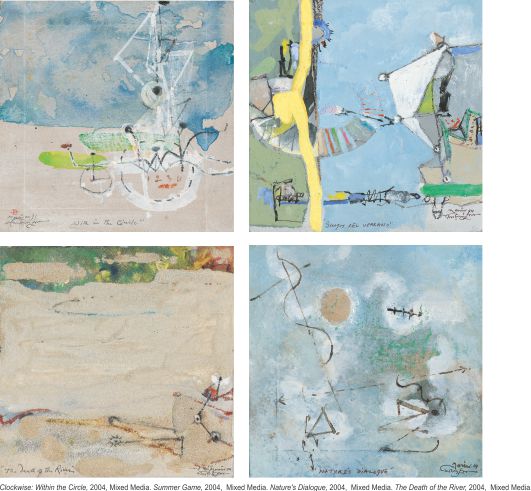
Yes, in some of my abstract works, figures lie in hiding. These figures have a different function though, and are very suggestive. Figures often blend with nature, or mark out a particular landscape feature, so that the focus is not on the figure, but on some aspect of nature, or on the relationship between the world of man and that of nature. Nature still remains a very important part of my work.
How has nature influenced you?
In many ways. My line, for example, which you’ve mentioned as a strong point of my work. I grew up in a small town on the mighty river Meghna. Its shorelines intrigue me. This, and other rivers, fascinate me. The river is a powerful line, it is dynamic and ever changing. I have also studied the masts of country boats that flock on the river year round. The sails of country boats are a feast of colours. The butterfly like sails have very abstract, and often impossible colour combinations. I pick up these colours, and the bewildering array of forms of the boats—and indeed everything around me. I also like light and space. I want viewers to go inside my work and roam around. Nature doesn’t give you a cluttered or closed feeling—it is what we create ourselves. If you look at our abstract paintings closely, you’ll come to appreciate the many different ways nature influences our visual thinking. The base of our abstract art is often heavy. I once asked Muhammad Kibria, one of the finest practitioners of abstract art in our region, why this was so. He told me that this was a reflection of the relation between the sky and the earth. The earth—the base—holds the sky above.
But you also drew city images.
Yes, in Spain I did a series on the city, and it was quite at the other end from my work where nature is a theme. When I lost my scholarship at the beginning of the liberation war, I had to move out to cheaper accommodation in a suburb—in a rat-infested house with a garden but no bathroom or running water. The rats were huge and people loathed them. I had to draw water from a pump—plenty of it, since etching needs water. I lived in that house for five years, and came to realize first hand what it means to live in an enclave of misery in the midst of wealth and prosperity. There I began work on a series on the city and rats play a prominent part in it. The series tells you about the loneliness and the misery of living in an alienated city. The cityscapes were also a bit surrealistic.
You have quite a large audience now and are sought after by art dealers and galleries. Do you feel any pressure to work in any particular style?
No. For one thing, I work continuously, and have a large number of works to choose from for a dealer or a gallery. I also innovate a lot. Sometimes I like to create what I call a gazpacho style—after that famous cold tomato soup of Spain. I believe, if an artist has variation, and is always looking forward—rather than backward—there will be no pressure on him to stick to a particular style, or overproduce in one particular area.
Have you been influenced by any contemporary Spanish artists?
Not influenced, but certainly inspired, by Joan Miró and Antoni Tapies—with their honesty and valor—a Spanish word which doesn’t translate well in English. I have also been energized by younger artists who combine the three qualities admired by the Spanish—individualism, impatience and a bit of anarchy. I too often feel impatient—I want results. I also don’t want any other artists to cast a shadow on my work. And I want my work to break barriers and to upset ‘norms’ that I feel to be restrictive.
How do you look at the challenges that an artist faces now?
Painting is now more intellectual and less emotional than before. There have been great changes in the art world in the last fifty years. New materials have evolved—acrylic, for example, or marble dust, or fibre glass. With new materials have come new images, or image-making power. Installation art, for example, has changed the way we think about art, and the look and structure of images. And then there is the digital image, which is computer generated and has added a new dimension to our sense of virtuality. The art fairs in Spain, until even 2/3 years ago, promoted digital images, which seemed to outshine work done in oil or acrylic. Although the recent trend is once again in favour of ‘serious art,’ digital images have their charm and their following. New figuration is another area that is attracting a great deal of attention in Europe. I can also see that European artists are seeking forms and images beyond their known parameters. The search is taking many of them to other cultures. This is one reason why non-Spanish painters are being reevaluated and appreciated.
Will you do any digital images yourself?
I have a feeling that I will. You see, the prints we create need a surface—canvas, paper, wood, metal plates and you can feel them. These are real. Digital images are done on virtual surfaces, which entail a wholly different approach. It’s difficult, to say the least, but exciting. I’ve been invited to work in this area, to experiment. I’ll take up the invitation, although I know these images will not give me the personal touch, the intimacy of the intaglio and relief process. I’ll do it as an experiment.
Jamini editorial board member Syed Manzoorul Islam recently talked to Monirul Islam in his studio in Dhaka on a range of subjects related to his work. In 1969, when he was 26 and a Lecturer at the College of Art in Dhaka, Monirul Islam went to Spain on a scholarship to study painting. He eventually…