
committed to modernism
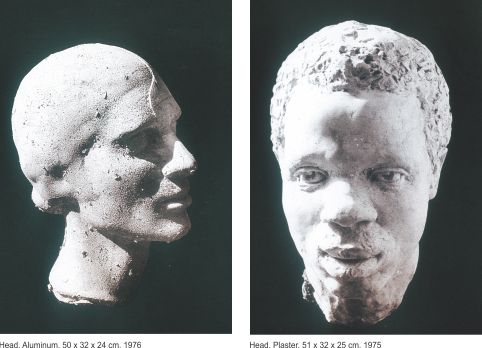
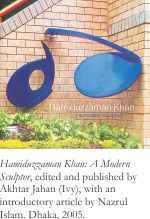
The appearance of this handsomely produced album of reproductions offers us an opportunity to make a critical survey of the career of one of our most prolific and highly regarded artists. I am using the broader term advisedly, for though sculpture does seem to be Hamiduzzaman’s major mode of creative expression, he is a remarkably prolific painter and draughtsman as well, and is game enough, when the opportunity arises, to have a go at such unconventional genres as Installation or Performance Art. Nazrul Islam’s introductory article, though riddled with idiomatic infelicities, is critically informed enough to guide us through the artist’s life and work.
Hamiduzzaman Khan was born in 1946 in a village in Kishoreganj and, after matriculating from the nearby Banagram High School in 1962, enrolled in the Dhaka Art College. He graduated in 1967 with a BFA in Painting and Drawing, going through his Final exams only four months after a serious road accident that caused the loss of a portion of the cranium. He then sailed to the UK for reconstructive surgery at the Edinburgh General Hospital, following which he visited art galleries and museums in London, Paris and Rome, and acquired an interest in sculpture. On his return home in 1969 he began to work on sculpture at the Dhaka Art College, and the following year joined the faculty of the College as a ‘teacher’ in the Sculpture department.
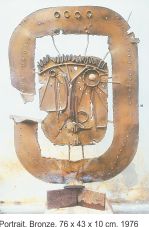
The liberation war of 1971, in course of which Hamduzzaman was once picked up by the Pakistan Army for interrogation, gave him his first major theme. After the war he assisted his teacher, the doyen of Bangladeshi sculptors, Abdur Razzaque, in putting up Jagroto Chowrongi (The Vigilant Crossroads), the sculpture of a young freedom fighter that towers over the Joydebpur crossroads. A two-year stint (1974-76) as a graduate (MFA) student at the University of Baroda honed Hamiduzzaman’s skills, so he could embark on a major series, Remembrance ’71, that occupied him for years. The sculptures and installations in this series are among his finest and most moving achievements. Bronze and wood are the chief materials (with an occasional use of cloth in installations), and these have been used with conspicuous success in arresting the viewer’s eye, forcing him to contemplate the forms and the historical reality they embody.
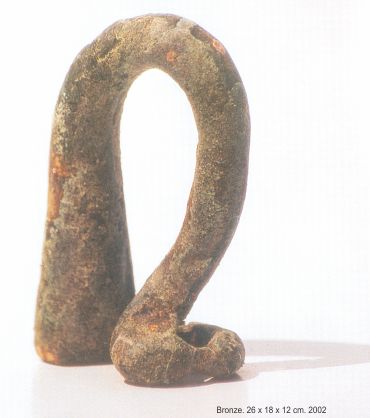
From circa 1990 Hamiduzzaman adopted steel as his main sculptural medium, virtually abandoning bronze. Whatever the reason behind the switch, it was a lamentable choice. Painted, steel gives a mechanical feel; and shiny steel repels the gaze as well as the tactile aspect of the sensibility, making aesthetic contemplation impossible. Some of the steel sculptures, commissioned to embellish buildings, become indistinguishable from them: witness the stainless steel figure slapped onto the Unique Trade Centre on Panthapath in Dhaka. Another recent stainless steel sculpture, ‘Fish,’ at Dhaka’s Farmgate looks like a factory produced object. Among Hamiduzzaman’s works of the past decade and a half, the few bronze pieces he has crafted, small in size though they are, are to this reviewer at least worth more than the large glittering steel creations.
All through his career Hamiduzzaman has been prolific in producing paintings, mainly watercolours, and drawings. It’s interesting to note how they complement the sculpture. Till around 1990 they hang together satisfyingly with the sculpture; but since then their aesthetic impact has had a relationship of contrast to the steel sculptures: his paintings are more hospitable to the aesthetic gaze. Hamiduzzaman’s recent steel creations may have a very modern look, but it’s only a formulaic sort of modernism they manifest. The drawings and watercolours, as from his recent solo (September-October 2005) at Shilpangon, effortlessly blend the modern and the traditional, and show that the creative spirit is still alive in Hamiduzzaman Khan.
Kaiser Haq is member of the Jamini editorial board
The appearance of this handsomely produced album of reproductions offers us an opportunity to make a critical survey of the career of one of our most prolific and highly regarded artists. I am using the broader term advisedly, for though sculpture does seem to be Hamiduzzaman’s major mode of creative expression, he is a remarkably…