
bells on our feet
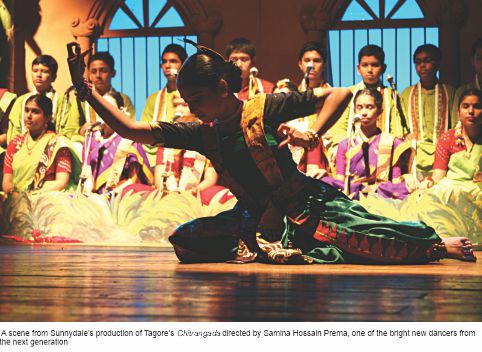
You wouldn’t think that a school production of Tagore’s dance-drama Chitrangada would be a significant event, would you? But, as I sat through the extremely artistic presentation by the students of Sunnydale School on an April day this year and saw a performance choreographed by a young dancer who is a generation younger than us, I was overwhelmed. For years a few of us had been custodians of this fragile art form which just couldn’t seem to find its feet in our country. Not anymore. That day, as I watched, I felt dance in Bangladesh was finally standing on firm ground. My eyes kept welling up as I relived the long circuitous journey of dance and dancers in Dhaka, as I have witnessed it, for these last forty years. Though a story full of grit, hope and despair, it has also been a story of joy, echoing the joyous sound of the bells on our feet
I am told that I always danced. So much so that, starting from the time I was a toddler, my grandfather always called me Marium Bai, bai being short for baiji or dancer, little realizing how prophetic it would be. My first dance teacher was my mother, Sultana Sarwatara. She loves telling us how they were taught dancing while students at Begum Rokeya’s Sakhawat Memorial Girls High School in Calcutta, where they regularly staged dances. They even performed outside the school premises at the Muslim Institute and the Islamia College of Calcutta. This in the early 1940s! At home, in their largely Muslim neighbourhood of Park Circus, there would often be family performances of dance dramas like Shakuntala and Krishanlila. It is not surprising that my mother would encourage her daughter to dance.
Robindranath was always there in our lives, beginning with my first ever dance performance of his song ‘khawro baiyu boy bege’, at age six, taught to me and my sister Naila, by my mother. Fortunately, my paternal family was also very culturally inclined. Our phupu, Nurunnahar Faizunnessa, would often organize cultural shows, mainly at the Azimpur Ladies Club where some older cousins would teach us younger cousins dances based on old Hemonto Mukhopadhay songs such as ‘megh kalo adhar kalo’. But, this wasn’t enough for my mother. So one afternoon she marched us two sisters to the lively little household of Anwara Bahar Chowdhury. Bahar Nani, as we called her, with a few others, had set up BAFA, Bulbul Academy of Fine Arts, to commemorate the memory of the late Bulbul Chowdhury, a dancer from Chittagong who had performed with Uday Shankar’s troupe. Bahar Nani’s daughters, Selina and Bachchu, happily took us under their wings. It was the beginning of the most joyous and, though we didn’t know it, the most definitive phase of our lives.
learning to be avant-garde
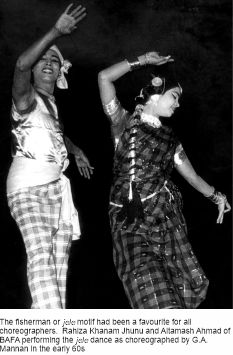
At BAFA we were taught an avant-garde style of dance, which, I now realize, was an eclectic mixture of dance movements which had been introduced, from greater India, into this provincial little city called Dhaka, in the first half of the last century. There was, of course, the influence of Bulbul Chowdhury. On the other hand, there were quite a number of Tagorean productions in Dhaka in the 40s. Much later, I heard from Amita Sen, mother of Amartya Sen, that she had first produced Tagore’s plays in Dhaka when she came to the city from Santiniketan after her marriage in the early 1930s. The building where BAFA was housed used to be the ‘nautch-ghar’ of the Nawabs of Dhaka. So, unwittingly that influence too was there. We had teachers who knew a smattering of this or that dance style. So, we were taught a large repertoire of movements which would be choreographed into dances which we were taught as ‘bharatnatyam’, ‘manipuri’, ‘shapure’, ‘jele’, ‘bawshonto’, ‘kathak’ et al. My first stage performance at the Engineer’s Institute was in a group dance in a dance-drama version of Tagore’s ‘Shawrgo hote bidaye’. The dance we learned was a veritable potpourri of styles.
Looking back, I realize now that the movements vaguely incorporated the ethos of each style. But let me not belittle the sheer delight of learning to move in rhythm – to jump and to pirouette, to extend and contract your body to express each nuance of your soul. It gave us wings which no one would ever be able to clip. I wish every child could be taught to dance and summarily throw all inhibitions to the winds.
But there was no genuine tradition behind our dances. Even as a child it left within me a yearning for ‘origins’. Those were years of a culturally repressive regime. At the same time a lot was happening in India. Traditions were being revived. Rukmini Devi was setting up Kalakshetra in Chennai, while Vallathol was establishing the Kalamandalam in Kerala. We knew nothing of all this. For us in Dhaka we didn’t have a tradition of dance which we could go back to. Both the Bengals had by that time lost whatever classical form of dancing they ever had. Folk forms were also very rudimentary. We were our own resource. Perforce, we learnt to create. Years later I learnt formalized dancing. Do I wish it was the other way round? Yes, but I value those formative years too. I know now that the arts need strict nurturing. Left to me I would, however, incorporate a bit of the freedom to express that we grew up with.
Rahiza Khanam Jhunu and Dulal Talukdar were my first dance teachers in BAFA. They were students of G.A.Mannan. Dalia Nilufar and Altamash Ahmad were two of his other students. Mannan Bhai had left BAFA and formed his own school, Nikkon by the time I joined the institution. An extremely creative dancer, he had left a repertoire of dances which not just BAFA, but almost all the dancers in Dhaka, danced for many years ‘Rhythm and Melody’, ‘Holi’, ‘Spring’, ‘Fan Dance’, the dance-drama ‘Nokshikathar Math’ and even a ‘Manipuri’ dance. The other dance school we heard much of was the Jago Art Center run by Gaohar Jamil and his wife Roushan Jamil. The style of dancing there too was much the same, with but a bit more of the folk flavor and a touch of glitz. I had the opportunity to work with Gaohar Da from 1977 onwards till his unfortunate death in a road accident. He was the epitome of the spirit of ‘joie de vivre’ in the arts.
When Chayanaut, the music school, was formed there was no dance department. Dance, as it was in Dhaka in those years, was considered not refined enough for the founders of Chayanaut. I do not think they realized the importance of the fact that just allowing Muslim girls to dance was reason enough to promote it. Tagore, on the other hand, was open to any form of dance being incorporated into his productions. He realized what a significant role dance could play in cultural education.
a touch of tagore
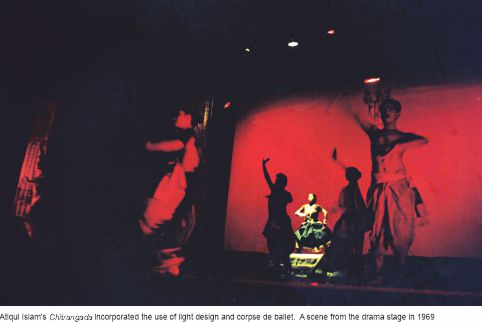
In the later half of the sixties, Atiqul Islam brought about a sea change in BAFA. He had been studying in Santiniketan and it was whispered that he had been a favorite student of the, even then, legendary singer Kanika Bandopadhyaya. Later he had studied choreography at East-West University in Hawaii. Besides instilling in us the entirely new concepts of ‘space and void’, ‘light and dark’, ‘stage and audience’, he brought with him a professionalism that I continue to value till date. For the first time we were taught the ‘theory of dance’. It opened a world of thought and query which has today led me into the study of the Sanskrit shilpashastras and the study of aesthetics. Atiq Bhai’s passion was Tagore. From 1967 onwards BAFA staged, one by one, almost all the dance-dramas of Tagore. Laila Hassan, Kajol Ibrahim, Zeenat Barkatullah, and Dalia Salahuddin were the stars and we were happily the corps de ballet. I can sing each of Tagore’s play verbatim from beginning to end with Atiq Bhai’s voice resonating in my heart all the time. Of course we also performed Nazrul and two very innovative dance-dramas, Hajar Tarer Bina and Raj Pawth Jawnopawth by Dr.Enamul Haque.
In 1968 my mother took us two sisters to Calcutta and from there to Santiniketan. We had letters of introduction from Atiq Bhai. Shantideb Ghosh welcomed us warmly. It was the holiday season and we were escorted through an empty asrama by Montu Da, Shantideb’s brother. Fortunately, the young Jitendra Singh, Visva-Bharati’s Manipuri dance teacher and dear old Kelu Nayyar, the renowned Kathakali dancer, were both in residence. I remember how both of them lovingly introduced me to these two styles of dance. Generously, they tried to teach me a few steps. I can still remember the sound of the stick beating on the floor in the dance class of the Sangit Bhavana as Kelu Da took me through the different steps of the ‘sari’ dance. Suddenly, I found myself. So, dance, I began thinking, does have a beginning. It started me on my own search.
the spirit of resistance
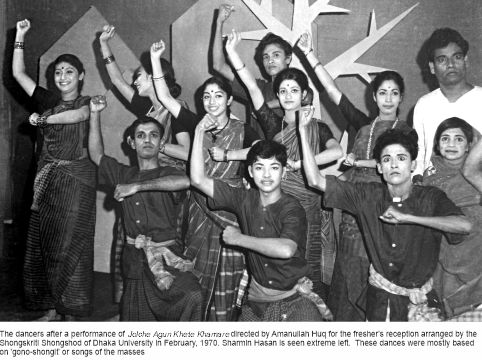
We must not forget that those were the years which saw the rise of Bengali nationalism. In 1969 Naila joined college which was a bit less restrictive than school. Our cousins in Dhaka University were very much part of the ongoing resistance movement. We were introduced by them to the culture of ‘gono-shongeet’, songs of the masses. While the singers sang the songs of resistance, we created dances to go with songs such as ‘Biplobero rawkte ranga jhanda orde akashe’. While in school we were invited to participate in shows by the Shongskriti Shongshod of the Students Union of Dhaka University. Sharmin Hassan was a senior student in the University then. She had learnt dancing in Calcutta from Prohlad Das. She used to choreograph most of these dances. Stages used to be constructed in the premises of Bangla Academy. We learnt at this time that art could be a tool in cultural politics.
At about this time Amanul Huq returned from Karachi after training with the Ghanashyams in Karachi. Ghanashyam Anjana was one of the first student at he cultural centre in Almora, setup by Uday Shankar.
new linkages
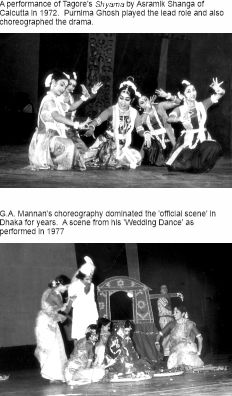
With the birth of Bangladesh in 1971, a whole new horizon opened up for us dancers. In 1971 I was introduced, by Kanika Bandhapadhya, to the Asramik Sangha, the alumni association of Visva Bharati. I was awed by Asramik Sangha’s principal choreographer and dancer Purnima Ghosh. For the first time in my life I saw dance performed in the way my heart had imagined it to be. Purnima Ghosh was the daughter of a Manipuri dancer but had trained in Bharatnatyam. Her husband Mihir Ghosh was a Kathakali dancer. In her there was an easy amalgamation of these styles.
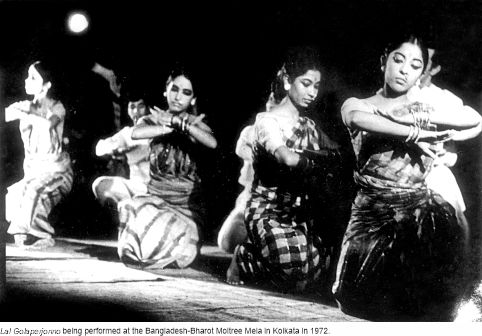
Because of the war, it wasn’t possible for me to dance with Asramik Sangha. But after independence, from 1972 to 1983, Khemendra Sen son of Kshitimohon Sen and convenor of the Sangha, invited me to participate in their yearly Festival of Tagore dance-dramas every year. Purnima Ghosh was our guru.
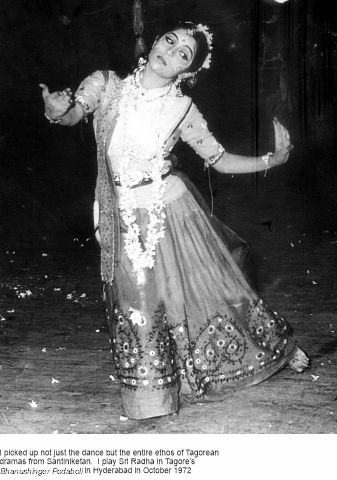
In October, 1972 I travelled with a troupe from Santiniketan to Hyderabad under the leadership of Nilima Sen, one of the finest exponents of Tagore songs. There we performed ‘Shyama’ and ‘Bhanushingher Podaboli’. Jitendra Singh choreographed the dances. It was only natural that I brought the dance style of Santiniketan to Dhaka. Atiqul Islam was overjoyed. He let me choreograph for the first time. Today, I realize how difficult it must have been for him to work with amateur dancers. His death was a great personal loss. My one regret is that he never got to work with us after we had learnt formal dancing.
During my visits to Calcutta I spent a lot of time at the Tagorean scholar Abu Sayeed Ayyub’s house. He was like a grandfather to us and never the formidable intellectual that many thought him to be. He first introduced me to Tagore scholarsip, first with his own books and then with a number of in-depth discussions about Tagore’s works. I started reading his essays on art, literature and philosophy. Through their reading another door of knowledge opened and I came to know about Indian philosophy and the Upanishads. I started asking myself, what is it that we do when we sing and dance? What is art?
In 1973 I travelled to South India with my friend Sayeeda Rahman. We had heard all about Kalakshetra in Madras and Kalamandalam in Cheruthuruthy in Kerala and decided to take a precarious bus ride to the little village of Cheruthuruthy. Totally overawed, we sat through an all-night performance of Kathakali danced under kerosene gas lanterns. Could dance really be this enthralling?
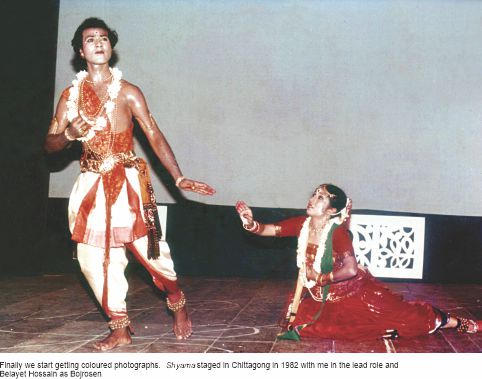
In 1975 I gave up formal studies to enter a dance program in Kalakshetra under the aegis of the Indian Council for Cultural Relations (ICCR). For the first time I learnt how rigorous dance training could be. Unfortunately, personal constraints didn’t allow me to continue for more than a year. But by that time a number of young dancers were studying with various gurus in all parts of India courtesy the ICCR – Shibli Mohammad with Birju Maharaj, Shukla Sarkar and Sharmila Bandopadhyaya at Visva-Bharati, Anisul Islam with Leela Samson, Belayet Hossain at Baroda under Chandrashekhar and many more. Each of them has done path-breaking work in the teaching of dance.
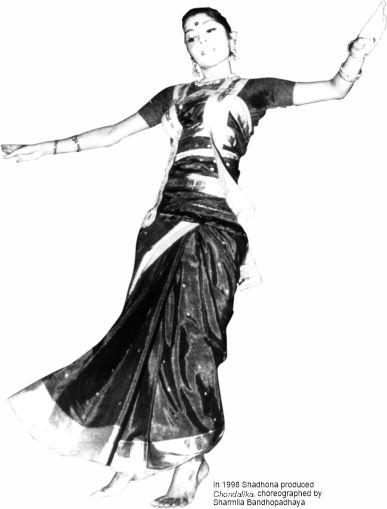
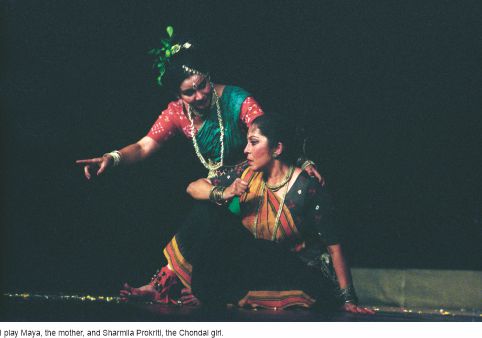
Shantibala Sinha, the foremost disciple of the Manipuri Guru Bipin Singh, settled in Dhaka after her marriage to Monihar Singh of Sylhet. ‘Chayanaut’ finally opened a dance department. I trained for a few years with Shanti Sinha. Chayanaut commissioned me and Sharmila to choreograph first Mayar Khela and then Shyama. I realized Sharmila had a special spark in her and I continue to believe that she is the finest choreographer of Tagorean dance-dramas in both Bengals. When in 1984 I formed Shadhona, which we call a Center for Promotion of South Asian Dance and Music, I requested her to choreograph first Chondalika and then Chitrangada.
Shadhona has also staged many recitals and workshops by leading dancers of India. Having missed out on any sort of exposure to the various classical dance styles of India in my own formative years, I did my best to ensure that our children would not be deprived of the opportunity of at least seeing the exciting dance forms of our region.
all set to take off
It heartens one to see today the number of young dancers who are skilled in the various dance forms of India. They are far better dancers than we ever were. Yet there is missing in dance forums of Dhaka the vitality of the theatre groups. Dancers are more trained and skilled than most theatre performers in Dhaka. Unfortunately, their glitz and the glamour tend to overshadow their skills. Theatre in Bangladesh has always been progressive in character and has championed liberal values. Also, theatre has gone full circle by being able to incorporate indigenous forms of narrative theatre into its contemporary format. This has given it a Bangladeshi identity. Dance in Dhaka, however, still needs to find a form of its own.
Of course, through the years, a number of dance-dramas based on folk tales have been produced in Bangladesh. Unfortunately, they have not been able to display the authenticity of indigenous folk theatrical forms. The tendency still is towards a glamorized and urban genre based on folk motifs. The glamour of the world of dance, specially the glamour of the small screen, is one of the major obstacles. Instead of veering toward theatre, the tendency is to go from dance to a glamorous career in modeling. I found a recent production of Behular Bhashan by Syed Jamil Ahmed, which used a lot of dance movements, very inspiring. The insights of the theatre movement in Bangladesh can show the path to our young dancers.
Robindronritto, or the Tagorean style of dance, is easily one of the forms that Bangladeshis can adapt as its own. Though based on formal classical styles it incorporates all forms within its aesthetic parameters. It is also devoid of the overt religiosity of most Indian classical dances.
Sunnydale’s Chitrangada is one of this form of dance now practiced in Dhaka. The choreographer displayed a fine sense of awareness and appreciation of the need for a harmonious presentation. But in addition to the skills on display, I saw a lot of love in that performance. If nothing else, somewhere down the line we must have done something right to have been able to instill this love in our young dancers. I have been the severest critic of dance in Bangladesh and have often despaired and wondered if dance would ever flourish in Dhaka. That night I sat back and enjoyed the performance knowing that our bells were now on more competent feet. Yes, dance in Bangladesh is all set to take off.
Lubna Mariumis a leading exponent of classical dance in Bangladesh
You wouldn’t think that a school production of Tagore’s dance-drama Chitrangada would be a significant event, would you? But, as I sat through the extremely artistic presentation by the students of Sunnydale School on an April day this year and saw a performance choreographed by a young dancer who is a generation younger than us,…