

the bold and the beautiful
A take on Dhaka’s most recent exhibitions – French photographer’s against-the-grain perspective on the beauty of unkempt city, the celebration of the traditional metal-casting art of Dhamrai and the diametrically different styles of two women artists, Rokeya Sultana and Laila Sharmeen
dhaka deconstructed
Bruno Ruhf’s eye is set on things that are all too familiar to Dhakaites, things that seem devoid of beauty at first glance. But Bruno feels that there is beauty in everything; what one needs is an eye for them. His oeuvre consists of the unavoidable encounters with an array of subjects that most Bangladeshi photographers would feel a tad uneasy to record for posterity. He photographs everything from garbage piles to the scaffoldings of under-constructed buildings, from roofs of shanties to shop windows that look like disaster zones rather than wholesalers displaying their goods.
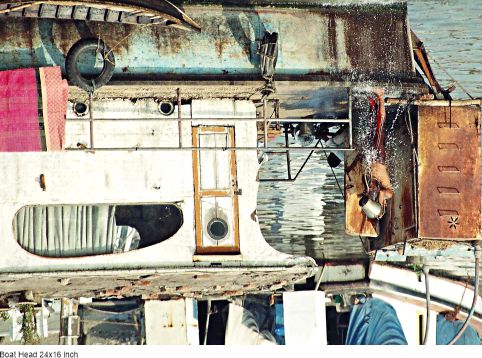
Bruno aptly calls his exhibition ‘Dhaka Upside Down.’ As the photographer himself testifies, he had not meant the photographs to reveal the uglier side of Dhaka. Rather, he had been out to discover the beauty of unkempt, unassuming Dhaka that many tend to avoid because of the sole reason that the photographs would not turn out to be palatable.
If the exhibition that ran at La Galerie, Alliance Francaise, Dhaka, from April 27 to May 9, is any guide, most of the takes on Dhaka are very likeable. The most engaging image turns out to be under-construction buildings covered with jute hessian. In two of the photographs that tackle the same subject the photographer resorts to computer graphics to doctor his images. In the photograph titled ‘Triple Caterpillars’ one photographed image is repeated thrice to make the building look elongated. In ‘Double Caterpillars’ it is repeated once. In every caterpillar picture one side mirrors the other to make it look like a double headed insect. To accentuate his subject the photographer has cropped off the background. The same ploy could have made a lot of difference in the series of tin-roofed shanties that Bruno captured and displayed up-side-down.
Most of the up-side-down images play havoc with our general sense of perspective. The object of such a ploy is unclear. Bruno says that ‘they look interesting this way.’ However, in each of the up-side-down pieces he is unwilling to make the pictures lose their context. If in the ‘Caterpillar’ pictures he has taken away the surrounding to make the images look like an abstract composition, in the series of roofs of shanties he eschews such a ploy, perhaps not to lose sight of the reality they are a part of. Bruno captures the whole perspective where even the palm trees that enter the frame from the sides play a part in the composition. It is the presence of the palms that anchor the pictures in reality and gives them the feeling of the here and now.

Among the photographs that depict the roof-top views, the most interesting is the one that captures the roof of an under-constructed building. Bruno zeroes in on an opening on the roof that shows the bamboo scaffolding inside and calls it ‘Green Head’ because of the greenish hue of the newly laid out cement of the roof.
Pascal Jenovjak, the erstwhile deputy director of the Alliance Francaise, Dhaka, wrote in the preface of the catalogue that Bruno successfully sets the objects free from their utilitarian characteristics. Yes, he sees objects as pure forms as do most formalists. However, what separates him from the regular formalist is his directness. Unlike the usual formalists, who stress the play of light and shade or any other abstract quality that render recognisable realities into highly aestheticised images, Bruno shows things as they are. He basks in the pleasure of the depiction of every detail. His is an aesthetic that is based on the eagerness to get down to depicting the reality in all its true colours and textures. His aim is to look for beauty in gritty reality, and the show ‘Dhaka Upside Down’ provides ample examples of such honest exposes.
metal mania
The art of metal-casting is a dying tradition. To keep it alive an organisation named ‘Intiative for Preservation of Dhamrai Metal-casting’ (IPDM) has been making an all out effort since its inception in the new millennium. From May 24 to June 2 the Bengal Gallery of Fine Art showcased the traditional metal-craft made by the artisans of the IPDM. It was an exhibition which brought the fruits of their labour to a newer front where an unsuspecting brand of connoisseurs had the chance to wake up to the presence of a vast treasure trove. It also made one thing clear: the IPDM artisans are out to reclaim a tradition that Dhamrai stood for in the past.
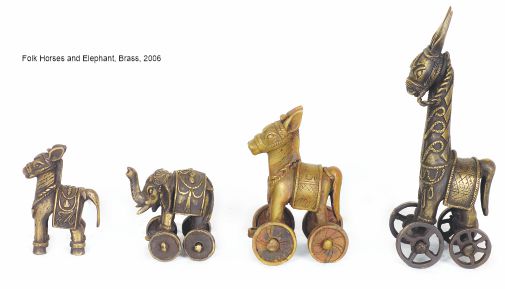
The ten-day-long exhibition titled ‘A Splendid Tradition: Exhibition of Dhamrai Metal-craft’ was not only an occasion to celebrate a long-standing form of art but also a means to make inroads into the non-traditional market. The traditional users of brass crafts have unimaginably dwindled in number as cheaper and lighter material like aluminum and plastic have replaced them. The use of brass too has seen a drastic decline and as consumers have swiftly turned to new materials, the number of craftsmen too have plummeted. In the past, everything from house-hold utensils and crockery to religious deities, had to be made of brass. Today, even the most traditional Hindu family has ceased to use brass crockery. But it is not only crockery for which Dhamrai used to be a traditional hub; the hand-cast Hindu and Buddhist deities made here was also famous. There was a huge demand for these deities across the nation in the past. ‘It is the village people who used to be the traditional buyers. Now, with the skyrocketing price of raw material, Dhamrai metal-crafts have become a luxury for the village people. Today, very few among the traditional users are able to buy them,’ says Shukanto Banik, the man at the helm of IPDM.
IPDM’s strategy has been to generate interest among non-traditional buyers, who are willing to consider their crafts as art works. Alongside the revival of a lost tradition, the IPDM is trying to rope in a new category of buyers, those who would buy metal-craft not as users but as collectors.
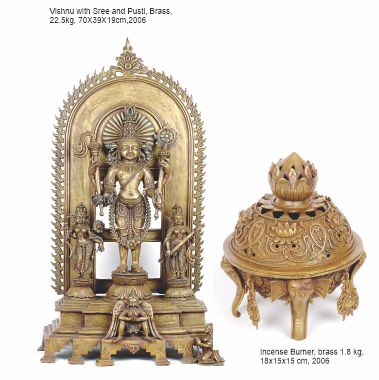
The vigorous display of the Dhamrai metal crafts at the Bengal Gallery of Fine Arts made a strong case for this art form. The lost wax method that IPDM is trying to revive has a history that goes back to the Pala dynasty. According to Shukanto Banik, they are trying to revive a tradition that was on its way to extinction. It was Shukanto who took the initiative to bring a number of artisans under his aegis. Although he belongs to a family which has been engaged in making metal craft for five generations, young Shukanto had to witness the waning of the tradition of his forefathers. With most artisans gone, he literally had to start from scratch. He went from door-to- door to look for artisans. Shukanto realised that the market for metal-crockery was no longer there and if he and his artisans were to survive they would have to make collectable items. Shukanto reoriented his craft by introducing a whole new set of designs.
The beauty of Dhamrai metal-craft lies in the fact that each piece is a unique creation from a single mould. ‘There is no such thing as a master mould from which several replicas are usually made, and the pieces never get repeated,’ says Shukanto.
The IPDM team now stands at 21, among which three are women. Ahmed Ali and Nimai Pal are the two artisans who head the group that is engaged in making crafts using the lost wax method. Manik Sarkar and his wife Bokul head the group that uses the hammering method.

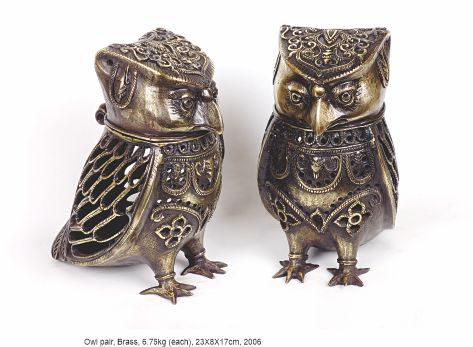
Ornate bowls, both large and small, and ornate serving dishes are the items that are made using the hammering method. Most deities, which bear clear sign of sculpting, are made using the lost wax method. In fact, it is this second category crafts that made the IPDM show so enjoyable. The series of sculptures that depicted Hindu gods and goddesses — Nataraj, Ummah, Krishna, and the ones that depicted Buddha are the pieces that provided the most delight. These are all intricately ornate sculptures. While some bear sparkling golden yellow, the color of brass some are made to look like antics. These antic-looking works, with their subdued colours, emanate a majestic aura that enhance the pleasure of looking.
In a number of pieces, the IPDM artisans tried to break newer grounds. Their most bold and ambitious work was the elaborate chessboard, where the chess pieces were carefully crafted sculptures.
The IPDM programme to save the hand-casting tradition of Dhamrai jump-started after it received the Ambassador’s Cultural Fund from the US mission in Bangladesh in 2003. Now it aspires to become a fully-fledged industry with the capacity for growth and expansion. IPDM is the last bastion of the tradition of Dhamrai metal-craft. It has also been the subject of a documentary made by the US mission. The video strove to promote this artistic tradition that goes back more than 2000 years. What remains to be seen is whether the IPDM, with the help of other organisations that are willing to lend a hand in saving this long-standing tradition will be successful in creating a new market for their crafts.
mythic mind games
Ronni, a young artist with a penchant for expressing himself in hyperboles, addresses paradox and other psychological realities through his norm-defying art. He resorts to the total denuding of the unconscious to reveal a netherworld populated by hybrids. It is through depictions of the conditions of these hybrids and their series of actions that Ronny challenges the perception of viewers.
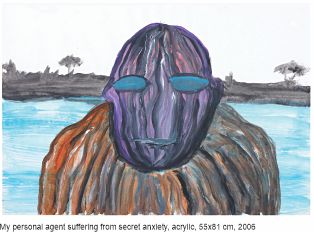
It is the wired juxtaposition of things that makes his world intellectually engaging. In one work, four mutant-like figures have turtles as their faces; in another, a burning candle takes the shape of an haggardly old man; in yet another work, a group of mutants, whose body structures imitate the steps of the stairs they are ascending, are known by their national emblem, which is the chilly. With each work, where there is something unusual going on, Ronni Ahmmed takes a stride towards an absurd conclusion. He brings into existence tales that defy logic, laws and ideologies of the world he himself lives in. In fact, the world that the artist strives to create is one tangentially related to the “real world”, if there is such a thing. In fact Ronni’s work calls into question this very idea of living in a world that is knowable as well as definable. Viewing the latest works of the artist in his 4th solo exhibition one realises that these fantastic images bring us closer to the realisation that reality itself is a very complex proposition and is, in most part, hinged on irrationality, no matter how hard we try to define it or reshape it according to human logic. Moreover the way we perceive our immediate realities leave us with no choice but to bring into play our imagination.
It is through his imagination that Ronni creates a world marked by hyperbole. In his work creatures create myths, engage themselves in technological endeavours, compete with each other in pursuit of unknown goals, and even inflict pain on each other without much consequence. Indeed, in this bizarre world all actions are futile and have no fruitful ends. The mutants, at times bestial and occasionally sharing a passing resemblance to humans, are engaged in absurd exercises and are utterly oblivious of the consequences that they might have. It is this sense of futility that the artist brings to bear on every aspect that he depicts of his strange parallel civilisation. Ronni’s world can at best be summed up as a cutting parody of the world we live in.
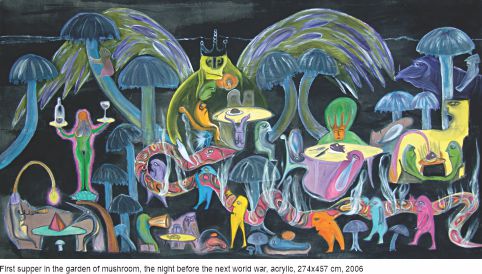
‘I want to pinpoint the main political ball games rather than what happens on the surface-level. One can depict Iaxraqis dying at the hands of the Americans in Iraq but that would amount to depicting surface-level politics. What I want to allude to is the knowledge and ideologies that are being invested in the actions of the multinational companies. That is why I deliberately strike at the centre of knowledge and try to find an alternative to the usual way of thinking,’ says Ronny throwing light on his own reasons behind his irrational creations. Preferring to raise questions about how reality and its interpretations are being thoroughly manipulated by the people at the helm, he avoids making straightforward political comments through his works. It is because of this very reason that he chooses to express himself in absurdist terms.
Ronny calls his recent show, ‘Tales of Pseudo Myth’ and in it he brings together a flurry of images, both small and big, that cross the boundary of rationality to bring to the fore the anarchy that rules over international politics as well as the private domain of the individual.
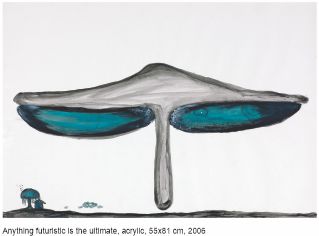
Nothing is sacred in Ronni’s world. All characters and their actions tellingly transcribe an exhaustively dehumanised condition that has been prevalent for very long, or so it seems after surveying most of the images. The epic dimension that the artist is able to infuse in all his pseudo-myths makes for engaging viewing. The huge canvas of the ‘Meeting of the Multinational,’ or the medium-sized ‘The Man Who Can Celebrate His Own Death According to the Lemon Clock,’ are overpeopled and chaotic images that have a mythic dimension. They are also a testimony to the futility of technological advancement. These are expressive canvases, where the mutants are married to devices born out of a strange science.
Ronni resorts to minimisation of elements when it comes to probing deep into the unconscious. However, his linguistic note remains high-strung as it is intellectually loaded in many a complex visual proposition. Characteristically, he sticks to long- winded and absurdist titles. In this particular show, through many a charcoal drawing, the artist takes swipes at the unimaginable and incomprehensible. For instance, the ‘The Supernatural Family Showing Respect to their Natural Neighbour,’ where circular heads are connected with a cord, or ‘Funeral of a Perfect Infant who Never Wrote a Letter to Plato,’ are works where he is abstruse but highly enjoyable.

His take on the human condition also has an absurdist tilt. In ‘Three Exclusive Specialist Discussing Absolutely Nothing’ three monolithic structures topped with human heads come together to discuss nothing. Paintings of similar strain abounded in this show. A poignant but absurdist theme is the work titled ‘The Largest Stone Had an Intimate Pet’, where a strange animal with its tentacle up stands resolutely beside a black stub of a stone. With these kinds of works the artist simply challenges our perception.
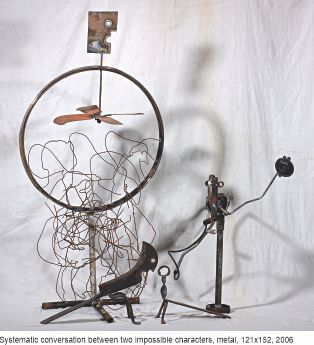
To design this exhibition, other than displaying works that were done on canvases with acrylic and a plethora of charcoal drawings on papers, Ronni brought together a number of sculptures. They compliment his prominent motifs on two dimensional surfaces. In fact, the most ingenious sculptural motifs were those that the artist concocted by altering the indigenous ‘da’, ‘curani’ and ‘sarta’ into mutants; the former is the traditional kitchen cutter and the latter are used in procuring coconut shavings and cutting betel nut respectively.
‘Tales of Pseudo Myth’ does what the artist intends to do–leave the uninitiated perplexed and the initiated with a strong sense of joy. The sheer power of creativity of this thirty-plus artist has overshadowed whatever borrowing that has enriched his vocabulary. If Max Ernst or Salvador Dali, the two major exponents of European surrealism, provided him with a springboard for his forays in the last ten years, it is also true that Ronni has built on the principles of surrealism by annexing a new world to the old one, a world that is undoubtedly his own. In this show he has even devised a script, which no one would be able to read, but which strives to provide a means (only on the conceptual level) to narrate the goings on of his strange world.

symbiosis of nature and women
Print making is an egalitarian medium. As numerous prints can be rolled out from a single plate, it enables artists to reach more people. However, in Bangladesh its practice is not wide-spread. There are only a few artists who have been steadfast in their effort to make it popular. Among them Rokeya Sultana stands out. Within the span of the last twenty years or so, she has gone through an artistic journey that has been unfailingly recorded in her etchings. Her 9th solo exhibition titled ‘Crafted out of Scattered Leaves’ that ran from 13 to 26 April at La Galerie, Alliance Francaise, Dhaka, was an occasion to survey the yields of two decades of work in this medium.
Standing in front of works that are mostly etching-aquatint prints one realises that Rokeya hinges her artistic ideas upon two major concerns, — one is appearance and the other spirit. If nature has provided her with an unending source of inspiration it is through juxtaposition of animal as well as human forms that she has synchronized her thoughts. To represent them fully, she brought together works from all periods of her work , starting from her student years at Santiniketan to recent times.
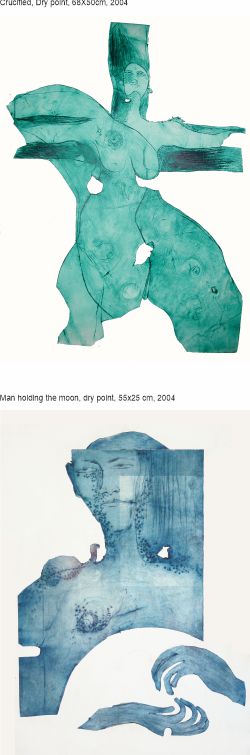
Though she is recognised primarily for her human forms, which are mostly of women, in her early composition nature had played a central role. An etching that dates back to her student years in the early 1980s testifies to her attachment to nature. The work titled ‘Composition,’ encapsulates a certain suffusion of feelings triggered by the experience of being amidst nature. It is a gem, if only in the sense that it evinced early on her tendency to dematerialize reality, a tendency which would stay with the artist for the rest of her life.
Even with human forms Rokeya demonstrates a certain kind of fluidity that is born out of this tendency to dematerialise the present.
If her early works as a student at Visva Bharati thrived solely on nature’s energy, the next phase revolved around a madonna who was accompanied by her girl child. These duo was brought into existence to formulate a discourse steeped in motherly fear, aspirations and hopes. She embarked on this series in the late eighties, and till this day, through many an image, she strives to capture her child’s and her own place in the world in many an etching.
Most of the time Rokeya perceives her madonna as an integral part of nature. Though there were occasions when she placed her mother and child amidst the hubbub of the city, perhaps to show the fact that modern life has brought on a sense of severance from nature alongside the usual overwhelming feeling of existential fear. The uneasiness that is evident in ‘Madonna with her Passengers’ can also be seen in the work ‘Dhaka City’, where a traffic police directing vehicles stand as the ultimate witness to urban chaos. Both the works were done in 1994; both are prints made from deeply-etched plates. The darkness that pervades these two images lends them a look of foreboding.

There are a number of images that testify to the fact that Rokeya sometimes needs breathers by resorting to abstraction. However, much of it was inspired by nature. In fact, it is to reinforce the presence of nature that she went back to unpeopled compositions.
Rokeya’s major concern has always been woman and her unbounded spirit. From the beginning to the present, she has been engaged in externalising feelings that speaks of her close communion with nature. And it is in the woman that she identifies the progenitor through whom the spirit of the primeval is brought to light. The imagery in ‘Relation’, where a woman with double pairs of breasts are seen with a mutated lower body is brought into existence to announce the same spirit. The birds and snakes and the other primordial animal forms on show only accentuate the fact that woman is in the centre of creation.
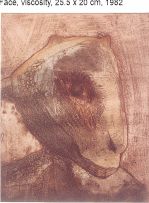
Over the years her attention has shifted from appearance to the spirit of things. As she began to strive to capture what is transcendental in human and nature, her pictorial solutions got shorn off of all other recognisable elements that play havoc with that real goal of the artist, which is to project huamans in their primordial condition.
Is Rokeya a conjurer of an enchanting world where her protagonists remain unscathed by outside realities? Her figures dematerialise into linear evocation of gesture and movement, and her depiction of nature transmutes into fluid formations of texture and cloudlike shapes, alluding to the turbulence of the world beyond. It is through distortion that the artist addresses the travails of the actual world while expressing her allegiance to all things natural.
truth, beauty and soul searching
Laila Sharmeen’s primary concern is to create a catalogue of her responses to nature and life. But the most interesting aspect of her efforts is that she uses the visions of some major poets as the conduits of her personal emotion. Her works are inspired by poems and are poetic in expression. Her efforts can be summed up in the Wordsworthian dictum of ’emotion recollected in tranquility.’
In her latest solo exhibition ‘Truth, Beauty and Me’ that ran at the Bengal Gallery of Fine Arts from July 19 to July 28 her tendency to recollect memories takes on a communal dimension, as what she craves for and laments about have a collective appeal. In most of her works the communal is addressed through the personal . Thus the search for beauty and truth becomes a means of tapping into the collective psyche. What at first glance seems like an individual’s way of remembering moments of joy, epiphany or loss turns out to be a means to draw upon shared experiences. Through imagery and words, her search for food for her soul also becomes a quest for all who participate as spectators.

If with image she is innovative, with the words she annexes to her images as well as uses as titles, she tries not to be overwhelming. Her words are chosen from the verses of Romantic poets of undivided Bengal and 19th century England, or Modernism.
Sharmeen is a romantic and aligns herself mostly with romantic poets in her effort to determine what is valuable in life. Like Keats she too feels that the concept of truth is interchangeable with that of beauty. It is this attachment to a romantic notion of life and nature that helps her distance herself from the scourges of modern life, that is to say loss of faith, alienation and most of all loss of the romantic vision. It also helps her exult in whatever simple ideas she lays her faith upon. In her work she never gives into pathos and it is with a sense of exaltation that she approaches her life and work. However, the joy that imbues every aspect of her creations is not only a reflection of the romantic soul that she possesses but also the result of her ability to build her imagery from fragments.

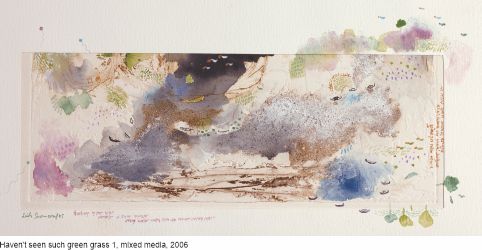
Although Sharmeen is conceptually anchored in Romanticism, her works are fragmented, a trait that any Romantic poet would have deplored. In each piece the artist agglomerates her elements with the zeal of a creator for whom every creative action is a way to view the present — where humans have been pushed to the periphery to make way for consumerism — in the context of a past where humanity used to hold centre stage. The collage, the squiggles and the coloured patches as well as white embossed areas that come from zinc plates, and the watercolour washes and tiny-winy drawings that are astutely used to complete the final imagery, all go to create a monologue to remind spectators of the fact that the artist is in search of beauty and truth at a time when the situation is adverse to such a quest.
Though it is the harmony of disjointed forms that Sharmeen lays her faith upon, she does not see her images as a respite from the drudgeries of the mechanised world. If it were so, she would have preferred depiction of natural scenery. Instead, she composes her pictures out of scraps and squiggles to elucidate the fact that today we have no other option but to be contented with scraps of truth and beauty. Works like ‘Shantih Shantih Shantih’, and ‘Datta Daydhvam Damyata-2’, testify to her craving for a ‘whole’ that the artist feels we have lost to modernization.
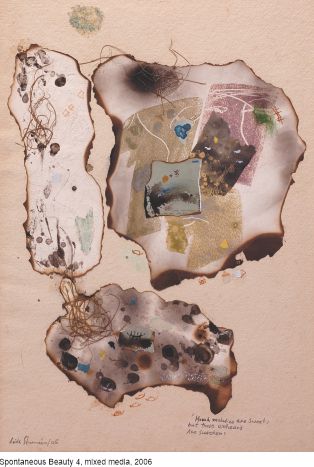
It is to reenforce her belief in Romanticism that each of her image is accompanied by a text. On most occasions the text reflects on nature and life and is chosen from the verse of her favourite poets. ‘Heard melodies are sweet, but those unheard are sweeter,’ ‘Beauty is truth, truth beauty,’ are a few example of her borrowings from the romantic poets.
On occasions images accompany a whole stanza of a poem. In her amazingly balanced yet informal compositions, the hand-written texts easily go with other elements that encourage closer inspection. Among these elements, minuscule boats can be considered her favourite emblem. She places them in strategic places to enhance the pleasure of looking as well as to reassert her link with the Bengal of the past. The dots and lines that adorn her composition add to the miniature-like quality of her work.
Sharmeen’s quest is for spiritual enrichment. Personally she feels that for any one seeking spiritual fulfillment there is no alternative to resorting to the world. To demonstrate her allegiance to the thinkers of the world she brought together dust jackets of philosophical as well creative works of writers who matter in our civilisation. She makes them part of an installation, of which the most interesting element is a fortune teller who sits in the exhibition hall with all his countrements, including parrot and fortune cards hidden in a set of envelops. For every viewer willing to try their luck the parrot picks up a card. But to the astonishment of the viewer the words written on the cards are not the usual revelation but insights that enlighten them about certain discrepancies of our civilisation.
A women sleeping in a bed with silver and golden magic wands lying at her feet and head respectively is also part of her installation. S. Monzoorul Islam, a renowned art critic, interprets the sleeping beauty and its adjoining arrangements of the fortune teller and the magic mirror that distorts whatever is reflected in it as a commentary on contemporary state of knowledge as well as on our eagerness to replace rationalism with fairytale solutions.

If the installation seemed like an attempt at making sense out of this chaotic world where things collapse on a daily basis, the series of mixed media works are her homage to the world where the simpler pursuits of life are seen as the most consequential actions of all. Sharmeen’s ability to express her emotions is aptly encapsulated in her paintings. However, the installation could easily have been an altogether different exhibition. Her mixed media works are enough for her to secure a place in our art world.
a survey of mro life
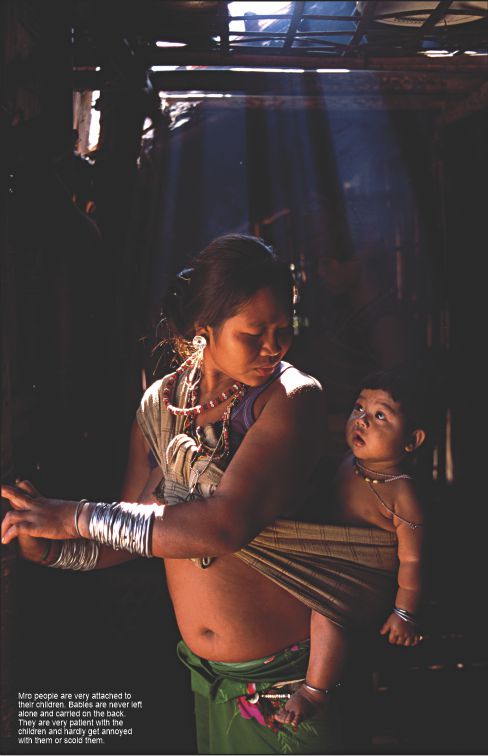
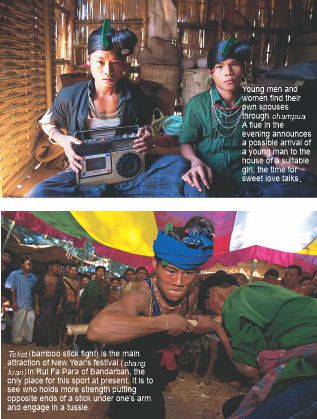
In the exhibition titled ‘Life and Struggle of the Mro people in Bangladesh,’ photographer Mahmud provides an extensive survey of the life of this small group of indigenous people whose main habitat is in the Bandarban district. His work has both an anthropological and an aesthetic interest. There is the aestheticised depiction of scenic beauty that surrounds Mro habitats. At the same time, while he is on the trail of Mro people, capturing their beauty amidst pristine nature, he also pays attention to their belief system and the other cultural elements of their society as well as their agricultural and economic practices.
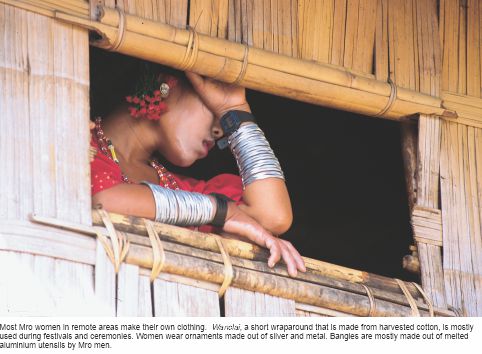
When Mahmud first went to the hilly districts in 2002 he had no idea that he would work on a single ethnic group. However, as he got involved with the indigenous communities living there he realized that to work on more than one ethnic group is an impossible task. That is why Mahmud’s recent photography show exclusively captures the whole gamut of Mro life.
The photographer mingled completely with the Mro people. He says that at every step it is the Mro people who helped him capture their life. Mahmud’s work indeed is clear evidence that he has been in the midst of this indigenous people as if he was one of them. His photographs tell poignant stories as intimately as possible.
Mahmud is not content with keeping the records of events impersonal. If he had the eye of a mere anthropologist, the communal events would not have been depicted with such passion. On top of that, in many pieces he portrays the individuals involved in the events to make sure that his stories have a strong human interest. In many a photograph he presents the story from the individual’s point of view, so that one can look at a communal event from an individual perspective.
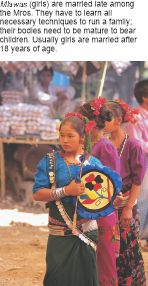
Mahmud’s show is like a refresher course on the history of the Mro people. Alongside the photographs there runs a parallel text that reinforces the pictorial saga. The exhibition begins with the tale of the Mro people, — how they were defeated by the Sandhus and the Khumis in the clan wars that took place in the Arakan hills and how they escaped persecution by taking refuge in the Chittagong hills where in Busidong they met Bangalis for the first time. It also touches on the subject of how Bengalis from the river-eroded districts were given legal papers for land till the year 1998, when an order was issued by Local Hill Council to stop the process. From Mro history to Mro folklore and the present predicaments of Mro life — Mahmud has it all on the platter. Just as he has an eye for detail in his photographs, his texts, too, seem to speak of his relentless effort to elucidate all aspects of Mro life. The photographs and the texts are interdependent; one goes about discovering the aspects of Mro life and culture through both conduits.
Though many photographs give the impression that the photographer has conducted an anthropological survey and is displaying his data with the zeal of a scientist, after closer inspection Mahmud’s artistic self becomes more pronounced to the viewer. What marks Mahmud out is the intimacy that he is able to infuse in most of his photographs. Though displayed in a fashion that put more emphasis on the information that each photograph imparts, Mahmud’s work is laden with artistic as well as humanistic significance. From the bamboo fighter’s determination to the loving mother rocking the cradle of her little child, everywhere the stamp of the man who is interested in the goings on of Mro life is evident. That is exactly why surveying Mro life through Mahmud’s eyes seems such a stimulating experience.

M Zaman is a freelance writer. He also contributes for leading journals and magazines in Bangladesh.
A take on Dhaka’s most recent exhibitions – French photographer’s against-the-grain perspective on the beauty of unkempt city, the celebration of the traditional metal-casting art of Dhamrai and the diametrically different styles of two women artists, Rokeya Sultana and Laila Sharmeen dhaka deconstructed Bruno Ruhf’s eye is set on things that are all too familiar…