

the greening of architecture
Rafiq Azam
Architecture for Green Living
Skira – Bengal Foundation, 2013
Milan
In his 1851 classic, Moby-Dick, the great American novelist Herman Melville makes his meditative and depression-prone narrator Ishmael ponder on mid-nineteenth century Manhattan and its citizens and then exclaim, “but these are all landsmen; of week days pent up in lath and plaster—tied to counters, nailed to benches, clinched to desks. How then is this? Are the green fields gone? What do they here?” Surely, a sensitive and sensible Dhakaite, contemplating the mushrooming, mildewed metropolis that Dhaka has now become in the second decade of the no longer new millennium, and surveying its cluttered, chaotic, soulless buildings and jaded, fed-up citizens, could say, “where have our lush-green spaces, our flowing water bodies disappeared; how can we cope any longer with this claustrophobic world? Where is the way out of urban squalor and dreary cityscapes?”
Surely, one way out of Dhaka’s ugly and nightmare-inducing sprawl will be to reclaim its verdant spaces and flowing water bodies through daring architecture and visionary planning. This is the message that the exquisitely produced book Rafiq Azam: Architecture for Green Living delivers so effectively at this critical juncture of the city’s existence. Surely, the kind of vision embodied in architect Rafiq Azam’s work can lead to a design recipe that others may emulate so that we can start rebuilding for a viable, livable city where even in crowded, poor neighborhoods as well as relatively spread out, affluent ones, one can hope to view greenery everywhere, breathe fresh air, and even glance occasionally with pleasure at the few water bodies still surviving in the city. Viewed from this perspective, this is a timely and valuable book, and Azam’s visionary architecture and the thinking behind it deserves the compliment of close attention.
Clearly, Bengal Foundation (along with Skira Editore, the Milan-based and internationally renowned publisher of fine arts book committed to splendid publications) has brought out Rafiq Azam: Architecture for Green Living purposefully to show how Bangladeshi cities can still salvage nature’s bounty through creative architecture that takes inspiration from Bangladesh’s infinitely green and riverside world. In fact, Abul Khair, Chairman of the Bengal Foundation, suggests in his introductory note that he has “dreamed of creating a new vision for Dhaka that would take in the beautiful rivers and canals encircling the city” and that would “become an urban planning charter for its future growth.” That is no doubt why Bengal Foundation felt that it should co-produce this book to enable readers to view not only Azam’s architectural creations and read his thoughts about them, but also to see them in the perspective of insightful essays and a thought-provoking interview that articulate fully the aesthetics informing the architect’s creations.
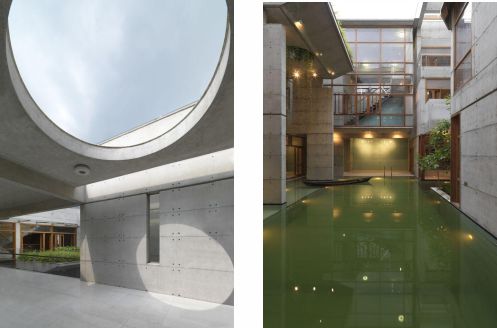
The first of the prefatory essays by Rose Maria Falvo, the Italian Editor of the volume, titled “The Poetics of Space” notes how Azam’s architecture is rooted in a landscape full of water bodies and abundantly green vegetation and an enduring tradition of poetry, folk art and even science (remarkably, she reminds us in this context of Jagadish Chandra Bose’s experiments with plants) expressive of nature’s bounty, if only to make us aware of the necessity of human interaction with “its beauty and potential.” Falvo’s work is followed by the distinguished Australian architect Kerry Hill’s brief but suggestive piece where he notes that Azam’s achievement is in his discovery that “a building must respond to its physical location,” which is why his buildings make so much out of “the use of water, the placement of a tree, and the masterful orchestration of sun and shade.”
These shorter pieces of this lavishly conceived and sprawling book are followed by two more substantial essays on Azam’s architectural vision. The first of them is by Kazi Khaleed Ashraf, the author of Designing Dhaka, the important book on the city reviewed elsewhere in this issue. Perceptively, Ashraf situates Azam’s work in two major contexts. The first of these is what he identifies, following the German sociologist Ulrich Beck, as “second modernity”, that is to say, the modernity of the digital age and late capitalism, which has to contend with relentless “development” and “the dense hyper-built fabric of an urban reality.” Ashraf sees in Azam someone who extends the modernist architecture of Le Courbusier and Louis Kahn. However, he also views Azam as someone who walks in the footsteps of Muzharul Islam, the pioneering Bangladeshi architect, who brought modernist architecture to this part of the world, and even succeeded in giving some of his buildings a Bengali facade through the use of pavilions, “projected eaves and green setting.” But still another context of Azam’s work for Ashraf is the flora and fauna, the watery landscape and seasons of Bangladesh. In other words, Azam’s is an architecture where location is the ultimate determinant and source of inspiration. What the architect does, Ashraf suggests insightfully, is meld these two contexts, inspired in this also perhaps by the contemporary Japanese master architect Kengo Kuma, so that modernist fascination with form is blended with “the reality of tropical nature.”
The second of the longer essays prefacing Azam’s part of the book is by Philip Goad, an Australian professor of architecture. Deftly, Goad places Azam’s creations alongside those of other contemporary architects of Asia such as Kevin Low of Malaysia, Andra Matin of Indonesia and Chelvaduri Anjalendran of Sri Lanka, all of them designers committed to “ practice that is thoroughly in tune with the constructive capacities of its context.” Goad notes that even in his first major work which involved redesigning his mother’s Lalbagh house, Azam tried to work with “places of nurturing landscape, conviviality, contemplation and quiet,” based on treasured memories of an old Dhaka that is now facing urbanization on an unprecedented and unbearable scale. Elsewhere, Azam has incorporated water too into his designs to complement greenery. As Goad puts it, “The courtyard, water, and the garden are the three essential elements of Rafiq Azam’s act of dreaming Dhaka into his unique building projects.” But Azam’s ability to incorporate Dhaka’s traditions goes beyond a preoccupation with giving a green look to his creations and keeping provision for water bodies in his design. Goad thus notes Azam’s use of brick and concrete, “local stuff” of buildings, both rooted in building practices that go as far back in history as the medieval city of Pundranagar, which existed close to where Dhaka now is, where brick was also used as the basic building material. The use of reinforced concrete, on the other hand, has been spectacularly established in Kahn’s constructions in Sher-E-Bangla Nagar. But Goad notes other international influences on Azam’s increasingly ambitious later works—the Australian architect Glenn Murcutt’s “language of thinness” and the Japanese architect Tadao Ando’s innovative concrete constructions to give buildings protection from seismic upheavals. For Goad, then, Azam’s “new modernism” is dreamt out of Bengali history and the Bengal landscape but also out of modernist and internationalist experiments with brick and concrete. As far as Goad is concerned, this unique fusion makes Azam “symptomatic of a new generation of architects “who are “rooted in their own traditions but who combine local knowledge with cosmopolitan building and structural innovations”, benefitting, as it were, from “transnational practices.”
These prefatory essays are followed by the main section of the book where Azam’s building projects—completed or ready to be executed—are displayed chronologically in vivid and elegant fashion. Each project is introduced by Azam succinctly so that readers can understand the vision behind it; some excellent photographs, sketches and drawings; and in some cases, models. These image the projects delightfully as well and make them meaningful for readers. Interspersed throughout are bonuses for readers provided by Azam in the form of his beautiful watercolor pieces that reveal his fondness for the colors suffusing Bangladesh’s landscapes. Beginning with the project that lead to his rebuilding his mother’s Lalbagh residence, this part of the book concludes with Azam’s works-in-progress, at least a couple of which are meant to be constructed outside Bangladesh sometime soon. Seen in sequence, they also show an architect who began by designing modestly but who now dreams grandly and even with the confidence of a visionary builder.
Azam’s introductory notes to his various projects reveal his nostalgia for Dhaka’s lost green spaces. They show him to be a romantic, someone who would retrieve those spaces and gesture at least at recreating “heaven on earth.” They indicate that he is sensitive to the need to play with light and shade and offer vistas of “nature and the sky” as well as water. These brief paragraphs also tell of his conviction that Bangladesh’s climactic conditions must figure in any building design. They point to an aesthetic that considers sociability as an important consideration in such design, for he has no doubt that opportunities of communal interaction must be treasured just as the need for privacy should be ensured by the architect. Where Azam has more space to work with, as in his later works where he was commissioned to build outside the city, he reveals a mystical/metaphysical side, as in his execution of a family graveyard project in Noakhali, where he points out he that he attempted to create “a transcendental space, connecting the temporal to the celestial through a frame made of concrete.”
The final part of Architecture for Green Living consists of a section where the eminent writer and critic Syed Manzoorul Islam engages Rafiq Azam in a conversation that very successfully highlights major aspects of the architect’s aesthetic, while illuminating the man behind the work. We realize from it that Azam’s instincts have always been painterly and that he is a natural fit in a profession that blends “science and art.” The conversation indicates that Azam is at least in instinct a poet, for he creates images as a poet would by playing with “desire, hope, and memories.” But the conversation also reveals an architect who is very au courant as well as architectural theory is concerned, as when he talks about “the changing textuality of architecture” or reveals his intimate knowledge of the works of Louis Kahn and Glenn Murcott. The interview is important, finally, because Islam makes Azam ponder over the challenges facing the architect in contemporary Bangladesh, where the architect must contend with shrinking spaces, water logging, river and land erosion, and the sundry problems of a developing country. As Azam so pithily expresses the predicament facing Bangladeshi architects in our time: “at the moment, architecture here is at a cross-road between necessity and desire.”
However, any thoughtful reader of Azam’s book will think at this point of the central problem associated with the presentation of his architectural oeuvre in this otherwise splendid book—Azam articulates the predicament of contemporary Bangladeshi architects well, but he himself seems to have opted not to face the predicament in the work that he took up after his Lalbagh project. Almost all his later works appear to be designed for affluent neighborhoods of Dhaka, or for people or establishments based outside Bangladesh. In other words, he talks about the problems of designing buildings in crowded Dhaka eloquently, but in his work he has been evading it consistently. Where in the architectural execution of his vision is the Dhaka that we all know—the jam-packed, chaotic, increasingly ugly city where 99 % of its citizens live? It is all very well to talk about panaceas for these places but he can only offer one of his buildings as a solution. What is the use of a “philosophy” that clearly perpetuates the charge always brought against architects—they cater to the rich and come up with projects that only the wealthy can translate into reality? No reader of the book will doubt that Azam has been getting better and better in his work, but has not he been working exclusively with open spaces, plots neighboring lakes and water bodies, and already green and sprawling places such as Gulshan or Savar or Ghazipur?
The other caveat that must be recorded about this otherwise exemplary book is Azam’s very loose use of the word “philosophy” as when he prefaces the section on the Mamun Residence that he designed in Chittagong by saying “the philosophical cue here came from the traditional mathal (hat) farmers in this region wear during harvesting to protect them from rain and sun.” At least to this reader, such a statement sounds pretentious; surely, words such as “philosophy” or for that matter “mysticism” must be used with precision and must not be bandied about, or made to sound like waffling.
These caveats aside, it must be said that Architecture for Green Living is as good a book as one can have on one’s coffee or tea table. However, it should be treated not only a visual feast but also as a work that will have some use as a source of ideas for future planners and architects here in Bangladesh and elsewhere. The book is of course not meant for everyday use and will no doubt be owned by very few people because of the expense that has gone into its production, but it is to be hoped that it will find its way into university libraries, architectural studios, town planning resource centers and think tanks, because it contains much food for thought for architects, town planners, designers, and anyone interested in the beautification of Dhaka as well as the eventual restoration of greenery to its neighborhoods. It is also to be hoped that the work will be seen by the discerning as a worthy tribute to a visionary architect’s unfolding design brilliance and evolving aesthetics.
Fakrul Alam is a member of Jamnini’s editorial board and a professor of English at the University of Dhaka.
Rafiq AzamArchitecture for Green LivingSkira – Bengal Foundation, 2013Milan In his 1851 classic, Moby-Dick, the great American novelist Herman Melville makes his meditative and depression-prone narrator Ishmael ponder on mid-nineteenth century Manhattan and its citizens and then exclaim, “but these are all landsmen; of week days pent up in lath and plaster—tied to counters, nailed…