
an interview with ruby ghuznavi the crafts conversation
Ruby Ghuznavi is one of South Asia’s foremost experts on natural dyes. In her interview with Syeda Samara Mortada she talks about attempts to patent the Jamdani fabric, the role of the National Crafts Council and the state of crafts in Bangladesh. Her views on these matters help illuminate not only the problems facing those who work with Jamdani and natural dye, but the issues facing the crafts industry as a whole.
Syeda Samara Mortada How did you get your start?
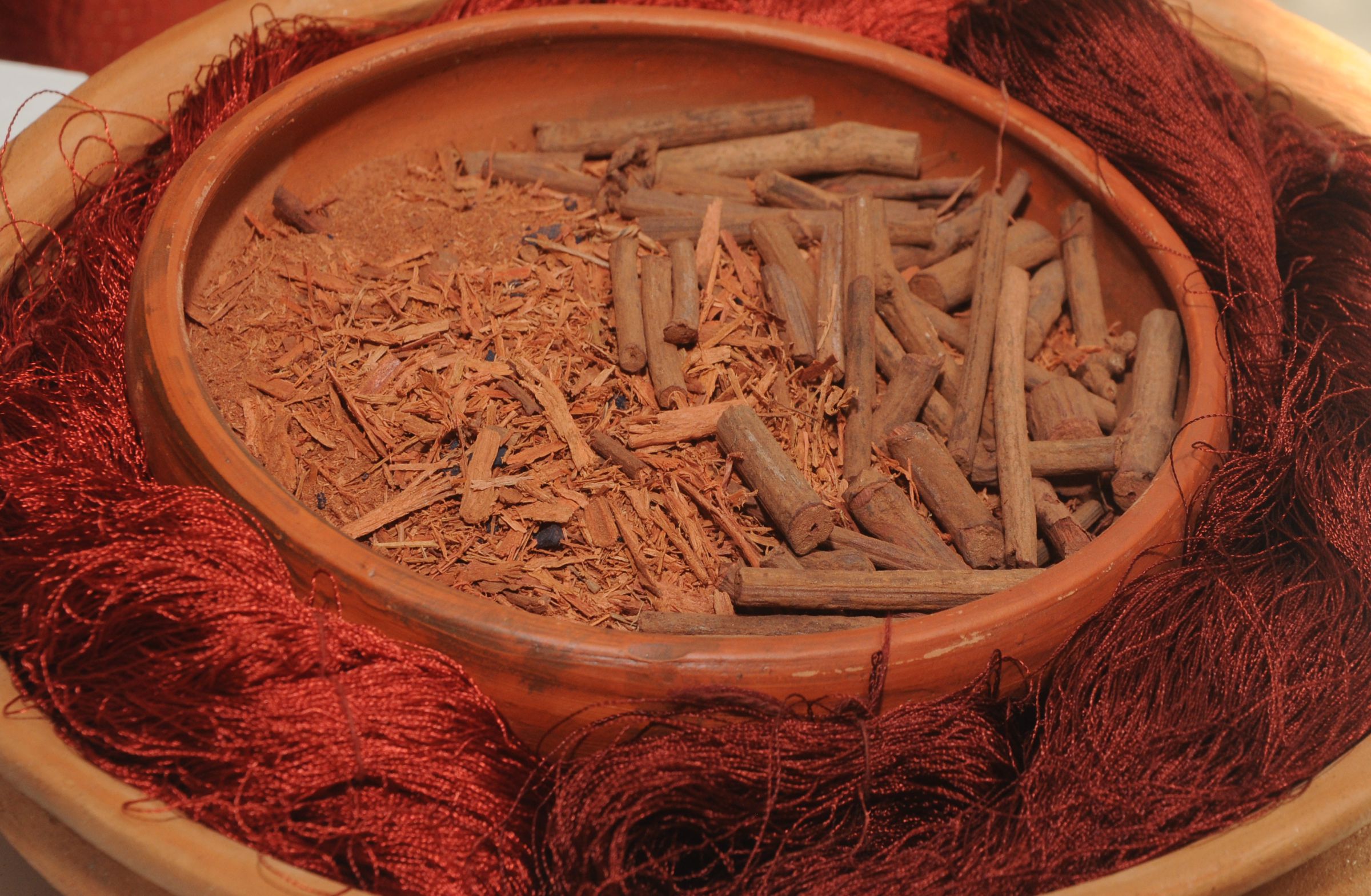
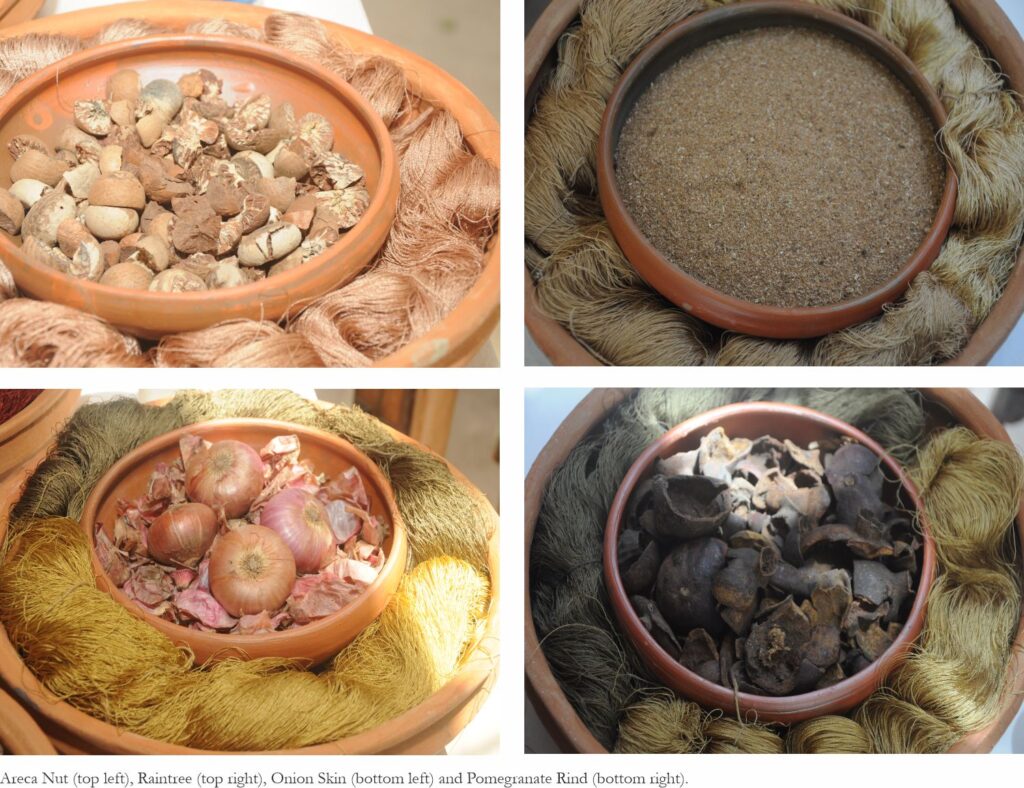
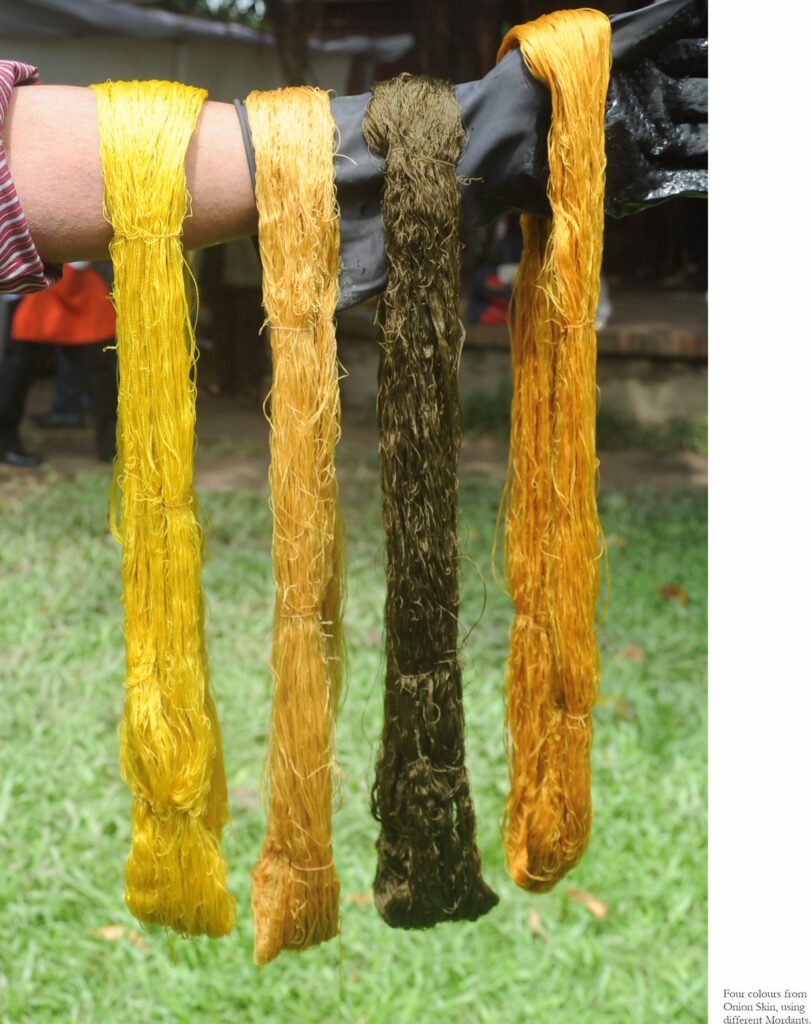
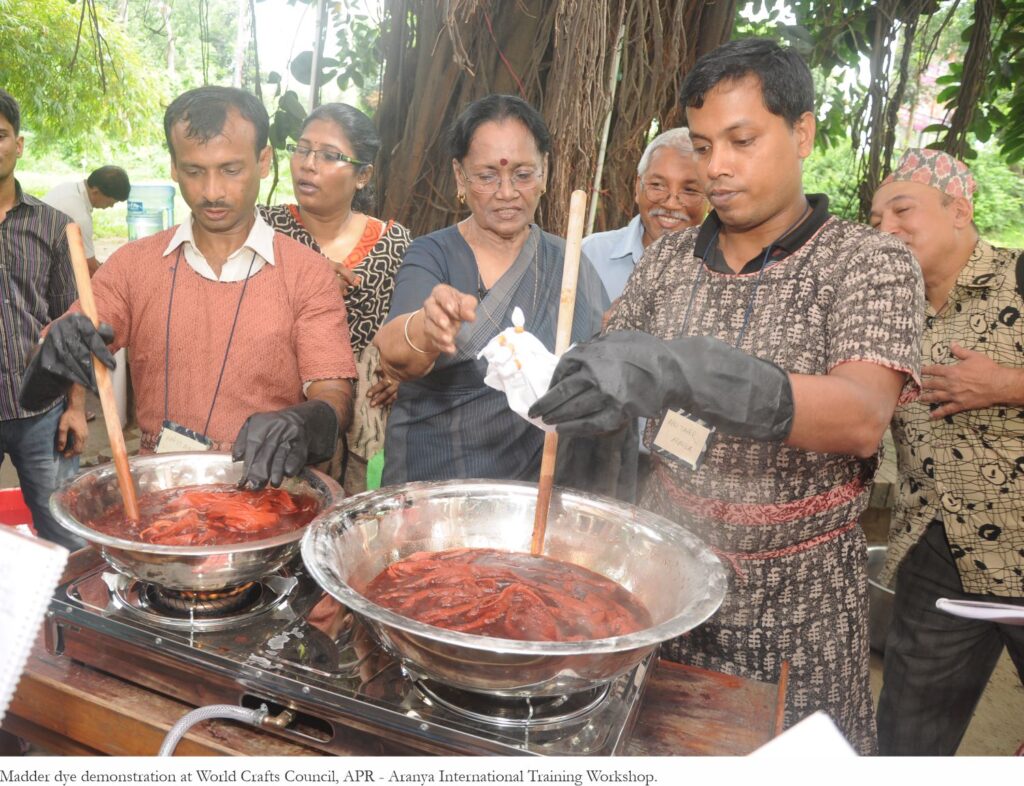
Ruby Ghuznavi In 1979, I went to a conference in India on natural dyes. There I met Kamaladevi Chattopadhyay who encouraged me to revive them in Bangladesh. So, we did a survey and found that a number of dye-producing plants were available in Bangladesh. After a year of research we set up a Research and Development Project under BSCIC. Our goal was to revive the use of natural dyes and standardise them. In the first two years of the project we were able to standardise 15 colours. During those two years we had Indian experts come to Bangladesh and teach us for two to three months at a time. They taught us six basic colours but we experimented with different plant sources and came up with a variety of colours. At the time, we tried extracting colours from any plants we saw and we would try out leaves, flowers, fruits etc. Almost all of these gave us some colours. But, they weren’t colourfast. I’m sure you remember the dyes like holud and sheuli used for saris at weddings when you were a child. The trouble with those is that they’re not lasting colours. So we had to standardise these into fast colours. In the first 2 years of the Project we standardised 15 colourfast dyes and added another 15 in the next two years; today Bangladesh is amongst the foremost countries in this field in the use of natural dyes.
And then you set up Aranya?
Well, there was a debate, not just in Bangladesh, but in the whole region that natural dyes were not cost effective. So we started Aranya and after working for several years we have now proven that natural dyes are commercially viable. Most importantly, they are eco-friendly and non-pollutant. The project has the added advantage of generating greater employment opportunities. If you work with chemical dyes, you’ll find that you need only five workers, whereas if you do the same amount of work with natural dyes, you’ll need ten. But, though the process is labour intensive, the cost of the end product evens out. Some of our raw materials are from waste materials like leaves, used flowers like ganda phool from weddings, etc. which balance out the cost of some of the more expensive dyes like indigo and manjit. If you compare Aranya’s costs with similar stores you’ll find that our prices are more or less the same as theirs. Now, I have handed over Aranya to the Bengal Foundation because they are committed to promoting natural dyes. A lot of people were interested in Aranya but they wanted to combine our work with chemical dyes which I didn’t want. Bengal Foundation is committed to the promotion of organic dyes and so they were a much better option. The production has already doubled and now we’ve even opened a new outlet in Dhanmondi.
When you initially began work, did you know that you were going to end up with Aranya?
No. I was purely concerned with crafts development. Zainul Abedin, Quamrul Hassan and others had mobilised a few of us to work with local craftspeople. After the Liberation War in 1971 there were a lot of women-headed households as their husbands had been killed. The women who survived somehow had to take care of the children. How were they going to do so? They couldn’t leave their children and go out to find jobs. So, we had to find their strengths with which they could take care of their families. Crafts were the obvious option; the products they made for themselves like shika and kantha could now be marketed for them.
I see. So they could make handicrafts at home?
Yes, they would stay at home with the children and keep working. We started Karika, the first craft marketing organisation in Bangladesh, with the support of Zainul Abedin and Quamrul Hassan. My work with natural dyes was an automatic next step from a crafts development standpoint.
Do you think customers in Bangladesh understand the intricacies of producing natural dyes?
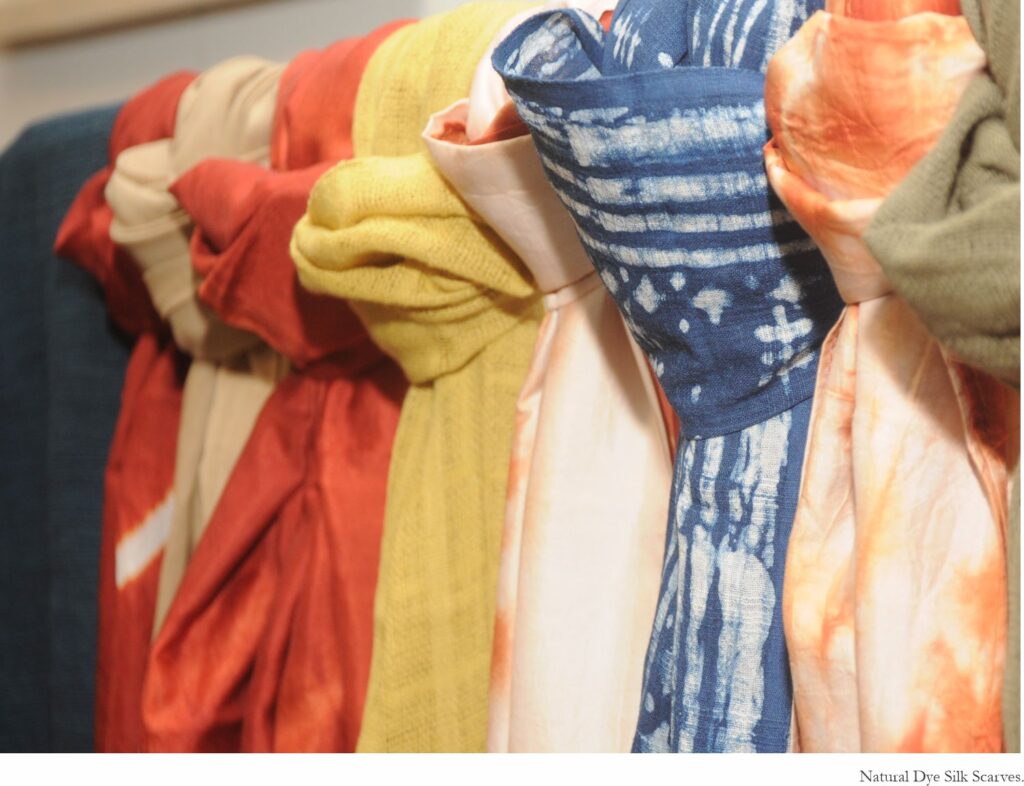
The customers in the world don’t understand it! Even amongst our people, there is only a small segment of the public who do understand and who buy our products for the right reasons. But unless the designs and the finished products are good, nobody is going to buy them. So you have to compete with others who are in the business. There are a lot of misconceptions about natural dyes. People think the colours are not durable or as bright as chemical dyes. This is not right. If you wash a chemical dyed garment and dry it in the sun for several hours, it will fade. The same thing is true with natural dyes. Also, we do have bright colours like purple, red, blue and green in natural dyes. What we don’t have are a few select colours like royal blue or emerald green but you have to learn to live without them or buy chemical dyed products. However, nobody is saying that chemical dyes should be abandoned; there’s no chance of that ever happening. But if even 5% of Bangladesh’s handloom is made in natural dyes, we’re talking about saving millions of Takas and supporting a traditional skill of this country. In that respect I feel that bigger craft NGOs should do much more. They do very little with natural dyes and can afford to do far better.
What do you think about the domestic market for these products?
Actually, the younger generation is now wearing a lot more hand-woven products than they did ten or twenty years ago, so in that respect the domestic market is much healthier now. Price is a problem but there’s a lot of scope to expand here; demand for natural dye textiles far outstrips production. In fact, we have the problem of people using chemical dyes and passing them off as natural dyes!
Where do you think the problem is from the production standpoint?
Where we’re really weak is in design. We don’t have good designers. Abroad, you would either have a designer on your staff or could commission a collection from one. It’s not like that here. What this means is that everybody is a designer. And you can’t be a designer and claim to know patterning, cutting, and all of that without formal training. When someone calls me a designer, I’m the first one to clarify that I’m not. But, because of circumstances we have to design our own product range. I have to work with artists. But you can’t call yourself a designer just because you’ve graduated from fine arts. You can ask any designer in Dhaka and they’ll tell you at best that they graduated in fine arts. There are others without even that qualification.
What do you think should be done to fix this?
Our government should have what India, Thailand, Sri Lanka and others have and that’s fashion and design institutes. If we could replicate some of these institutes, we’d be very well off. There are young people in Bangladesh who want to study design seriously. But if you do a survey of our institutes, you’ll find that even some of the teachers aren’t really qualified. They’re all arts graduates. How can they teach without an in-depth understanding of fabrics, colours, weaving, patterning, cutting etc.? I wish more of our young people could go abroad for training. By abroad I mean just next door. The cultural affinity remains and there’s a lot to learn from our neighbours.
What’s your take on the recent uproar caused by India applying for the Jamdani patent?
Oh God, where do we start? When the National Crafts Council of Bangladesh (NCCB) learnt about India applying for the registration of Jamdani as its own product under GI, it began working on it through a committee set up in collaboration with CPD – who are knowledgeable about WTO issues – and a group of concerned social activists. The first step towards ensuring that Jamdani and other Bangladeshi products are not hijacked by other countries is the enactment of the national GI Act in Bangladesh, which is a prerequisite of registering all products under GI. The draft of this law has been ready since 2009 but it has not been finalized nor approved by concerned ministries to enable its enactment by our Parliament. We have lobbied with relevant ministries to expedite the process and I must say that their response was very positive. We met Ministers and officials of the Ministries of Industries, Commerce, Culture and Foreign Affairs and were assured that the draft law would be ready for approval at the present Winter Session of the Parliament. Meanwhile, the WTO cell at the Ministry of Commerce has registered its objection officially with WTO in Geneva, stating that Jamdani is the exclusive textile tradition of Bangladesh. We hope the necessary GI Act will be enacted in the near future. In the meantime, with support from BRAC, we are undertaking a research project to document archival records to establish the history, geographical location, weaving techniques and traditional designs of Jamdanis as this information will be required in order to register it as a Bangladeshi product. We must raise awareness about these issues among the craftspeople as well as the general public. NCCB has held meetings with Jamdani weavers to discuss the problems with them while CPD is planning on organizing a seminar to inform the general public about these issues. Newspapers such as the Daily Star and Prothom Alo have been very supportive in disseminating information on the subject. NCCB has also raised the concerns of smaller countries at the World Crafts Council so that there is cooperation between its member countries, rather than competition. Ultimately the success of our efforts to protect the traditional products of Bangladesh will be determined by the commitment and support of the Government. We hope that will be forthcoming.
Is our national identity as Bangladeshis related to Jamdani in any way?
Yes, in fact, I think that’s truer now than it was thirty years ago; no one in India claimed to be making Jamdani then. Things are different now. However, we need more support for high quality Jamdanis which are expensive. The trouble is that people who can afford them end up going to Thailand, France, etc. for shopping. I think everyone has an obligation to buy domestic products first and then buy anything they like. They shouldn’t exclude locally made products from their wardrobe. Another problem we have is that the younger generation can’t really afford Jamdanis. So we’re trying to get the weavers to simplify the designs so that they become more affordable. Of course, in earlier times Jamdani was worn by queens and princesses, meaning that it was always meant for the affluent in our society. What that means today is that your wardrobe will have maybe one Jamdani and not as many as before. None of us can afford to have innumerable Jamdanis. These are adjustments that the market and the consumers will have to get used to.
What do you think the next step should be, for the mass media, the general public and our lawmakers, with regards to Jamdani?
Everybody has to root for it. Wherever we talk, whether it’s in the universities or in newspaper interviews we must present the correct picture; there is a lot of misinformation about Jamdani and GI. I read some articles stating that India has already taken the patent for it. No, they haven’t! There’s a big difference between applying for it and actually getting it. We have the time to register our protest. If we don’t do that soon we may lose out. We’re hoping that our experts and our lawyers can help. We will organize a series of talks and seminars to acquaint people with the issues. We’re trying to have the first one as soon as possible and involve the mass media so that we can reach a lot of people. We want to include people from all segments of the population for this discussion, including the weavers who are really the main people concerned with this effort. If India manages to acquire this patent it will mean that every time Jamdani weavers sell Jamdani in India or abroad, they will have to pay a duty to India. It’s ridiculous! We all believe that Jamdani is ours. There is no way we are giving up an inch of this.
Can you elaborate on the role of the National Crafts Council of Bangladesh?
The focus of the NCCB, is the development and promotion of crafts and improving the livelihood of our artisans. We have a variety of programmes in place to do this. One is the Shilu Abed Lifetime Award for outstanding craftspeople sponsored by BRAC. The other is the Master Craftsperson’s Awards, organized jointly with the Bengal Foundation. Their objective is to acknowledge and honour the rare skills of artisans. This encourages them to continue doing good work and value their profession. Craft is really such an ill-paid, tedious work that many artisans don’t want to remain in this field. Instead, they decide to start their own business or become day labourers. We’ve lost many excellent craftspeople in this way because it’s just not worth their while to stay in crafts. If the market knows that someone is a Master Craftsperson everyone will value and appreciate his or her work. We also do the Karumela, a craft bazaar. It is very important because here the artisans learn to sell directly to you, the consumer. It gives them a chance to learn about the changing tastes of the consumers and make contact with retailers.
Do you think that crafts should be introduced as a subject in our school curriculum?
Definitely. The World Crafts Council is doing a Craft Education Program. All schools should have such
a component. Actually, when we were in school I remember there being a crafts component. They had us making baskets and other knick-knacks. Now, it has to be a bit more formalized. Thailand is the best model for this. Every school has a crafts programme where they bring in a master craftsperson who stays for three months or so and teaches the children various crafts. The children have to learn, not to become craftspeople, but so that they can always appreciate the work and skill that goes into the making of crafts. It will stay with them.
How do you ensure the craftsmen’s livelihood?
Through marketing and workshops. The most important support that you can give to craftspeople is to build their marketing capacity by providing access to the market. Where we have failed is in our effort to get high quality silk and cotton yarn at controlled prices for our weavers. We have been to ministers and ministries, everywhere, but weren’t able to get what we wanted for our weavers. We’re facing a problem right now with Jamdani in not being able to find good quality yarn. Weavers are making Jamdanis with 80 count cotton when Jamdanis should be made with 150-250 count yarn. What is happening is that those who have the skill of fine craftsmanship of weaving Jamdani are losing it by using coarse yarn. The skill of fine weaving is getting lost.
Can the government do anything?
The problem is that the policymakers all think at the macro-level. They don’t look at the micro-issues. Many of them think that craft itself is an irrelevant matter. But it is not. It is second only to agriculture as far as employment opportunities go in this country. India, Pakistan, and Thailand have craft policies. We don’t. That shows what our perception of crafts is. The reality is that there are hundreds of millions of people who depend on it for their livelihood. How can NGOs and craft projects alone do something about the problem? I’m not saying that we should give them charity. They don’t want that. They’ve never asked for charity. All they’ve asked for is what should be their right. We hope someday the Government will provide necessary support services to our craftspeople and enhance the rich craft sector of Bangladesh.
In December 2013, the traditional art of Jamdani weaving was inscribed on UNESCO’s “Representative List of Intangible Cultural Heritage of Humanity”. The decision was made at the eighth meeting of the Intergovernmental Committee for the Safeguarding of the Intangible Cultural Heritage in Baku, the capital city of Azerbaijan.
Syeda Samara Mortada did her BA in English from East West University, Dhaka and MA in Women’s Studies from the University of York, UK.
Ruby Ghuznavi is one of South Asia’s foremost experts on natural dyes. In her interview with Syeda Samara Mortada she talks about attempts to patent the Jamdani fabric, the role of the National Crafts Council and the state of crafts in Bangladesh. Her views on these matters help illuminate not only the problems facing those…